
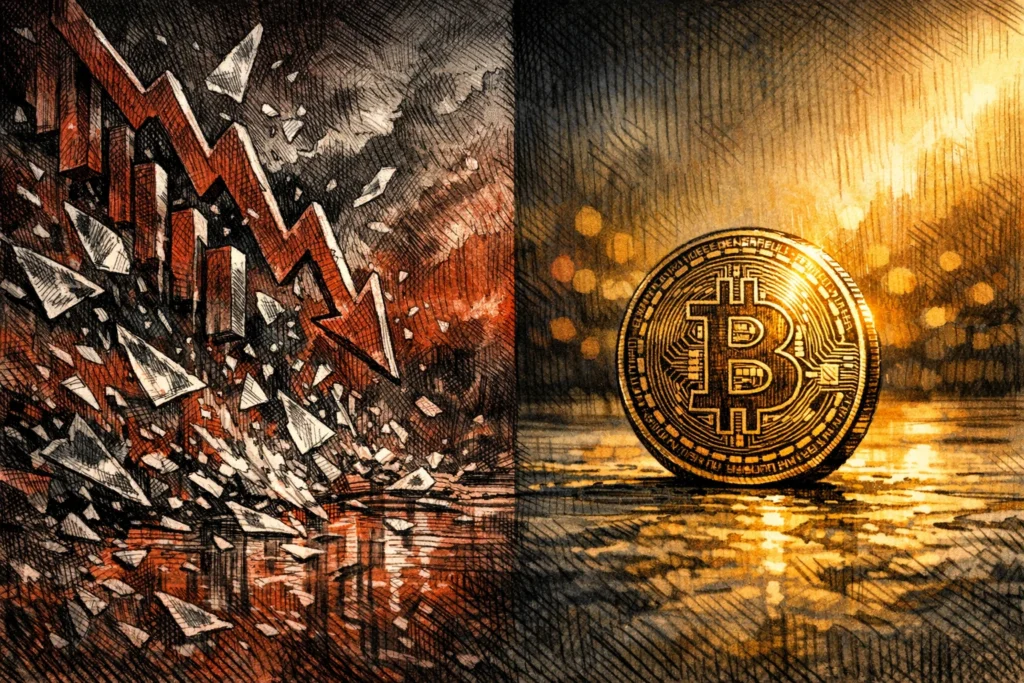
Taiwan stocks posted their biggest single-day closing-point loss on July 17, with the benchmark index falling 2,953.71 points, or 6.47%, to close at 42,671.27. Turnover jumped to NT$1.212957 trillion.
According to the closing data cited in the report, the drop moved well past the previous two biggest point declines on record: the 2,065-point fall on April 7, 2025, tied in the article to trade-war panic sparked by Trump tariffs, and the 1,807-point decline on Aug. 5, 2024. Roughly 1,500 stocks in Taiwan closed lower.
TSMC led the slide as heavyweight tech names fell across the board
Taiwan Semiconductor Manufacturing Co. (TSMC) was at the center of the sell-off. The stock was hit by a mysterious sell order of nearly 10,000 lots near the close and ended the day down NT$180 at NT$2,290, a 7.29% decline that marked the biggest one-day point loss in the company’s history.
Other major names also dropped sharply. MediaTek fell 8.92% to NT$3,370, Delta Electronics lost 8.66% to NT$1,740, and both United Microelectronics and Nanya Technology closed limit down at NT$144 and NT$395.5, respectively. Memory and substrate names including Winbond, Unimicron, and Macronix were also pinned at limit down. The OTC index fell 28.57 points, or 7.02%, to 378.44.
Record TSMC results failed to stop the selling
The report noted that TSMC had held its earnings call just a day earlier, on July 16. The company reported record second-quarter consolidated revenue of NT$1.27 trillion and earnings per share of NT$27.25. Chairman C.C. Wei said AI demand would remain strong through 2030.
At the same time, TSMC raised its 2026 capital expenditure plan to between $60 billion and $64 billion. Its third-quarter guidance also pointed to slightly lower gross margin and operating margin than in the second quarter. The article said the market took that as a signal that investors were starting to question whether AI capital spending had gone too far, turning what should have been positive news into a trigger for fresh selling.
South Korean deleveraging pressure was cited as a deeper driver
BlockTempo quoted Wealth Magazine chairman Hsieh Chin-ho as saying that TSMC’s cautious tone was only one spark and that a deeper cause was the aftershock of a leverage break in South Korea spreading through global markets.
In the report’s account, South Korea’s KOSPI dropped 8.95% on July 13, triggering the seventh circuit breaker of 2026. Memory giant SK Hynix plunged 15.37% in a single day, the worst such loss in its history, wiping out nearly $200 billion in market value. South Korean markets were closed on July 17, but the deleveraging shock was described as still spilling over.
U.S. equities also weakened. The four major U.S. indexes all closed lower on Thursday, while the Philadelphia Semiconductor Index fell 4.29%. The article tied that to cooling AI enthusiasm, broad chip-stock weakness, and rising tension between the United States and Iran. In Asia, Japan’s Nikkei at one point dropped more than 4,100 points intraday, and Hong Kong’s Hang Seng Index fell more than 2%.
Bitcoin showed smaller moves than semiconductor names
While TSMC logged its biggest one-day point loss and SK Hynix shed nearly $200 billion in market value, Bitcoin was described as comparatively resilient. At the time of publication, BTC was trading around $63,000, down about 2.1% over the prior 24 hours, a smaller move than the slump seen in chip stocks over the same period.
The contrast was also visible in July performance data cited by the report. Semiconductor ETF SOXX was down 17.6% for the month, while BlackRock’s spot Bitcoin ETF IBIT was up 9.5%, leaving Bitcoin on the rare side of a decoupling trade against semiconductor shares.
Focus turns to AI spending and global leverage risk
The article framed Taiwan’s record sell-off as a snapshot of two pressures hitting at once: doubts over the AI capital-expenditure story and concerns about global leverage. In its telling, leveraged ETF stress appeared first in South Korea, was followed by a sharp break in memory stocks, then fed into a valuation reset after TSMC’s earnings call and spread across Asian equities.
For crypto investors, the question raised in the report is whether Bitcoin becomes a shelter as money exits overheated AI trades, or whether it turns into the next asset in line to fall. The source did not offer a final answer.