

By Banmian Zhiwai, written by Huahua
Tencent launched Yuanbao Search as a standalone webpage on Nov. 11. Users can search webpages, WeChat official accounts, WeChat Channels and academic literature without downloading an app, while AI can organize the results into an answer. Rather than placing search only inside a chat window, Tencent has put it back into the browser. That takes the company directly into the core market Baidu has operated for more than two decades.
Search demand has not disappeared
China had 782 million search-engine users as of December 2025, equal to 69.5% of the country’s internet users. The figure was down from 878 million at the end of 2024, but search still represents a daily need for hundreds of millions of people.
People do not always turn to AI with a defined task. They check the weather, look up a company, verify a news item or find a document. An Agent generally requires a user to identify a task and invoke it. Search is easier to trigger in these routine situations.
Yuanbao was initially positioned as one of Tencent’s main products in the contest for the AI entry point. The rollout of WorkBuddy this year extended that competition into office work, knowledge management and Agent execution. Chat and Agents broaden Yuanbao’s capabilities; search supplies a more direct use case.
If search were only a feature inside the Yuanbao app, it would primarily serve people who had already opened Yuanbao. A standalone webpage allows people who have not installed Yuanbao but still use search to access it from a browser. Tencent is seeking a path that does not require users to remember AI first. An information-search need could be enough to bring them to Yuanbao.
Baidu, however, has operated search for more than 20 years. Tencent’s return raises an immediate question: how much room remains for a new entrant after Baidu has already built AI into search?
AI is changing the search traffic business
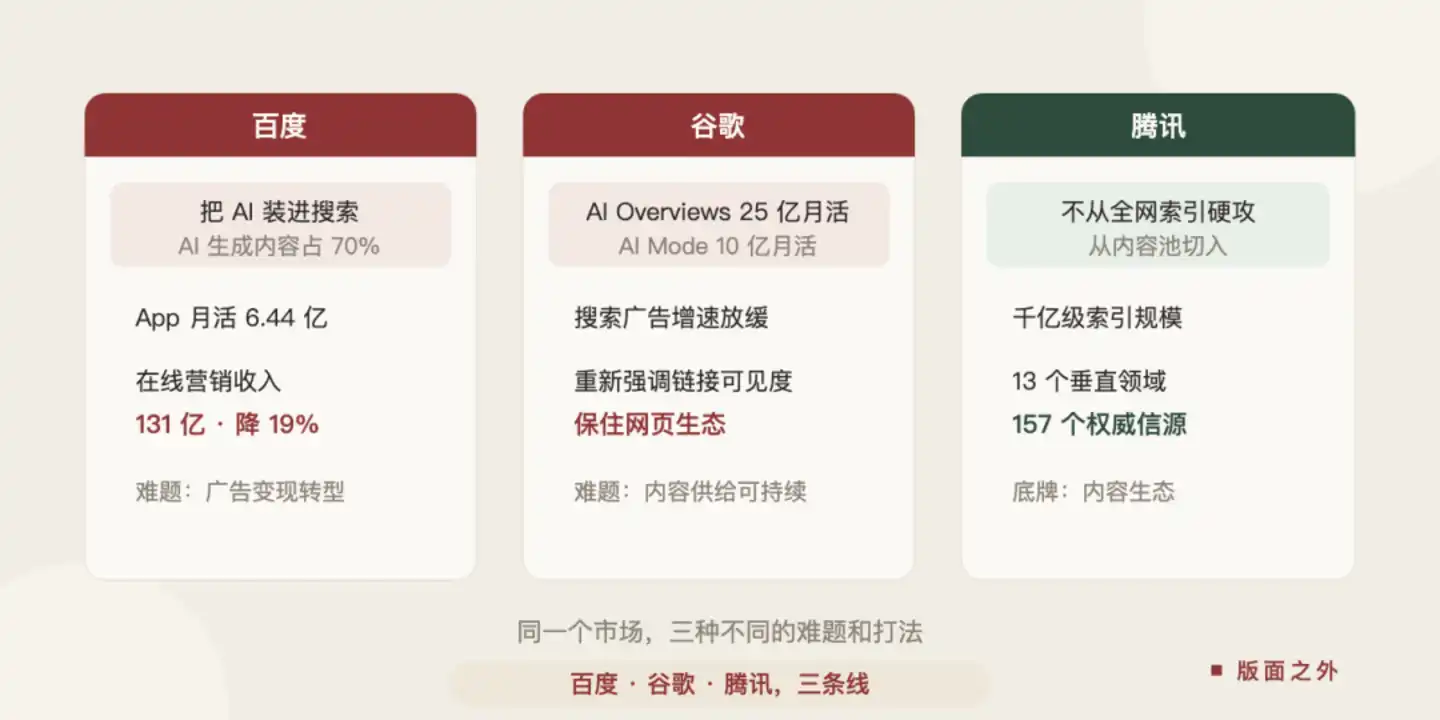
Baidu accelerated its AI search overhaul in 2025. By July of that year, 64% of the results pages in Baidu’s mobile search contained AI-generated content. The share rose to about 70% in October.
The changes went beyond the results page. Baidu upgraded the search box to support long-form text and multimodal input. Results expanded from conventional link lists to structured text, images, videos and files. Baidu also connected MCP services, allowing users to call external tools. Search began handling more complex questions and moving toward task execution.
Baidu still has a large user base. Its Baidu App reached 644 million monthly active users in the second quarter of 2026. Its web index, search algorithms and accumulated user habits are assets that a new entrant cannot quickly reproduce.
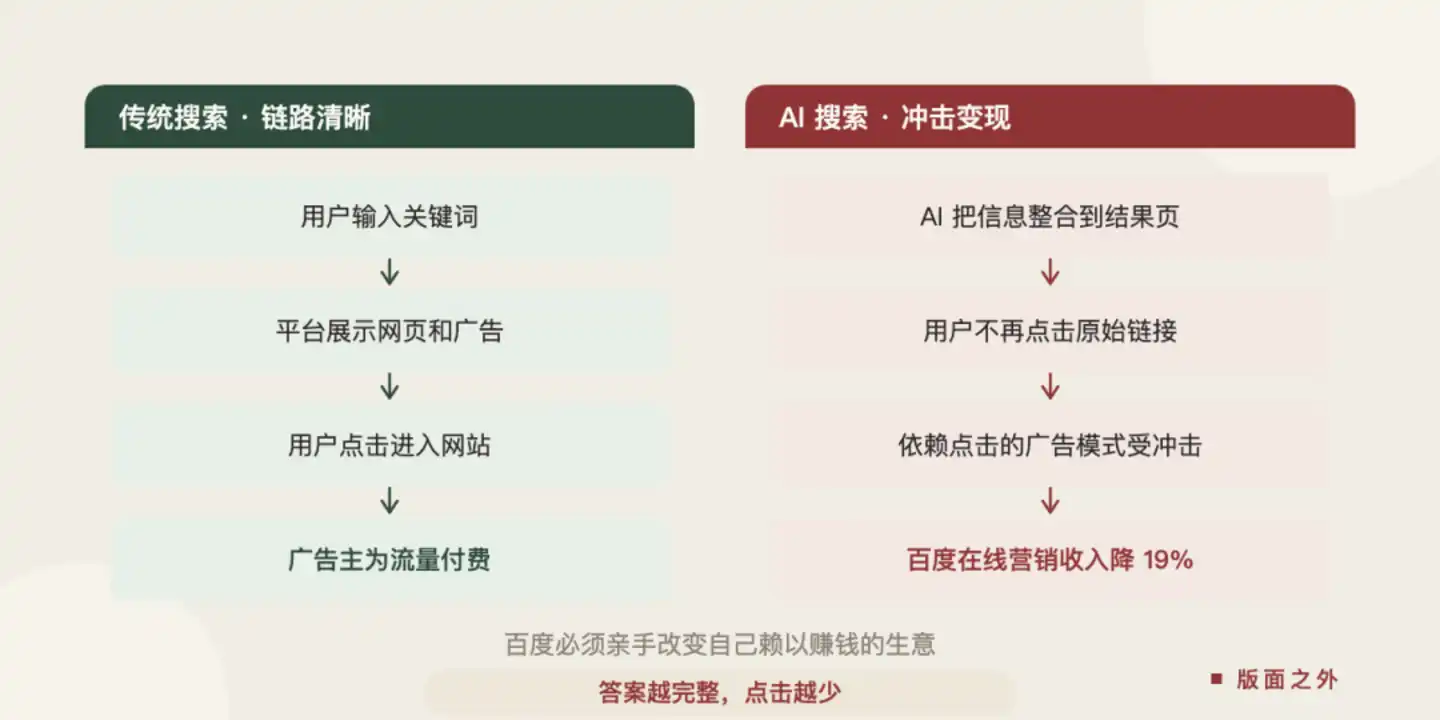
AI search brings a direct conflict: the better AI becomes at answering a question on the results page, the less reason users have to click an original link. The traditional search business is straightforward. A user enters keywords, the platform displays webpages and advertisements, the user clicks through, and advertisers pay for traffic. If AI consolidates the information on the results page, users may stop opening the original sites, putting the click-based advertising model under pressure.
That is not merely a product-upgrade issue for Baidu. It requires the company to change a business on which its revenue has long depended. Baidu reported 13.1 billion yuan in online marketing revenue in the second quarter of 2026, down 19% from a year earlier. The change reflected multiple factors, including macro advertising demand and industry competition, and cannot be attributed to AI search alone. Still, pressure on the traditional advertising business makes the commercial challenge of the search transition more visible.
Baidu has to keep advancing AI search to retain users. Once answers become more complete, advertisers must reconsider whether they are paying for answer exposure, brand recommendations or clicks to external links. The old monetization logic needs to be adjusted.
Google is putting links back in view
Google is facing a similar change. It first placed AI summaries in search results through AI Overviews, then introduced AI Mode, which lets users ask follow-up questions around one topic.
In June 2026, Google said AI Overviews had more than 2.5 billion monthly active users and AI Mode had more than 1 billion. AI features were driving growth in search queries, and search usage reached a record level. User growth did not remove the cracks in the commercial model.
Google’s search advertising revenue rose 12% year over year to $63.4 billion in the third quarter of 2026. The result was below market expectations and clearly slower than the nearly 20% growth rate earlier that year. Google Chief Business Officer Philipp Schindler said on the earnings call that AI Mode was affecting the traditional search business and putting pressure on its ability to monetize advertisements.
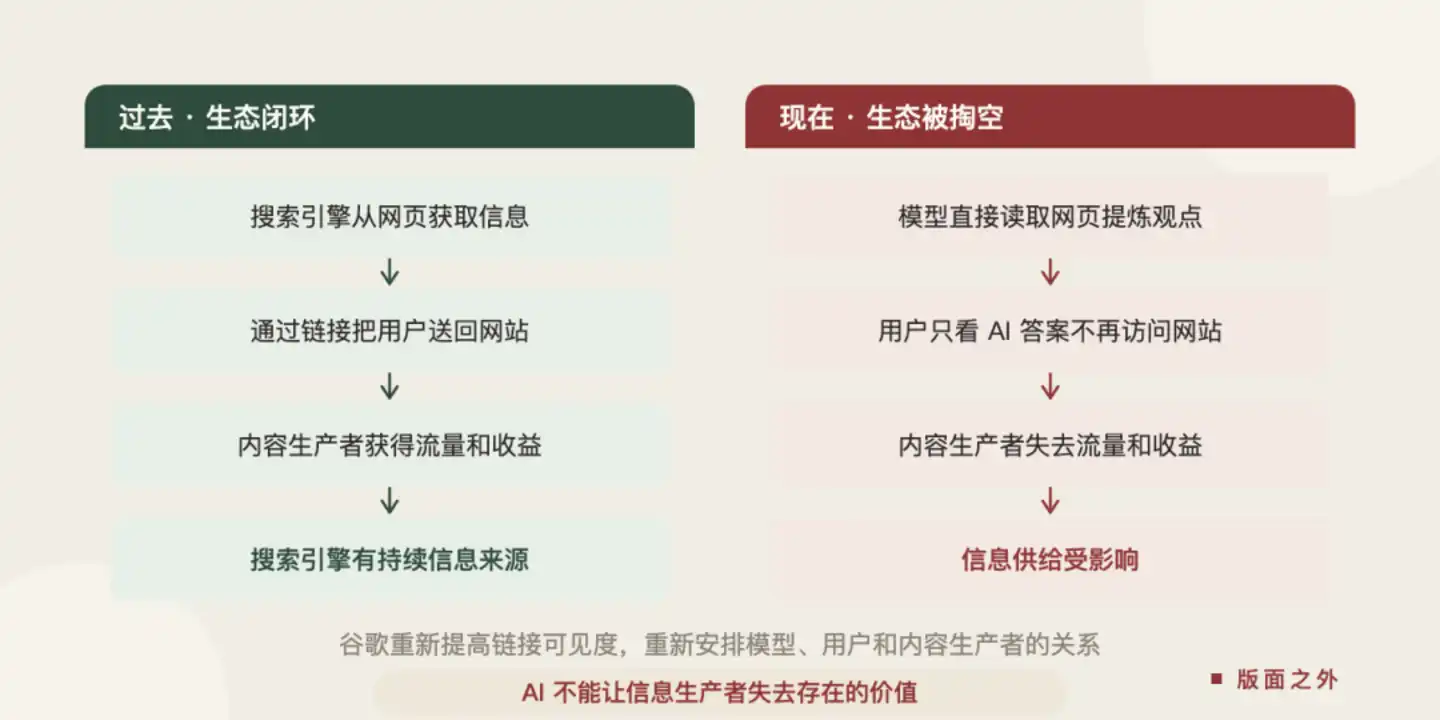
Baidu’s immediate problem is how to adapt search advertising revenue. Google faces a wider issue: the sustainability of the web ecosystem itself. Google has long connected websites, news organizations, specialist publishers and advertisers. Search engines obtain information from the web and send users back through links. That mechanism gives publishers traffic and gives search engines a continuing supply of updated information.
AI changes that relationship. Models can read webpages, extract views and organize answers directly. Users receive information more efficiently, but publishers may lose traffic and revenue if more people read only AI-generated answers and stop visiting original sites. In the short term, AI search can keep users on the platform longer. Over time, if publishers lose the incentive to keep producing content, the information supply that search depends on can also be affected.
On Oct. 15, Google announced changes to the presentation of AI Mode and AI Overviews. The company increased the visibility of webpage links so that important sources would be easier to click. Links now do more than direct users to a relevant page. They also identify sources, help users verify answers and support the continued supply of content.
Google therefore has to solve more than the question of how to monetize an AI answer. It also has to avoid weakening the content ecosystem behind the web.
Tencent’s content ecosystem is its main card
Tencent’s WeChat official accounts, WeChat Channels and information accumulated across its businesses are resources that could distinguish Yuanbao from Baidu. Much of that content was previously spread across separate products. AI can now reorganize it.
This is not Tencent’s first search attempt. The company launched Soso in 2006. In 2013, the Soso business was merged into Sogou, and its search capabilities gradually settled into products such as WeChat Search. During the traditional web-search era, Baidu built a huge web index, search algorithms and user habits. Tencent could not move the market with a search box alone.
This time, Tencent is taking a different route. Instead of attacking the entire web index head-on, it is starting with the content pool where it has the deepest position. In October 2026, Tencent Cloud opened Yuanbao Search to enterprises and developers. The system has an index measured in hundreds of billions, handles hundreds of millions of calls per day, supports more than 50 businesses including WorkBuddy, ima, Tencent Financial Technology and Tencent Video, and connects to 157 authoritative sources across 13 vertical fields, including finance, healthcare, law and transportation.
Before its consumer launch, Yuanbao Search had already been running across multiple internal Tencent business scenarios, building technical and service capabilities.
The content ecosystem also creates a filtering problem. WeChat official accounts and Channels contain a huge volume of material, but quality is uneven. Research from professional institutions, industry experience, personal views and marketing content can all appear around the same keyword. A rigorous industry analysis and a rewritten marketing post may sit next to each other in search results. More content makes the filtering responsibility heavier.
Monetization is another unresolved issue. Li Ruizhang, head of the Yuanbao Search webpage product, told media that Yuanbao Search does not reject advertising, but users should not have to look for answers inside advertisements.
That statement points to one of the most sensitive boundaries in AI search. If advertisements can also be integrated into an AI-generated answer, the platform has to keep commercial information clearly distinct from organic information. Users may accept advertisements in search results, but it is harder to accept an answer whose origin they cannot identify. Tencent’s content ecosystem gives it an entry point; it does not by itself guarantee user adoption. The quality of Yuanbao Search remains the test.
Search can become infrastructure for Agents
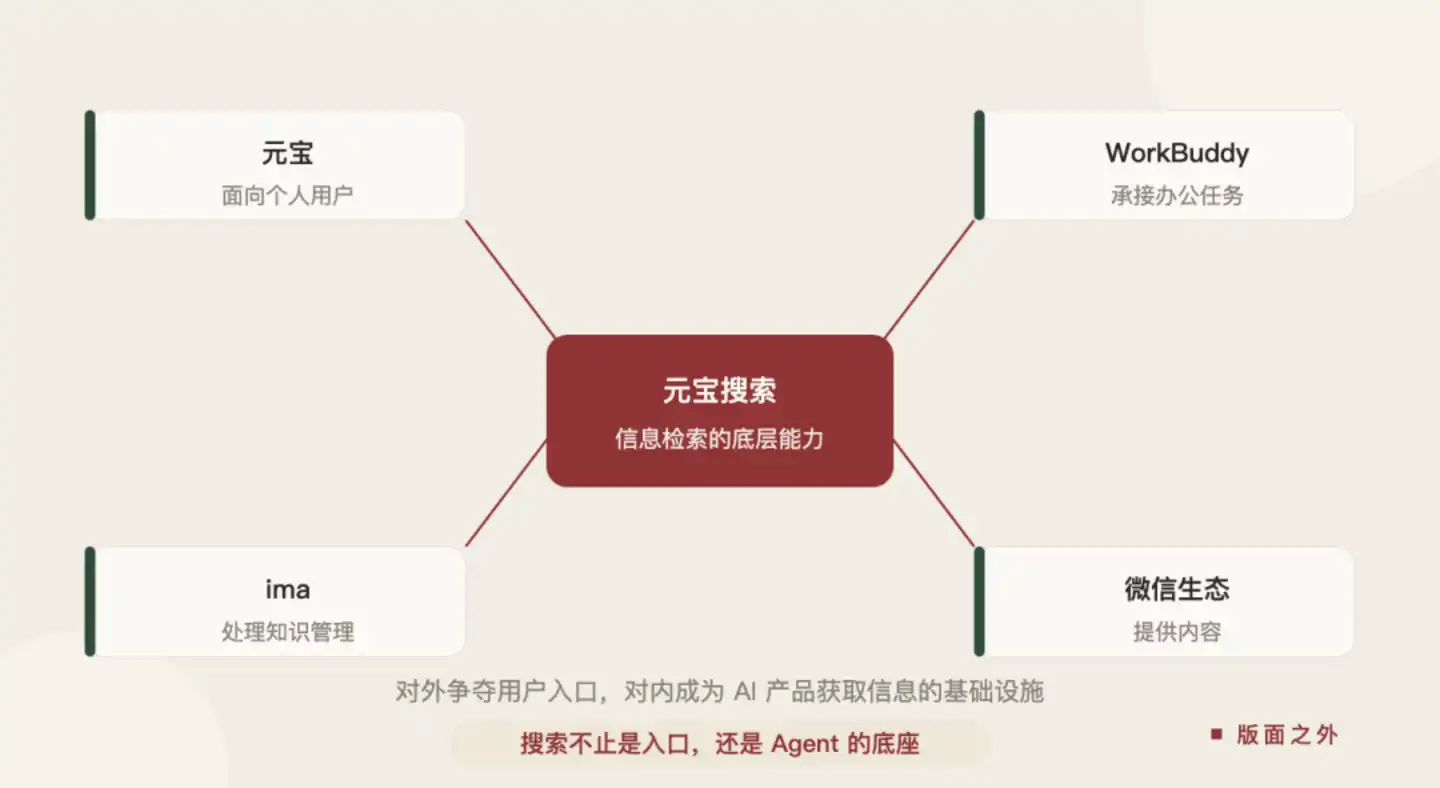
Search is not only a way to obtain information. Without stable retrieval, an Agent will struggle to complete work that requires current information. Tencent Cloud had already made Yuanbao Search available to products including WorkBuddy and ima. Search does not have to remain a feature of Yuanbao alone; it can become a shared underlying capability for several Agents.
The links between Tencent’s products are clearer in that structure. Yuanbao serves individual users, WorkBuddy handles office tasks, ima focuses on knowledge management, the WeChat ecosystem supplies content, and search provides information retrieval. Externally, Yuanbao Search competes for the user entry point. Internally, search becomes infrastructure for Tencent’s AI products.
That helps explain why Tencent made search a standalone webpage. It wants to handle routine information needs while extending retrieval into more complicated Agent tasks.
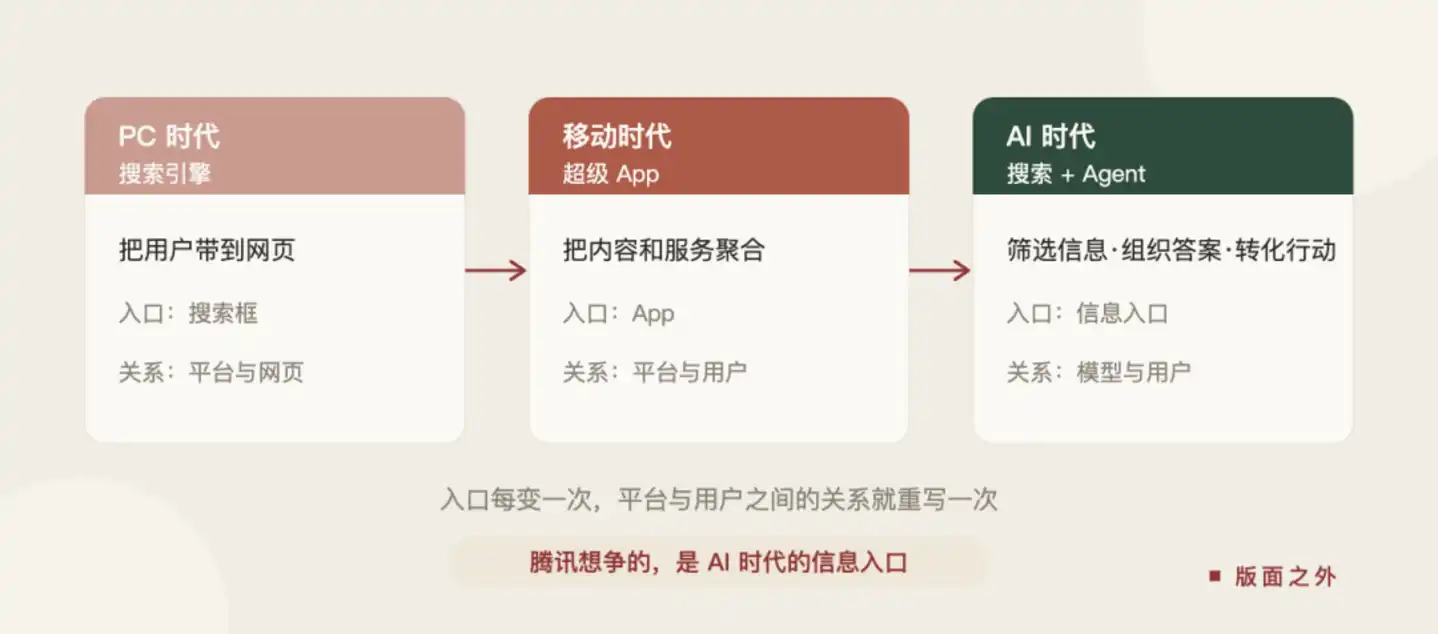
Internet entry points have changed before. In the PC era, search engines took users to webpages. In the mobile era, super apps gathered content and services inside their own ecosystems. In the AI era, search is beginning to filter information and organize answers for users, while Agents turn that information into action.
Tencent’s move into Baidu’s search territory is, on the surface, a contest for the search market. At a deeper level, it is a contest for the information entry point in the AI era. The launch was quiet, but the competition has begun.
Banmian Zhiwai described search’s traditional core capability as finding information. AI has made that process faster, while gradually shifting the power to filter information from users to models. The more complete an answer becomes, the easier it is for users to stop asking questions. Yet important information may be hidden precisely in what an answer leaves out. The scarce capability in future search may not be answering questions alone, but keeping answers traceable and open to challenge.



