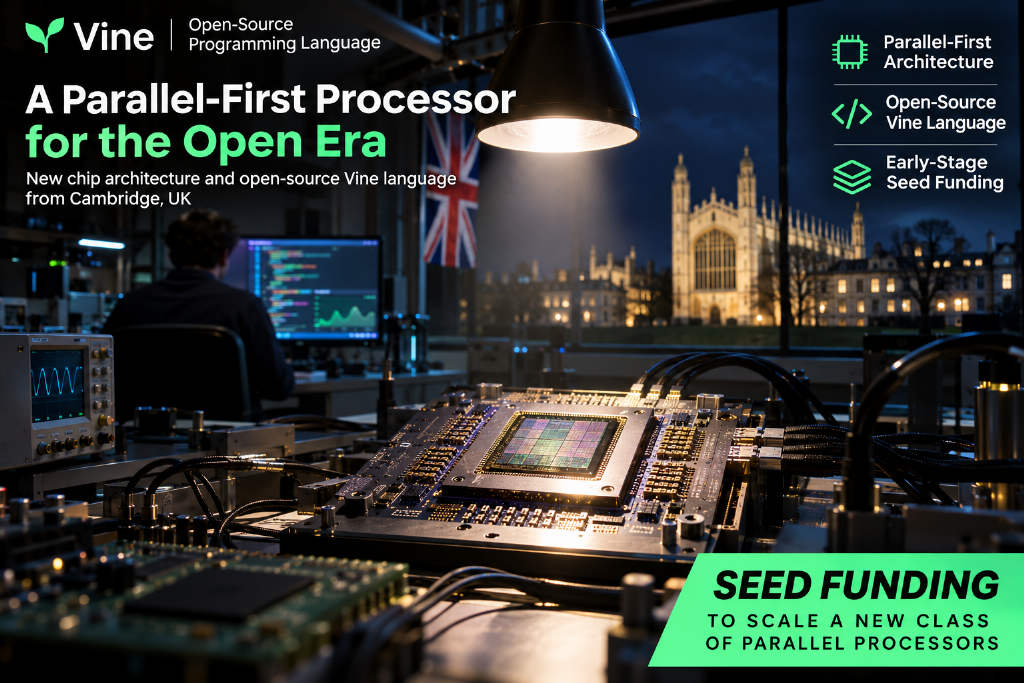
Cambridge semiconductor startup Tendrils has raised a $30 million seed round, equivalent to about €26 million, according to EU-Startups, as cited by ChainCatcher. Benchmark led the round, with participation from Visionaries Club, the UK Sovereign AI Fund, FR8, Antimatter, Cloudberry VC, Conviction, Embassy Ventures and SV Angels. Several angel investors also joined the financing. Founded in 2025 by chief executive Nils Cremer and co-founders T6 and Hugo McNally, Tendrils is developing a general-purpose processor architecture designed to allow thousands of cores to work in parallel. The architecture is based on an interaction-net computing model that represents programs as connected nodes, allowing independent operations to run at the same time rather than relying on shared mutable memory and a linear sequence of instructions. The company is also developing Vine, an open-source programming language with syntax similar to Rust, to help software adapt to its parallel-first architecture. Tendrils said GPUs already handle large-scale numerical workloads, while AI agents still rely heavily on CPUs for irregular tasks such as executing code and retrieving documents. Jack Altman, a Benchmark general partner and co-founder of Lattice, will join Tendrils’ board.
Tendrils raises $30 million seed round
Cambridge semiconductor startup Tendrils has completed a $30 million seed financing round, equivalent to about €26 million, according to EU-Startups in a report cited by ChainCatcher.
Benchmark led the round. Visionaries Club, the UK Sovereign AI Fund, FR8, Antimatter, Cloudberry VC, Conviction, Embassy Ventures and SV Angels also participated, alongside several angel investors.
A processor built for parallel execution
Tendrils was founded in 2025 by chief executive Nils Cremer and co-founders T6 and Hugo McNally. The company is developing a general-purpose processor architecture designed to allow thousands of cores to operate in parallel.
The architecture is based on an interaction-net computing model. Programs are represented as connected nodes, allowing independent operations to run at the same time. Tendrils is seeking to move away from the shared mutable memory and linear instruction sequence used in traditional approaches.
The company is also developing Vine, an open-source programming language whose syntax is similar to Rust. Vine is intended to make it easier for software to adapt to the architecture’s parallel-first design.
Jack Altman to join the board
Tendrils said GPUs have already taken on large-scale numerical computing, but AI agents still depend heavily on CPUs for irregular tasks such as executing code and retrieving documents.
Jack Altman, a Benchmark general partner and co-founder of Lattice, will join Tendrils’ board.
This article was originally published by Bit.Fan. For more cryptocurrency news and market insights, visit www.bit.fan. Disclaimer:
The market information, project data, and third-party content displayed on this platform are for industry information sharing only and do not constitute any form of investment advice or return commitment.
Cryptocurrency trading carries high risks. Users should fully assess their risk tolerance and make independent decisions. All profits, losses, and legal responsibilities are borne by the users themselves.