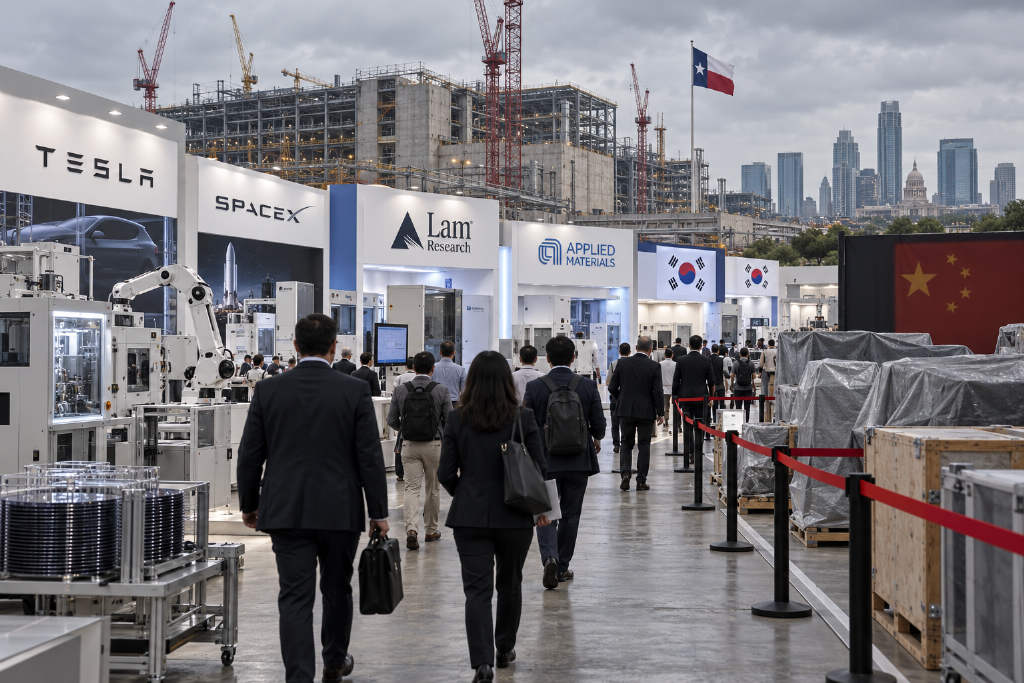
Citrini analyst Jukan said on Oct. 20 that Terafab, a Texas semiconductor project being pushed by Elon Musk-linked Tesla and SpaceX, is broadly excluding Chinese suppliers. According to Jukan, the project shifted toward Korean vendors after finding Japanese products too expensive, and is asking Korean companies to submit bids at or even below the pricing offered by Chinese suppliers. On the opening day of SEMICON West 2026, Terafab reportedly visited about 10 Korean company booths based on a prearranged list. Equipment makers Lam Research and Applied Materials have also set up dedicated teams for the project. Jukan added that the initial facility, with monthly capacity of about 100,000 wafers, could be completed before 2030. On logic chips, the project is working with Intel and is in contact with Taiwan Semiconductor Manufacturing Co. (TSMC), while memory production would use a separate process line. A representative from an overseas equipment supplier said Musk had first explored buying production lines from Intel, TSMC, and Micron, but turned to partnerships after being rejected. A Korean partner also described an unusually fast response cycle, saying questions sent in the early hours of U.S. Eastern Time were typically answered within 30 minutes to one hour.
BlockBeats reported on Oct. 20 that Citrini analyst Jukan said Terafab, a Texas semiconductor project being advanced by Elon Musk-linked Tesla and SpaceX, is broadly excluding Chinese suppliers.
Jukan said the project turned to Korean vendors because Japanese products were considered too expensive, while Korean companies were being asked to offer prices matching or even below those from Chinese suppliers.
Terafab approached Korean companies at SEMICON West 2026
According to Jukan, Terafab visited about 10 Korean company booths on the opening day of SEMICON West 2026, following a prearranged list. Global equipment suppliers Lam Research and Applied Materials have also created dedicated teams for the project.
Initial facility targets 100,000 wafers per month
Jukan said the initial facility is expected to have monthly capacity of about 100,000 wafers and could be completed before 2030. On the logic chip side, the project is working with Intel and is also in contact with Taiwan Semiconductor Manufacturing Co. (TSMC). Memory production would be built under a separate process line.
Musk first explored acquisitions before shifting to partnerships
A representative from an overseas equipment supplier said Musk initially explored acquiring production lines from Intel, TSMC, and Micron. After those efforts were rejected, he moved toward partnerships, with a level of execution the representative described as unusual in the semiconductor industry.
A Korean partner also said that even when questions arrived in the early morning hours on U.S. Eastern Time, replies usually came within 30 minutes to one hour. The same person said engineers held decision-making authority, making the collaboration model very different from that of typical customers.
This article was originally published by Bit.Fan. For more cryptocurrency news and market insights, visit www.bit.fan. Disclaimer:
The market information, project data, and third-party content displayed on this platform are for industry information sharing only and do not constitute any form of investment advice or return commitment.
Cryptocurrency trading carries high risks. Users should fully assess their risk tolerance and make independent decisions. All profits, losses, and legal responsibilities are borne by the users themselves.