
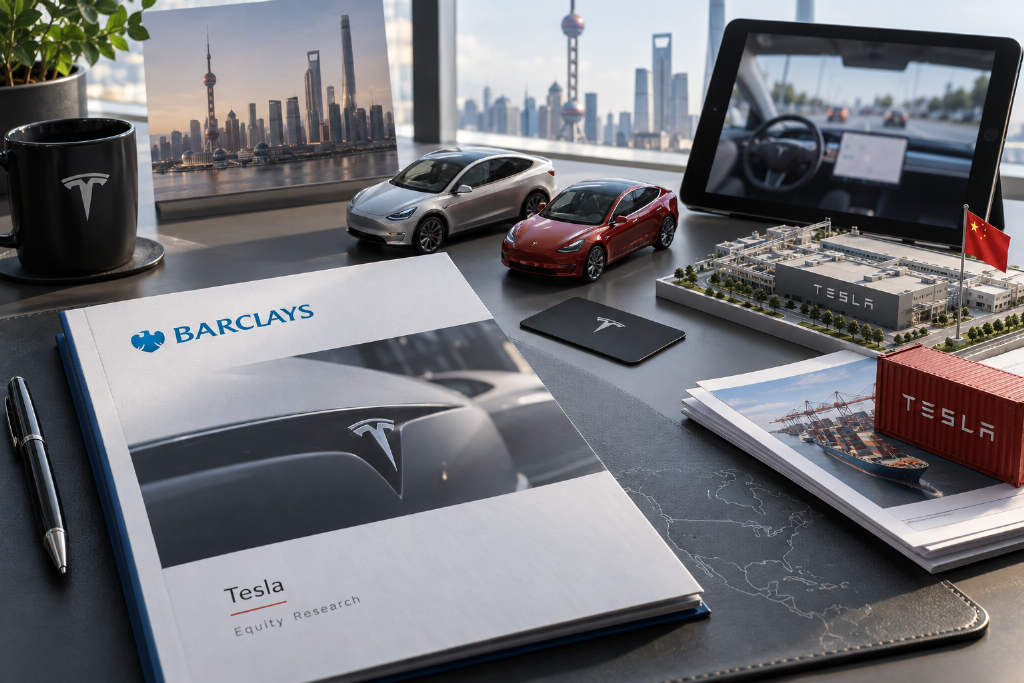
Barclays said in a report dated Sept. 18, 2026 that Tesla could deliver about 475,000 vehicles in the third quarter, down 4% year over year but above the market consensus of 466,000. The bank maintained a neutral rating and kept its price target at $370. Based on the cited current price of $366.20, that implies about 1.0% upside.
Analyst Dan Levy wrote that Tesla’s fundamentals are being masked by investor focus on its artificial intelligence efforts, including Robotaxi and Optimus. Even so, Barclays said two parts of the auto business still matter heavily to the quarter’s outcome: FSD adoption is helping both volume and margins, and exports from the Shanghai Gigafactory are adding to global deliveries. Those two factors, in the bank’s view, support the call for better-than-expected third-quarter deliveries.
FSD adoption in North America is running ahead of prior guidance
Barclays said more buyers are choosing Tesla because of FSD. In the second quarter, FSD penetration in North American deliveries exceeded 55%, far above management’s earlier guidance in the upper half of a 20% to 30% range. Management said on the second-quarter earnings call that FSD was a meaningful driver of North American demand and that some consumers were buying specifically for that capability.
The bank expects that trend to continue in the third quarter and said FSD should keep supporting U.S. sales. Tesla’s autonomous driving efforts also drew more attention after the Cybercab launch in Austin, according to the report.
Barclays expects U.S. third-quarter deliveries of about 165,000 vehicles, up roughly 5,000 from the prior quarter but down 23,000 from a year earlier. It said the year-over-year decline looks larger partly because the third quarter of last year saw a surge in purchases before an electric-vehicle tax credit expired. Barclays added that incremental buyers tied to FSD have partly offset the pressure from lower subsidies.
Shanghai exports seen as a key source of global growth
Barclays said it visited the Shanghai Gigafactory last week and reaffirmed Tesla’s notable cost advantage there. The bank estimates that Shanghai exports account for at least 20% of Tesla’s global sales this year. Markets that had received less attention before, including Australia, Colombia, and parts of Asia outside China, are now contributing meaningful incremental volume, the report said.
Shanghai wholesale volume in July and August reached 180,000 units, up 19% year over year, with exports up 92%. Tesla is still prioritizing exports to support demand in Europe, Asia outside China, and other regions, especially as the domestic Chinese market remains soft, Barclays said. Exports are also supporting higher production. Output in July and August rose 23% year over year. The bank added that exports from Shanghai are margin accretive because production costs in China are lower.
Europe is expected to fall sequentially but rise from a year earlier
In Europe, Tesla sold about 21,000 vehicles in July and August combined, down roughly 18,000 from the prior quarter, a 46% drop. Barclays expects third-quarter deliveries in Europe to total about 71,000, down around 21,000 sequentially but up about 8,000 from a year earlier.
The bank said the sequential decline was expected because August is part of Europe’s summer holiday season, when auto sales tend to slow. It expects September to account for about 70% of Europe’s third-quarter deliveries, above 57% in June of the second quarter and above 63% in September of last year’s third quarter.
That said, the year-over-year increase of about 8,000 would be well below the 36,000 gain in the second quarter and the 23,000 increase in the first quarter. Barclays said Europe is still benefiting from imports from Shanghai, which carry a margin benefit because of lower manufacturing costs in China.
China wholesale is strong while retail remains weak
Barclays said domestic retail demand in China has been soft and exports have become the main growth source. In July and August, China retail sales totaled 77,000 vehicles, down 21% year over year. Wholesale volume reached 180,000, up 19%, while exports jumped 92%.
The bank expects China third-quarter deliveries of about 137,000, up 9% from the prior quarter but down 19% from a year earlier. Tesla is still prioritizing exports to meet demand in Europe, Asia outside China, and other markets.
Barclays also expects Tesla to shift more attention back to domestic sales in China in September, in line with normal quarter-end seasonality. It forecasts about 60,000 deliveries for the month, well above the July-August average of 39,000. The report said September sales should be helped by incremental incentives. Early in September, Tesla began offering new discounts of RMB 10,000 on Model Y inventory vehicles and RMB 5,000 on Model 3 inventory vehicles delivered before month-end. Those discounts came on top of existing promotions covering paint, insurance, and financing subsidies.
Margins seen flat to slightly down sequentially
Barclays said cost pressure and incentives are the main headwinds. It expects Tesla’s third-quarter margin to be roughly flat or slightly lower from the second quarter. The report listed second-quarter margin at 16.3%, excluding regulatory credits and including stock-based compensation.
The bank pointed to several pressures: a modest sequential drop in deliveries, which weakens fixed-cost absorption; a regional mix shift, with Europe and Asia-Pacific mix lower sequentially and China mix higher; pricing and incentives, including incremental incentives in China and continued financing incentives in the United States; and higher raw material costs. The report specifically cited steel, aluminum, and copper, along with inflation in gold and silver, and said electric vehicles use more gold and silver than internal combustion engine vehicles.
FSD, by contrast, was described as a tailwind. Barclays said second-quarter FSD penetration was an unexpected positive for margins, and management stated that FSD adoption in North American deliveries had exceeded 55%. The bank expects strong adoption to continue in the third quarter. It also said FSD could help in Europe after Tesla received temporary approvals in multiple countries during the second quarter. A European Union-wide vote on FSD approval is expected in October, according to the report.
Production, inventory, and energy storage forecasts
Barclays expects Tesla to produce about 480,000 vehicles in the third quarter, above the 477,000 consensus. Second-quarter production was 452,000. The bank also forecasts an inventory build of about 5,000 vehicles, partly reversing an inventory decline of about 30,000 in the second quarter. Tesla plans to raise output across all factories in 2026, the report said. Production rose 11% year over year in the first half, and third-quarter production is expected to grow 7% from a year earlier.
Outside the core auto segment, Barclays expects Tesla to deploy about 15.6 GWh of energy storage in the third quarter, up 25% year over year and 16% sequentially. It said margins in that business could improve from about 20% in the second quarter, which was affected by warranty adjustments, to the mid-to-high 20% range, in line with management’s long-term outlook.
Barclays keeps its neutral stance
Barclays said a strong third quarter would add evidence that Tesla’s auto growth has moved into a positive inflection, a trend the bank said became more visible after second-quarter deliveries came in well above expectations. Management said in the second quarter that Tesla ended the period with its largest order backlog since 2023, leaving room for more growth ahead. Barclays said it will watch whether management still sees strong demand when third-quarter results arrive.
The report ends by framing FSD penetration and Shanghai exports as two separate supports for Tesla’s auto business: one validates demand, and the other highlights cost advantage.
The source article said it was a整理与解读 of a third-party brokerage report from Barclays dated Sept. 18, 2026, combined with public market information. Any ratings, target prices, earnings forecasts, and related judgments cited in the piece are the views of Barclays analysts and represent only the position of that institution. The article also said it does not constitute investment advice and should not be used as the basis for buying or selling any security.
