
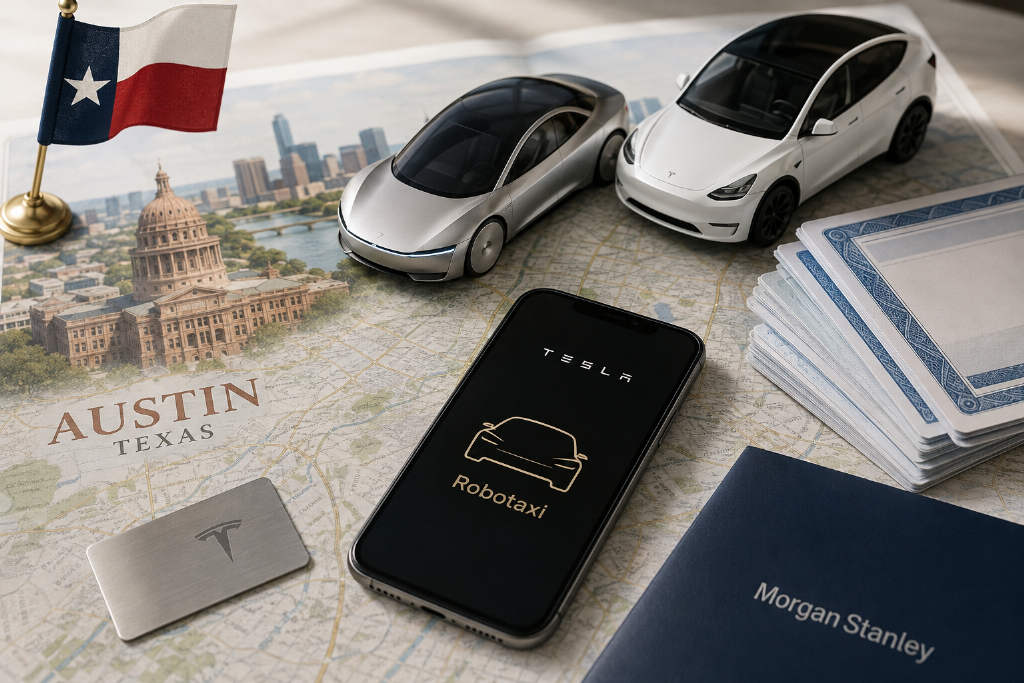
Tesla’s Cybercab is now offering driverless rides to the public in Austin, according to a Sept. 4 research note from Morgan Stanley, a move the bank said puts Tesla’s Robotaxi effort into an operational validation phase.
Users can book rides through the Tesla Robotaxi app and choose between the two-seat Cybercab and a four-seat Model Y. Morgan Stanley said the exact scale of the commercial rollout remains unclear, but several signals point to a broader deployment push. The bank kept its Neutral rating on Tesla with a $400 price target, saying that implied about 6% upside from the current share price. It also said Tesla’s excess stock performance on Sept. 3 had already shown market recognition of progress in Robotaxi, and that the next stage would hinge on public data proving continued fleet expansion.
Cybercab was built as a native driverless vehicle
Cybercab is Tesla’s first mass-produced vehicle designed from the ground up for autonomous ride-hailing. It has no steering wheel, no accelerator pedal, and no brake pedal, and runs entirely on Tesla’s Full Self-Driving, or FSD, system. Inside, the cabin has only two seats and a 22-inch center display that runs a real-time 3D user interface built on Epic Games’ Unreal Engine.
The vehicle uses a matte gold finish and butterfly-style doors. Ground clearance is 144 mm. Morgan Stanley said the setup improves ease of entry and exit. The trunk offers 572 liters of cargo space, enough for two checked suitcases and two carry-ons, and it can also fit a folded wheelchair.
Accessibility was highlighted as a key feature. Seat height is close to the seating surface of a wheelchair, door handles and roof buttons include Braille markings, and Grok voice control allows visually impaired passengers to complete ride booking and in-car actions on their own.
On powertrain specs, Cybercab uses a single-motor front-wheel-drive layout with peak output of 163 kW. Curb weight is about 1.41 tons, battery capacity is about 47.6 kWh, and range is about 483 km. Tesla has said the vehicle is expected to cost less than $30,000 and carry an operating cost of less than $0.2 per mile. It also supports wireless inductive charging and can connect with an automated cleaning process, creating a fully unmanned cycle for charging and maintenance.
Texas records show 45 registered Cybercabs
Texas Department of Motor Vehicles data cited in the note showed Tesla had 420 autonomous vehicles registered in the state as of Sept. 3. That total included 45 Cybercabs and 375 Robotaxi Model Ys. Morgan Stanley said the Cybercab registration count rose from 7 to 45 in the days just before the launch event.
The report stressed that 45 is a registration number, not the same thing as the number of vehicles actively carrying passengers on the road at the same time. Videos circulating on X showed a large number of Cybercabs driving in Austin this week. Morgan Stanley said the exact number available for commercial use remains unknown, but the intensity of road activity suggests Tesla is preparing for a much larger fleet deployment.
Tesla has also launched a new page that lets customers express interest in buying Cybercab fleets. The form asks for business details, deployment regions, and collaboration direction, with options that include ride-hailing fleet procurement, mobility hubs and infrastructure, and event partnerships. Morgan Stanley said Tesla appears to be treating Cybercab not only as a mobility service tool but also as a product that can be sold directly.
Unsupervised driving mileage passes 1 million miles
Another milestone came from Tesla’s unsupervised driving mileage, which has now exceeded 1 million miles. Ashok Elluswamy, Tesla’s Vice President of Autopilot and AI, announced the figure at the Cybercab event.
Tesla had previously disclosed 380,000 miles on its second-quarter 2026 earnings call. Using those figures, the note said the company added roughly 620,000 miles in just six weeks, a clear acceleration in pace. Before that, Tesla had taken more than a year to reach 380,000 miles. Tesla said there had been “no notable accidents” during that period.
Tesla still trails Waymo on scale
Morgan Stanley said Tesla still lags Waymo by a wide margin in deployment scale. Waymo has about 4,000 autonomous vehicles operating across 14 U.S. cities and completes more than 500,000 rides a week. In Texas alone, Waymo has 988 registered vehicles, versus Tesla’s total of 420 in the state.
Waymo said last week that its cumulative mileage had reached 200 million miles, and it had already crossed the 1 million-mile threshold in 2023. Tesla, by contrast, has only just moved past 1 million miles of unsupervised driving.
Vehicle cost is another major point of separation. The note put Cybercab’s unit cost at about $23,000 to $25,000, compared with roughly $70,000 to $150,000 for a Waymo vehicle. Goldman Sachs estimated Cybercab’s per-mile cost at $0.05 to $0.30, which the note said gives Tesla a stronger cost position against rivals.
On pricing, the note said Tesla’s average Robotaxi trip in San Francisco costs $8.17, about half of Uber’s $17.47. Waymo’s average trip was listed at $19.69, making Tesla’s fare about 40% of that level.
How Morgan Stanley builds the $400 target
Morgan Stanley’s $400 target price is split across five business segments.
- Core auto is worth $45 per share, based on about 8.5 million units sold in 2040, an 8.4% EBIT margin excluding FSD, a 10.9% weighted average cost of capital, and a 10x 2040 exit EBITDA multiple.
- Network services account for $144 per share, the largest single component, based on an 80% FSD attach rate in 2040 and monthly ARPU of $240.
- Tesla mobility, meaning the Robotaxi network, contributes $120 per share based on a discounted cash flow model that assumes about 5 million Tesla vehicles operating on the network in 2040 at about $1.33 per mile.
- Energy contributes $35 per share.
- Humanoid robotics contributes $56 per share after a 50% probability discount.
The note said the $400 target implies about 75x 2027 estimated earnings, with valuation already embedding substantial expectations for future Robotaxi network revenue and FSD subscription income. A 10% change in FSD attach rate would change the network services valuation by about $18 per share, according to Morgan Stanley.
Neutral stance remains tied to measurable operating data
The bank listed upside risks as higher FSD attach rates, new battery cost milestones, new vehicle launches, faster Robotaxi rollout, and progress with Optimus. Downside risks included tougher competition, execution risk around FSD and Robotaxi, regulatory uncertainty, China risk, and dilution.
The National Highway Traffic Safety Administration, or NHTSA, has already opened a review into whether Cybercab complies with federal motor vehicle safety standards. Morgan Stanley said the process resembles the regulatory path taken by Amazon-owned Zoox in 2022, and noted that Zoox spent years before receiving federal approval.
Morgan Stanley’s Neutral view does not reject Tesla’s progress. The note said the bank is waiting for more measurable operating data, especially on how fast the fleet continues to expand. In that framing, 45 registered vehicles are a starting point and 1 million miles is a first milestone. Only when those numbers accelerate will market pricing of Tesla’s Robotaxi business shift from expectation to fact.
The article is a summary and interpretation by Chaoxiang Research of a third-party broker report from Morgan Stanley dated Sept. 4, 2026, combined with public market information. The ratings, target price, earnings forecasts, and related judgments cited in the piece are the views of the broker’s analysts, represent only the position of their institution, and do not represent the views of Chaoxiang Research or constitute investment advice.
Markets involve risk, and investment decisions should be made independently. This article should not be used as a basis for buying or selling any securities.
