
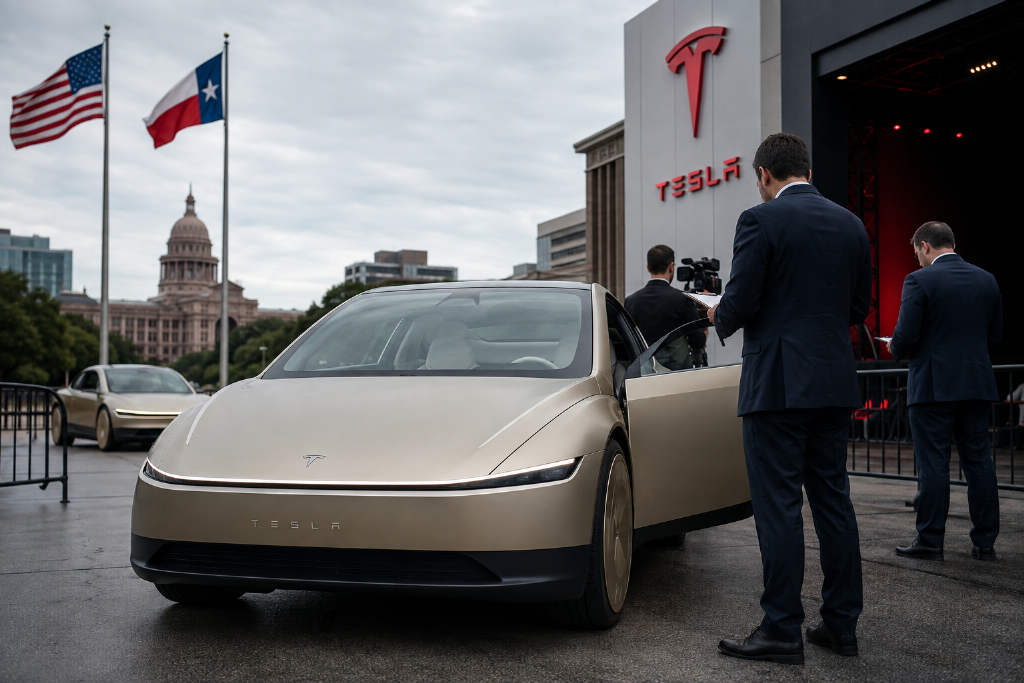
Tesla shares closed down 5.92% on Friday, Sept. 4, at $354.08, wiping out about $88 billion in market value in a single session. The drop erased the 5.42% gain recorded on the day of the Cybercab event, leaving the stock below the $357.01 close from the day before the unveiling.
On Sept. 3, Tesla held its Cybercab commercialization event in Austin, Texas. That same day, the U.S. National Highway Traffic Safety Administration, or NHTSA, opened audit investigation AQ26002 to examine how Tesla self-certified the vehicle under applicable Federal Motor Vehicle Safety Standards, or FMVSS.
NHTSA is examining Tesla’s self-certification basis
According to the agency’s filing, Tesla told regulators that Cybercab complies with all applicable FMVSS requirements even though the vehicle has 「no permanently mounted traditional manual driving controls, such as brake pedal, accelerator pedal, steering wheel, and rearview mirrors」.
NHTSA said it will review the process and technical data Tesla relied on for that certification, with special attention to 「the extent to which Tesla’s certification depends on determining that certain FMVSS are not applicable to Cybercab」. The filing also states that the case was triggered by public information and is estimated to involve 1,000 Cybercabs.
The core dispute is not current operations but future scale
The audit does not by itself amount to a violation finding. It has not led to a recall order or a determination that the vehicle is unlawful, and it does not currently force the Cybercab fleet to stop running. Tesla’s Austin service remains in operation.
The real regulatory question is which legal path Tesla is trying to use. Tesla’s position is that Cybercab already fits within the current framework and does not need an exemption. That approach carries a clear upside: under current rules, companies that go through the exemption route can deploy no more than 2,500 vehicles a year. Zoox, the Amazon-owned robotaxi company, is subject to that cap. Elon Musk’s plan calls for Cybercab production in the millions, which makes 2,500 vehicles a year far below the scale Tesla wants.
Zoox offers a recent comparison
The report points to Zoox as a precedent. In 2022, Zoox self-certified a robotaxi that also lacked manual driving controls and argued that it did not need an exemption or a change in the rules. NHTSA challenged that position and opened an investigation. The standoff lasted about two years before Zoox changed course and applied for an exemption.
NHTSA simplified the application process in 2025. Zoox became the first company to secure an exemption under the new process this summer, which then allowed it to begin charging passengers. In that context, the current review is not simply about whether Tesla’s 45 registered Cybercabs can operate. It is also about whether Tesla can avoid the annual 2,500-vehicle cap.
Registered Cybercabs on the road remain limited
NHTSA’s filing estimated that 1,000 Tesla Cybercabs may be implicated. JPMorgan, meanwhile, expects Tesla’s fleet to remain small through the end of 2026 and put the number at about 9,000 by the end of 2027. Royal Bank of Canada projects roughly 40,000 Cybercabs in the U.S. market by 2030.
The number that can be verified on the road right now is much smaller. As of Sept. 2, Tesla had 45 Cybercabs registered in Texas for unmanned operation, according to the report. That is only a small portion of the 420 Tesla robotaxis registered statewide, with the rest made up of modified Model Y vehicles. Waymo has close to 1,000 vehicles registered in Texas.
Analysts focused on missing details and early execution
The event was invitation-only and was not livestreamed publicly. Musk did not attend in person. In a Friday note, Royal Bank of Canada wrote that Tesla provided 「limited new exposure relative to prior announcements」 and said key questions on pricing, production timing, and regulatory approval remain unanswered. The bank also said the event 「was not publicly livestreamed, which was notably different from Tesla’s usual dramatic product launches」. Even so, the same note kept its buy rating.
Wells Fargo used a blunt title in its note: 「TSLA Cybercab launch disappointed」. The bank said the Austin robotaxi service is 「facing early execution issues」. Users have already posted online videos and complaints showing route errors, overshooting destinations, and long wait and ride times.
Barclays maintained its Equal Weight rating and $370 price target, saying Tesla’s limited direct communication and the lack of new growth or expansion targets could leave the event with less catalyst value than some investors expected. Evercore ISI analyst Chris McNally said the focus in the coming weeks will shift to how extensively these vehicles are actually used in regular operations.
Two questions raised repeatedly after the launch
Will the NHTSA audit stop Cybercab service?
Not at this stage. The audit is not a violation charge, there is no recall order, and no formal non-compliance finding has been issued. Tesla’s Austin service continues to run. The key issue is whether Tesla can avoid the exemption process, since that route comes with a 2,500-vehicle annual cap.
How many Cybercabs is Tesla actually operating now?
As of Sept. 2, Tesla had 45 Cybercabs registered in Texas for unmanned operation. That total accounts for only a small share of the 420 Tesla robotaxis registered in the state, with the remainder consisting of modified Model Y vehicles.