
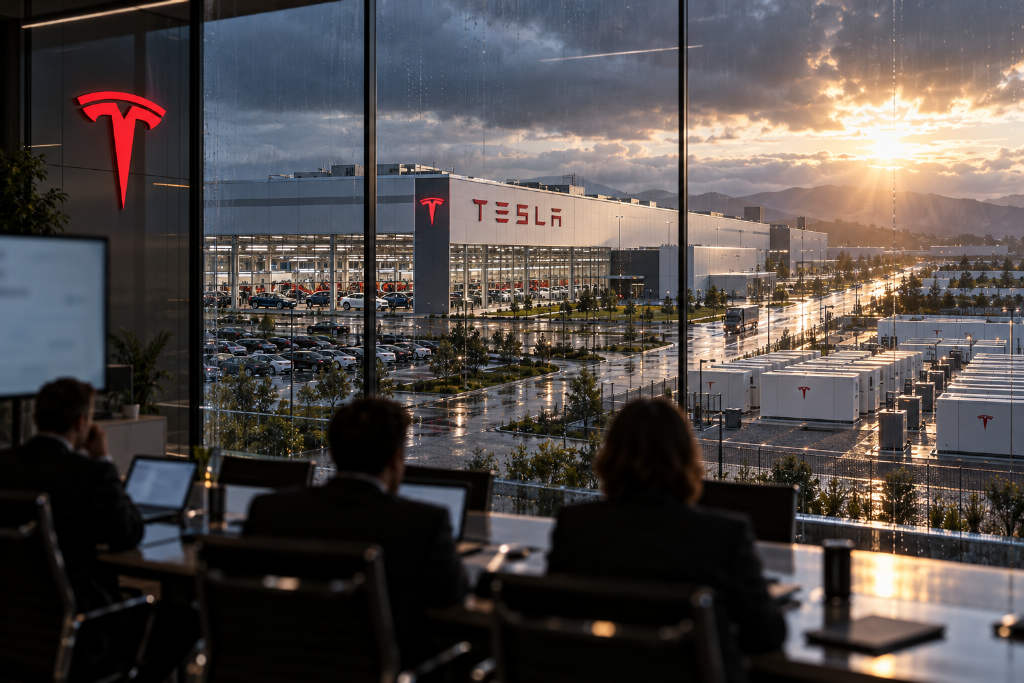
Tesla posts mixed Q3 FY2026 results as margins improve and cash flow turns positive
Tesla reported $28.046 billion in revenue for the third quarter of FY2026, down 0.2% from a year earlier and below the company-compiled market consensus of $28.341 billion, according to MSX Research Institute’s latest daily note on U.S. equities and RWA markets. Adjusted EPS was $0.48, above the $0.45 consensus. GAAP net income attributable to common stockholders was $787 million, down 43% year over year, which the note said mainly reflected a sharp increase in research and development spending and lower regulatory credit revenue.
The strongest part of the quarter was margin recovery and cash generation. Tesla’s overall GAAP gross margin rose to 19.6%, up about 160 basis points from a year earlier and about 170 basis points above market expectations. Automotive gross margin excluding regulatory credits reached 18.1%, up 270 basis points year over year and 180 basis points from the prior quarter.
Operating cash flow came in at $6.263 billion, while capital expenditure was $4.732 billion. That pushed free cash flow to positive $1.531 billion, compared with negative $1.092 billion in the previous quarter and much better than the market’s earlier expectation of negative $4.506 billion.
Lower capex helped cash flow, but raised questions on expansion pace
MSX said the cash flow beat did not come entirely from stronger earnings. Third-quarter capital expenditure was well below the market expectation of about $7.771 billion. On the earnings call, management also cut its 2026 capex outlook to about $20 billion from a previous expectation of more than $25 billion.
That slower pace of capital deployment supports near-term cash flow, but it also forces the market to reassess the expansion timeline for Robotaxi, Optimus, AI computing capacity and new production lines.
After the earnings release, Tesla shares fell more than 3% in after-hours trading before trimming losses. Late in the extended session, the stock was down about 1.4%. MSX said the market reaction suggested investors saw better financial quality in the quarter, while the pace of growth still needs to be tested.
Key figures from the quarter
- FY2026 Q3 revenue was $28.046 billion, down 0.2% year over year and below the market consensus of $28.341 billion.
- GAAP net income attributable to common stockholders was $787 million, down 43% year over year.
- GAAP diluted EPS was $0.22, versus a market consensus of $0.23.
- Adjusted net income was $1.697 billion, and adjusted EPS was $0.48, above the $0.45 consensus.
- GAAP gross margin was 19.6%, up about 160 basis points year over year and about 170 basis points above market expectations.
- Operating income was $718 million, down 56% year over year, with an operating margin of about 2.6%.
- Research and development expense was $2.761 billion, up about 69%, mainly reflecting higher spending on AI, autonomous driving and robotics.
- Operating cash flow was $6.263 billion, versus market expectations of about $3.267 billion.
- Capital expenditure was $4.732 billion, well below the market expectation of about $7.771 billion.
- Free cash flow was $1.531 billion, compared with negative $1.092 billion in the prior quarter and a prior market expectation of negative $4.506 billion.
- Cash, cash equivalents and short-term investments totaled $45.447 billion, up about $1.923 billion from the prior quarter.
- Automotive revenue was $20.560 billion, down about 3% year over year but above the market expectation of $20.272 billion.
- Automotive regulatory credit revenue was $113 million, down about 73% year over year.
- Automotive gross margin excluding regulatory credits was 18.1%, up 270 basis points year over year.
- Vehicle deliveries were 486,532, down about 2% year over year but up about 1.3% quarter over quarter.
- Energy generation and storage revenue was $2.881 billion, down 15.6% year over year and about 22.6% below the market expectation of $3.720 billion.
- Energy gross margin was about 33.1%, up about 170 basis points year over year and about 1,270 basis points quarter over quarter.
- FSD subscriptions reached 1.74 million, up about 67% year over year.
- Robotaxi cumulative unsupervised miles approached 2 million, up about 8x from the prior quarter.
- Cybercab joined the Austin Robotaxi fleet on Sept. 3, and the current production line has stated annual capacity of more than 125,000 units.
- Optimus entered early production ramp in Fremont, with the first production-quality robots starting to roll off the line.
- The company plans to raise AI training compute capacity to 400MW by the end of 2026.
- Tesla revised its 2026 capex plan to about $20 billion from a previous expectation of more than $25 billion.
Automotive margins improved even as regulatory credit revenue dropped
MSX said the clearest positive signal in the quarter was the recovery in automotive margin despite a sharp decline in regulatory credit revenue. Tesla’s automotive regulatory credit revenue fell from $417 million a year earlier to $113 million, yet automotive gross margin excluding those credits still rose from 15.4% to 18.1%.
According to the note, that points more to lower unit costs, changes in product mix and better manufacturing efficiency than to support from regulatory credits.
Automotive revenue reached $20.560 billion, slightly above market expectations. Deliveries fell about 2% year over year and revenue declined about 3%, but the margin improvement suggests Tesla was not relying only on aggressive price cuts to support volume. MSX argued that for a company that needs to fund AI and robotics, stabilizing automotive profitability matters more than a modest short-term increase in deliveries.
Even so, automotive revenue has not returned to clear growth. Tesla produced 464,391 vehicles and delivered 486,532 in the quarter, supported by the drawdown of about 22,000 units of inventory. The company also said battery supply still constrained vehicle output, and it said passenger vehicle order backlog at quarter-end was the highest in four years. The next question is whether those orders can convert into sustained deliveries rather than being driven by one quarter’s inventory and delivery timing.
Energy storage deployment rose, but revenue lagged
The energy business showed a different kind of split. Energy storage deployments reached 13.7 GWh in the third quarter, up about 10% year over year. Yet energy generation and storage revenue fell 15.6% from a year earlier and came in 22.6% below market expectations.
MSX said that does not necessarily mean weaker demand. Tesla said both order intake and backlog for energy storage hit record highs in the quarter, and its Texas Megafactory, which is planned for annual capacity of 50 GWh, has already started production.
The gap between deployments and revenue may reflect project recognition timing, geography and product mix, pricing, and delivery structure. One positive point was margin: energy gross margin reached 33.1%, well above 20.4% in the previous quarter. Still, because revenue fell, gross profit in the segment declined from $1.073 billion a year earlier to $954 million.
In MSX’s view, the issue in energy storage is not order volume. It is whether Tesla can steadily convert deployments and backlog into revenue and profit.
Cash flow was the biggest upside surprise
Cash flow was the largest upside item in the quarter. Operating cash flow reached $6.263 billion, about twice the market expectation. Capital expenditure was roughly $3 billion below expectations, resulting in $1.531 billion of free cash flow.
That means Tesla does not need to rely entirely on outside financing to support AI, Robotaxi and Optimus projects. Its $45.447 billion in cash, cash equivalents and short-term investments also gives it a sizable funding buffer.
Still, lower capex cuts both ways. Management’s decision to lower the 2026 capex plan from more than $25 billion to about $20 billion helps free cash flow, but it may also indicate adjustments to the pace of investment and construction for some long-term projects. MSX said Tesla now needs to show that the reduction mainly reflects better build efficiency and optimized spending cadence, rather than slower expansion in Robotaxi, compute infrastructure or robot production capacity.
FSD, Robotaxi and Optimus are moving into measurable execution
Tesla’s AI commercialization now has several measurable markers. FSD subscriptions reached 1.74 million, up 67% year over year. The company said more than 75% of new vehicle deliveries in North America included an FSD subscription. Robotaxi cumulative unsupervised miles approached 2 million, up 8x from the prior quarter, and Cybercab joined the Austin fleet starting Sept. 3.
MSX said those figures show Tesla moving from selling driver-assistance software toward operating an autonomous vehicle fleet. Optimus has also moved a step beyond prototype demonstrations and into manufacturing. Tesla has started early production in Fremont, and the first production-quality robots have begun rolling off the line.
The company is still changing hardware and manufacturing processes, however. MSX said the more useful metrics to watch at this stage are not distant output targets, but yield, unit cost, working hours and the real completion rate of factory tasks.
MSX view
MSX said the earnings report does not show Tesla entering a new phase of rapid growth. What it does show is that the automotive business can still improve margins and generate enough cash flow to support part of the company’s AI spending.
The next set of questions, according to the note, is whether automotive margin improvement can continue, whether energy storage orders can turn into revenue, and whether Robotaxi and Optimus can move from technical milestones into scaled commercial operations.
About MSX
MSX describes itself as an RWA trading platform focused on secure, efficient and transparent access to global financial markets. The platform said it offers spot and derivatives trading for nearly 400 tokenized stocks and Pre-IPO assets.
It also said it has built a digital financial services system covering U.S. stock spot and perpetual contracts, crypto-to-crypto trading, Pre-IPO products and research services.
- Website: https://msx.com/
- Chinese Telegram: https://t.me/MSXOfficial
- Global Telegram: https://t.me/MSXGlobal
- X: https://x.com/MSX_CN
Risk disclosure: MSX said macroeconomic conditions and the U.S. stock market can be highly volatile, and the material is for academic and research observation only and does not constitute investment advice.



