
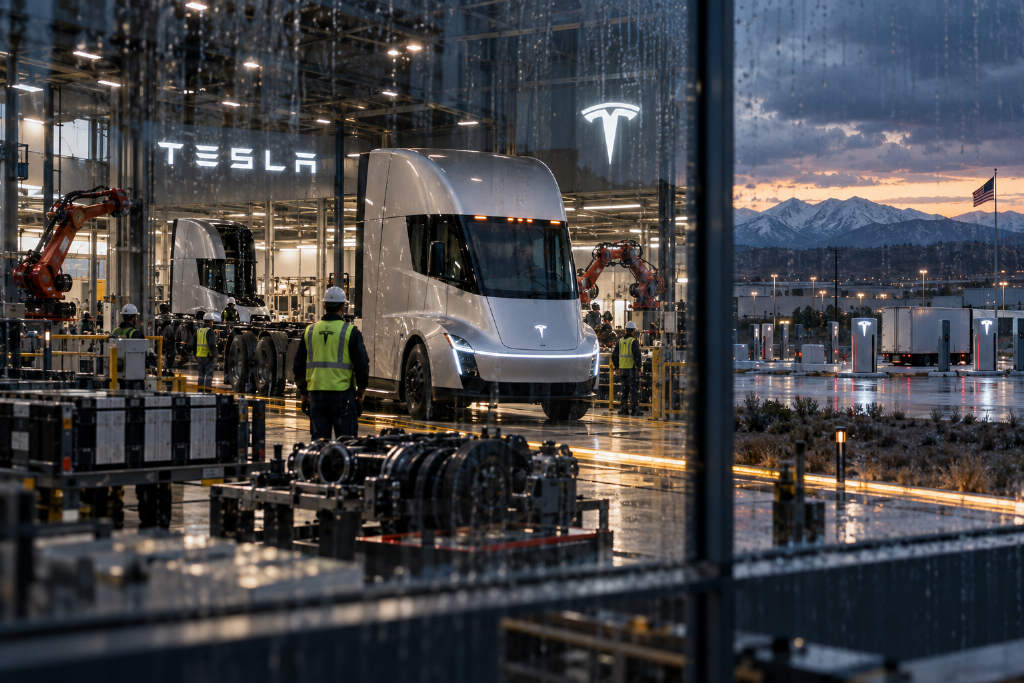
Tesla has begun mass production of its Semi electric truck in Sparks, Nevada, after a delay of about seven years from the company’s original timeline. In a post on its official X account on the evening of Sept. 24 U.S. West Coast time, Tesla wrote, 「Semi is here, Today, we're launching high volume production」. The company said the site is its first dedicated Semi factory, with planned annual capacity of 50,000 trucks, or roughly 1,000 a week.
Production starts years after Tesla’s original target
When Elon Musk unveiled the Semi in 2017, Tesla said production would begin in 2019. The first batch of trucks was not delivered by hand to PepsiCo until late 2022. Vehicles built on a true production line did not roll out until April 2026, putting the program about seven years behind the original promise.
Tesla says four years of redesign changed the battery, drivetrain and steering
Tesla said it spent the past four years redesigning the Semi to improve efficiency and reliability.
The truck’s battery pack moved from 2170 cells to Tesla’s in-house 4680 cells. According to the company, the new setup uses less weight and less energy capacity while keeping the same range, which also lowers cost. On the drivetrain side, Tesla said it switched the rotor to a steel-cage design to improve durability and reduce cost, while the stator now shares its design with the Cybertruck.
Steering is another major change. Tesla described the Semi as the first heavy-duty truck in the industry to use steer-by-wire, removing hydraulic parts that can leak and require maintenance. The company said that makes the vehicle lighter and improves steering precision, while also laying groundwork for future autonomous driving functions.
For thermal management, the Semi uses a next-generation heat pump system called Megamanifold. Tesla said it handles both cabin climate control and powertrain heating and cooling, and can draw waste heat directly from the powertrain to keep the cabin comfortable.
Range, energy use and charging figures
Tesla said the standard-range version can travel 325 miles and the long-range version 500 miles at a gross combined weight of 82,000 pounds. Energy consumption is about 1.7 kWh per mile. The company also said its Megacharger can deliver peak power of 1.2 MW and restore about 60% of range in 30 minutes.
Musk said the Semi waiting list is already sizable and that autonomous driving technology will be added in the future. He also said the truck’s electricity cost per mile is far below diesel.
ZET SCALE coalition announces procurement of 2,500 electric Class 8 trucks
Two days before Tesla announced mass production, the ZET SCALE coalition, launched by Catalyst Mobility and Smart Freight Centre, said it would procure 2,500 electric Class 8 trucks. Founding shippers in the coalition include Microsoft and PepsiCo.
Tesla was named the preferred supplier, while Kenworth, Volvo and RIDE were listed as secondary suppliers. That means the full 2,500-unit procurement will not all be Tesla Semis.
The trucks are set to be deployed over the next several years across 10 freight hubs, including Los Angeles, Houston, Chicago and Atlanta. The report said that scale would bring the number of electric Class 8 trucks on U.S. roads close to doubling.
Dan Priestley, director of the Semi program, said, 「ZET SCALE’s goals are exciting because they can amplify operational advantages to a scaled level.」
Swedish autonomous freight company Einride also placed an order for 500 trucks in August. Together with customers including PepsiCo, US Foods and DHL, Tesla’s order footprint for the Semi is expanding.
Diesel above $6 improves the math, but price and charging remain obstacles
Tesla’s push to scale Semi production comes as diesel prices have made electric trucking look more economical on paper. The U.S. national average diesel price rose to $6.0556 a gallon on Sept. 11, the first time it moved above $6 and a record high. The report linked that move to the U.S.-Iran war pushing up oil prices and tight refining capacity.
Using an estimate of about 7 miles per gallon for a diesel truck, fuel cost works out to roughly $0.86 per mile. By comparison, at 1.7 kWh per mile and typical commercial electricity rates, the Semi’s power cost is about $0.2 to $0.3 per mile.
Still, lower operating cost does not remove the barriers. The International Council on Clean Transportation, or ICCT, estimated the long-range version at about $290,000, while the market estimate for the standard-range version is about $260,000. Compared with the $180,000 price Tesla cited for the long-range version in 2017, the current estimate is about 60% higher.
Charging infrastructure is another constraint. Tesla’s map lists 66 Megacharger sites, most of them still in planning. They are concentrated in California, Texas and the U.S. East Coast, leaving large gaps in mountain regions and across the Great Plains.
Competition is building and the market response stayed cautious
Rivals are moving as well. Daimler’s Freightliner eCascadia is already in production. Volvo and Scania are preparing electric heavy trucks that support the MCS charging standard. Chinese brand Windrose has quoted a price of about $285,000.
Investors reacted cautiously to Tesla’s production announcement. On the next trading day, Tesla shares fell 1.54% to close at $372.11, while the S&P 500 rose 0.51%. BNP Paribas Exane also cut its Tesla price target on Sept. 24 to $268 from $280 and kept its underperform rating.
Michael Berube, chief executive of Catalyst Mobility, put it bluntly: 「Just because the technology is good does not mean the market is there.」