


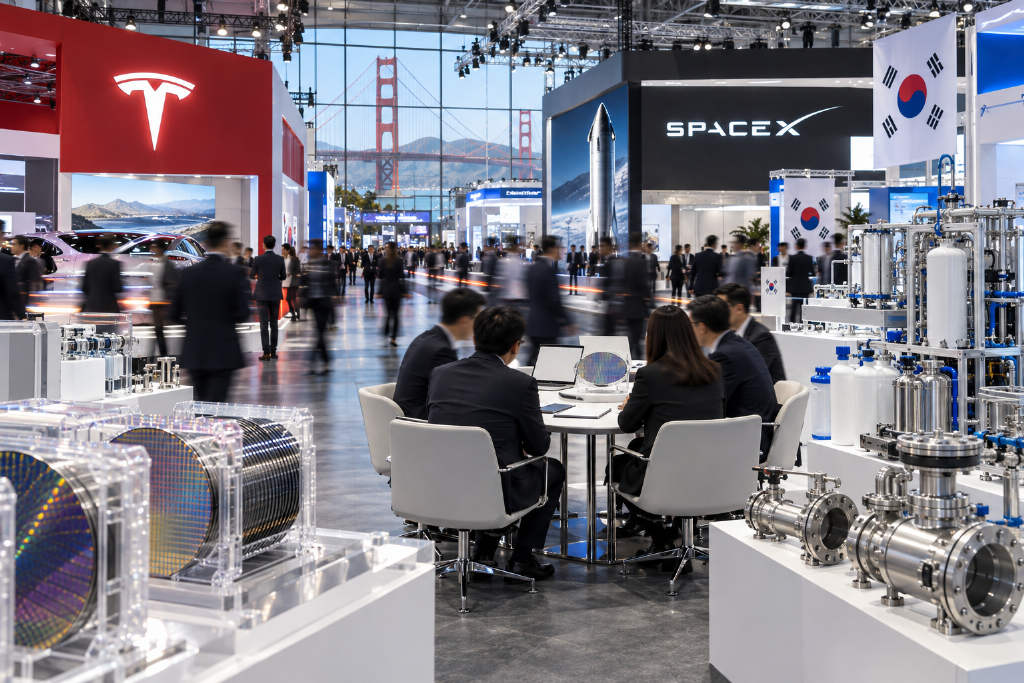
Tesla and SpaceX are approaching South Korean materials, parts and equipment companies for Terafab, a semiconductor manufacturing project, according to a report by South Korean media outlet THE ELEC. Some of the companies have signed non-disclosure agreements and are discussing possible supply categories.
The report said related personnel visited about 10 South Korean company booths at Semicon West 2026 in San Francisco from Oct. 13 to Oct. 15. They reviewed products and production capacity and proposed follow-up talks. A number of those discussions had already been going on for months.
South Korean companies named in the report
THE ELEC said ENF Technology, Asflow and G&G Intech were first-time contacts in this round. The areas discussed were process materials, piping parts and valves, and wastewater reuse equipment, respectively.
Komico, a cleaning subsidiary of Mico, signed a three-party non-disclosure agreement with Tesla and SpaceX about a month ago and discussed cleaning services for a Texas R&D pilot line.
Unisem signed a non-disclosure agreement covering environmental equipment including exhaust gas treatment. Dongjin Semichem was in talks over a Texas thinner plant and materials including phosphoric acid.
Hanmi Semiconductor is discussing thermo-compression bonding equipment. HPSP will supply one high-pressure hydrogen annealing system for the R&D line. Test socket company ISC has exchanged samples and design information.
Terafab project targets
Terafab is located in Texas and was announced in March this year as a joint effort by Tesla, SpaceX and xAI. The report said the independent corporate entity and equity structure have not been disclosed.
The project aims to reach monthly wafer input of 1 million units within 10 years. Initial investment is set at $16.8 billion, and the project is expected to employ more than 3,000 people.
THE ELEC also said SpaceX signed a tax abatement agreement with Texas earlier this month and began construction. Industry expectations cited in the report point to completion of an initial facility with monthly output of 100,000 wafers before 2030.
Initial chip applications
Initial output is expected to be used for Tesla chips for autonomous driving and robotics, as well as chips for SpaceX satellites and space data centers.