
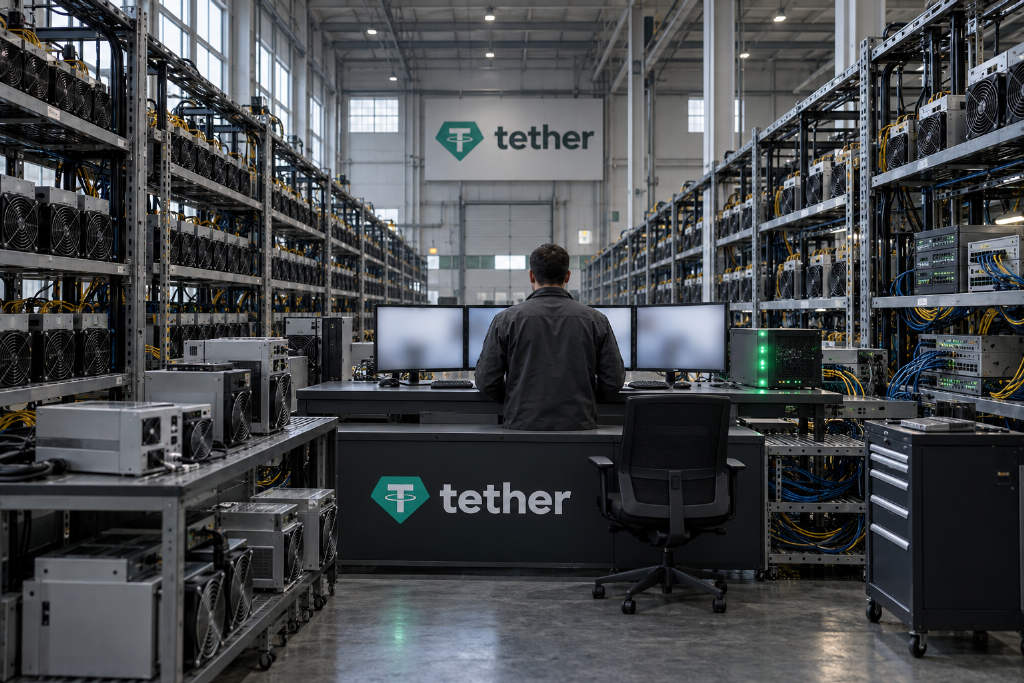
Tether said on Oct. 24 that 15 companies from across the bitcoin mining sector had committed to join its open-source Mining Development Kit, or MDK, to build a common interface for mining equipment worldwide. In the article's framing, the effort is meant to do more than clean up years of fragmented machine management. It is also intended to prepare mining sites for direct AI-driven operations.
Mining has scaled up, but management systems remain fragmented
The article says bitcoin mining is now firmly an industrial business. It notes that network hashrate hit a record of about 1.16 ZH/s, or roughly 1,157 EH/s, in October 2025, then pulled back sharply. In February 2026, it briefly fell to 850 EH/s, about 27% below the peak, before climbing back above 1 ZH/s. On Oct. 22, realized hashrate returned to 1,000 EH/s, while the seven-day average stayed above 1 ZH/s.
That scale has turned mining farms into large industrial data centers. Their management stack, however, still looks far less mature. A single site may run Antminer machines from Bitmain, WhatsMiner rigs from MicroBT and Avalon units from Canaan at the same time. Each vendor typically ships its own firmware, interface and back-end management system, and those systems do not interoperate.
As a result, operators that want to monitor all machines from one screen often have to hire developers and build custom integrations. If they switch mining pools, the code may need to be rewritten. If a manufacturer updates its system version, earlier integrations can break and force another rebuild. The article argues that while mining hardware has advanced for more than a decade, management software is still stuck in a stage where every system speaks a different language, leaving many "smart" workflows dependent on manual oversight.
That helps explain why Tether was able to gather Bitmain, Canaan and MicroBT, along with mining pools including F2Pool, SpiderPool and OCEAN, operators such as Bitdeer and FoundryDigital, and Block-owned Proto and the StratumV2 team under the same initiative. The article presents that lineup as a sign that the industry has grown tired of the current setup.
MDK is designed as a common translation layer
Tether's answer to the problem is a shared translation layer. According to the article, the company open-sourced a mining operating system called MOS in February, then introduced the MDK framework on top of it on April 27.
The framework is built with JavaScript and React and is available free of charge, from home miners to gigawatt-scale sites. Its basic structure is straightforward: each of the 15 participants writes a small plugin called an "MDKWorker" that converts data from its own machines or mining pools into a standard format. Once that is done, a site operator can deploy a top-level control console and manage machines from different brands through a single interface instead of being locked into one vendor's stack.
The article says Tether tried to lower resistance from hardware makers by letting them decide which functions to expose. Participants do not need to replace existing equipment, and they do not have to hand over control of their underlying systems. In that reading, the design preserves core interests for large manufacturers that might otherwise worry about losing technical barriers once interfaces become standardized.
The report also says MDK was upgraded to version 0.11 during the Plan ₿ forum in Lugano, and that Tether plans to release the first stable 1.0 version by the end of 2026.
Tether has already put its QVAC AI agent on the framework
The article argues that Tether's larger goal is not simply to save mining farms from writing custom software. It is trying to create the conditions for AI to run operations directly.
Tether's in-house QVAC mining AI agent is already running on MDK as the first demonstration user. CEO Paolo Ardoino said future software should not merely "watch machines run" but "manage machines on behalf of people." If every machine speaks a different language, he said, AI cannot work at scale.
Under that model, once MDK links machines into one network, operational decisions could shift from human staff to algorithms. The article lists several examples: adjusting power usage when electricity prices move, downclocking overheated machines, and switching batches of hashrate to whichever mining pool is more profitable. Those tasks have traditionally depended on engineers watching screens and making manual calls. The proposed setup would let AI issue those instructions automatically and much faster.
Three obstacles stand out
The article also says the plan still faces at least three major hurdles.
The first is that the 15 companies have only made a commitment. In Tether's Oct. 24 announcement, the companies were described as having committed to join, but no figures were given for how many machines have already installed the system, what share of global hashrate it covers, or how much money it has saved operators. Moving from a public commitment to code deployed across large fleets of miners still requires technical work and commercial negotiation.
The second is that industry standards are not set by announcement alone. The article notes that mining has seen multiple standardization attempts before, many of which did not stick. It points out that the StratumV2 team, which appears on the participant list, has its own work around mining pool protocol standardization. With more than one standards effort under the same roof, it remains unclear whether the result will be cooperation or rivalry.
The third, and in the article's view the most sensitive, is the security risk of letting AI manage mining farms directly. Industry media outlet CryptoSlate raised a pointed question: if the CEO wants AI to operate mining farms directly, who sets the boundaries of that AI's authority? Mining farms run physical industrial equipment and consume real electricity. If an AI system that can coordinate hashrate across brands contains a software flaw or is compromised by hackers, the consequences would not be limited to software. The article says the downside could include damaged equipment or even disturbances to the power grid.
It also cites an industry view that Tether's approach is too centralized for the bitcoin ecosystem and that these large companies may not fully cooperate in practice. In that view, a genuinely useful contribution would require an open-source and decentralized solution.
Tether is making a bet on mining infrastructure software
The article closes by arguing that Tether's strategy is fairly clear. Backed by interest income from issuing USDT, it is putting money into the software layer beneath bitcoin mining. It does not manufacture mining machines or build mining farms, but it wants to become the infrastructure manager that operators cannot avoid.
The piece says large-scale AI automation in mining will require common standards first. Bitcoin mining, built around machines, electricity and digital control systems, is naturally suited to algorithmic management. Even so, if Tether succeeds in laying that groundwork and AI moves into the driver's seat, operators will still need to answer a basic question: whether the steering wheel remains in their hands.


