
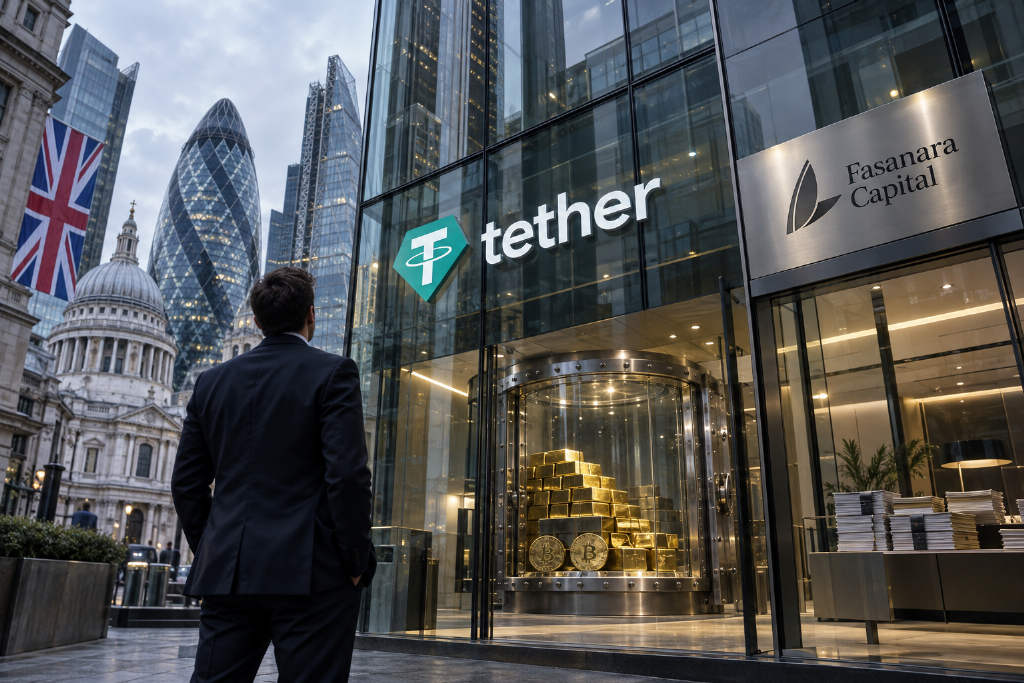
Tether and Fasanara Capital have rolled out StableFund, a private credit fund seeded with a combined $400 million from the two sponsors, and they want to pull in as much as $3 billion from outside institutions. Tether said it will serve as a co-sponsor, bring in financing opportunities linked to USDT, and supply the stablecoin settlement rails.
Fasanara Capital, based in London, is a global asset manager founded in 2011 and co-founded by Francesco Filia. The firm oversees about $6 billion in assets and centers on fintech-led private credit strategies. StableFund is domiciled in the Cayman Islands and will lend to fintech platforms in more than 60 countries, spanning small-business loans, consumer credit, trade receivables, and supply-chain finance.
The launch announcement never said how much of that $400 million came from Tether. And Tether did not reveal the number later, either.
Excess reserves fell by $4.12 billion in one quarter
Six weeks before StableFund was announced, Tether released its reserve report on July 31 for the period ending June 30. It showed total assets of about $187.75 billion and total liabilities of about $183.64 billion. The difference, $4.11 billion, is what Tether labels excess reserves: the amount by which reserve assets top liabilities.
On March 31, that figure was $8.23 billion. So in a single quarter, excess reserves dropped by $4.12 billion, a 50.1% slide. Over that same stretch, liabilities changed by just $106 million.
The article argues those figures, taken together, point away from redemptions as the main driver of the decline and toward valuation losses on the asset side.
Gold and Bitcoin were the main pressure points
Tether called the quarter “strong” in its release. But it did not explain what caused the fall in excess reserves. The article says the answer sits in auditor BDO’s report.
As of June 30, Tether’s reserve assets included:
- $114.96 billion in U.S. Treasuries
- $25.6 billion in reverse repos
- $40.3 million in cash and bank deposits
- $18.84 billion in precious metals
- $5.8 billion in Bitcoin
- $3.76 billion in publicly listed equities
- $5.24 billion in other investments
- $13.45 billion in secured loans
The article also says a $6.5 billion money market fund position that existed at the end of 2024 had been fully exited.
It points to gold and Bitcoin as the biggest source of the decline. Using the prices BDO applied, gold dropped from $4,668.06 per ounce on March 31 to $4,008.02 on June 30, a 14.1% fall. Bitcoin went from $68,200 to $58,600 over the same window.
Together, gold and Bitcoin made up $24.6 billion, while excess reserves were only about $4.1 billion. On that math, a 17% move in those two assets would be enough to erase the entire excess reserve buffer.
The article says BDO’s equity bridge shows it more plainly: group equity began the year at $6.34 billion, first-half financial results came in at negative $3.17 billion, and after adding $943 million in capital, equity finished at $4.11 billion.
For a company whose gold and Bitcoin exposure is about six times its surplus, the article says, a 2.2% buffer does not leave much room. It also follows the excess-reserves-to-liabilities ratio over time: 3.5% a year earlier, 5.2% at the end of 2024, and 2.2% as of June 30, 2026.
Secured loans remain inside reserves despite an earlier pledge
The piece also zeroes in on Tether’s secured loan book, meaning loans Tether made to borrowers against collateral.
In December 2022, after FTX collapsed, Tether said: “From now on, throughout 2023, we will reduce secured loans in reserves to zero.” That was a pledge to take secured loans in reserves down to zero over the course of 2023. At that point, those loans stood at $6.1 billion.
The later figures listed in the article are: $4.8 billion one year later, $8.19 billion at the end of 2024, $17.04 billion at the end of 2025, and $13.45 billion as of June 30, 2026. Tether called the latest $2.38 billion reduction a “15%” cut.
At the June level, $13.45 billion in secured loans was 3.3 times larger than the $4.1 billion excess reserve buffer.
BDO did not identify the borrowers or say what kind of collateral was posted. The article says BDO described the loans as “overcollateralized and regularly monitored,” while the prior three reports used the wording “fully collateralized by liquid assets.” It treats that wording shift as meaningful.
The timeline matters to the article’s argument. Excess reserves hit a record in the first quarter, got cut in half in the second, Tether was still trimming loans it had promised three years earlier to eliminate, and then in the third quarter it launched a new lending fund.
StableFund is not the only lending-related activity
The article says StableFund is not Tether’s only fresh lending business. Bloomberg reported this month that, as of the end of June, U.S. precious metals dealer Gold.com owed Tether about $1.45 billion, with Tether supplying most of the financing for the dealer’s $1.7 billion precious-metals leasing activity.
It also says Tether stated in November that it had extended about $1.5 billion in commodity trade finance and planned to “significantly expand.” In June, Tether and lending platform Ledn, in which Tether has invested, said holders of the XAUT gold token would be able to borrow against it later this year.
Tether’s line is that its investments are “funded by the company’s excess capital and profits and are fully segregated from USDT reserves.” The article adds that secured loans are inside reserves, while the StableFund commitment probably sits outside them, but says neither the StableFund release nor the June reserve report stated that outright.
The issue raised is not only concentration, but overlapping roles
The article says Fasanara itself is not the issue. The firm was co-founded in London in 2011 by Francesco Filia, manages more than $6 billion, and has spent a decade lending through fintech originators, which fits the business described for StableFund.
Even if Tether’s contribution to the fund is in fact segregated from USDT reserves, and even if every dollar comes from group equity, the article says the concern still does not go away. Why? Because Tether occupies several positions in the structure at once: it originates loans, advises the fund that holds them, and issues the token used to move money across rails it operates itself.
Filia described Tether’s value in the structure as “the world’s largest stablecoin network, a crypto-native investor base with huge capital capacity, and the USDT rails.” He told GTR the loans can stay in fiat, and that “the loans themselves and the fund equity do not need to be tokenized.” In that arrangement, the token is used only to move funds.
The article argues that if StableFund loans run into trouble — spread across 60 countries, tied to consumer and small-business credit, and originated through 141 fintech partners working with Fasanara — Tether could face reputational pressure to support them. And for a company carrying a 2.2% buffer, it says, any decision to provide that support turns into a reserve question no matter which account the money comes from.
Over the 90 days through Sept. 22, USDT circulating supply fell by about $2.8 billion, or 1.5%. The article says that is not a run, and that the third-quarter reserve report will show how excess reserves held up over the same period.
How the GENIUS Act frames the issue
The article also sets StableFund against the U.S. stablecoin rulebook. The GENIUS Act was signed on July 18, 2025, and it limits reserve assets for permitted payment stablecoin issuers to cash, insured deposits, U.S. Treasuries with remaining maturities of no more than 93 days, overnight repos, government money market funds, and similar instruments.
It points to Section 4(a)(2), which says reserves cannot be directly or indirectly pledged, rehypothecated, or reused by a permitted payment stablecoin issuer, except in narrow cases. Treasury’s proposed issuance rules were published on Aug. 18, comments are due by Oct. 19, and the law is expected to take effect on Jan. 18, 2027.
Tether’s answer is USAT, a separate token issued through Anchorage Digital Bank starting Jan. 27 and meant to satisfy compliance requirements. That same release said USDT is “moving toward” compliance.
The law sets two dates the article singles out. Under Section 3(b), U.S. digital asset platforms would be barred from offering non-compliant stablecoins three years after enactment, on July 18, 2028. Under Section 18, foreign issuers can enter the U.S. market after Treasury decides their home-country regime is comparable.
The article says StableFund looks like the kind of structure this rule is built to stop, just assembled one layer outside the rule itself. But it adds that the GENIUS Act does not bar a foreign issuer’s parent company from using its own equity to launch private credit. What it does bar is using reserves for that purpose. That is why the undisclosed figure — how much Tether contributed to the $400 million and where that money came from — matters more than the fund’s headline size.
Stablecoin issuers promise redemption at par. When valuations swing the wrong way, the article says, that promise rests on surplus. At the end of June, Tether’s surplus was $4.1 billion, half the March figure.
What to watch in the third-quarter reserve report
The article says Tether’s third-quarter reserve report is expected around the end of October and flags three main things to watch:
- Whether excess reserves recover alongside a rebound in gold prices. If gold and Bitcoin rise, the buffer could rebuild. If they keep dropping, pressure would grow.
- Whether secured loans keep shrinking or begin climbing again. Tether pledged three years ago to reduce them to zero, but the balance later expanded.
- Whether the StableFund commitment shows up in reserve disclosures or only in group-level reporting. That would decide whether a firewall exists between the fund commitment and USDT reserves.
The article adds two more follow-up questions. First, KPMG said on Aug. 13 that its 2025 audit found surplus that was $476 million higher than BDO’s figure for the same date, and Tether has not explained the basis for that gap. Second, Treasury’s comparability decision for foreign issuers under Section 18 will shape whether USDT can enter the U.S. market after 2027, while opening a separate question too: whether an issuer that sponsors private credit through a fund it advises is comparable to one that would not be allowed to do that.
Tether’s second-quarter release said reserves were strong. The article ends on a tighter point: the value of a buffer gets tested when reserves stop looking strong. In its account, Tether lost half that buffer in one quarter and then answered by sponsoring private credit.