

Bloomberg reported that the GENIUS Act, the first federal U.S. law to set rules for stablecoins, was reshaped during negotiations in ways that favored Tether, the world’s largest stablecoin issuer.
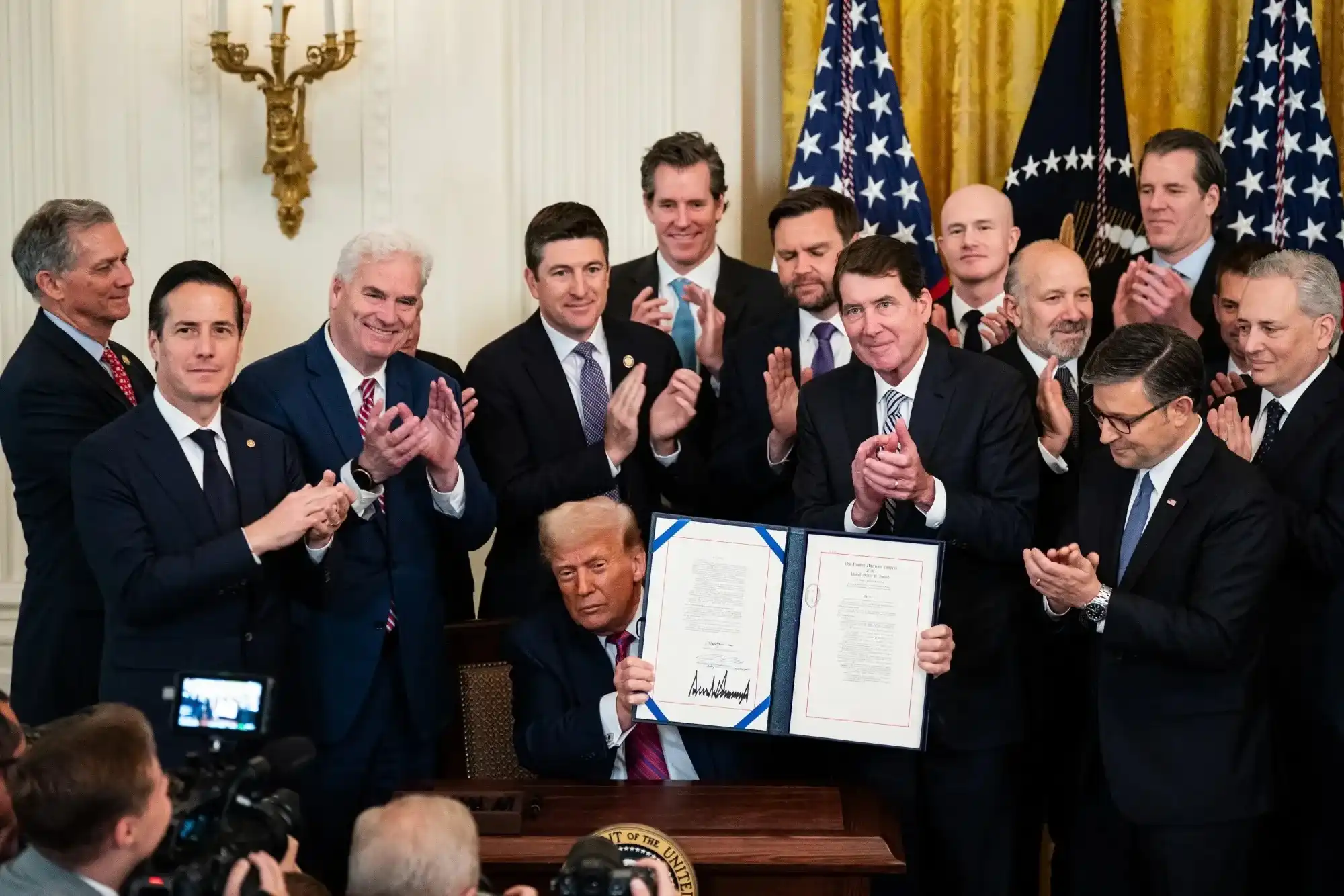
The law was treated as a major milestone for the crypto industry and as the first legislative win tied to Donald Trump’s push to make the United States the “crypto capital” of the world. One year earlier in the same month, Trump signed the GENIUS Act into law in the East Room of the White House and called it a key step toward bringing digital assets into mainstream U.S. finance.
The statute created a federal regulatory framework for stablecoins in a market Bloomberg described as worth $300 billion. It requires issuers to disclose accounts, guard against financial fraud, and aims to place stablecoin firms under U.S. oversight regardless of where they are registered, responding to long-running concerns that criminals, terrorist groups and sanctioned entities have used stablecoins to move funds.
But interviews, court documents and lobbying records reviewed by Bloomberg describe a different story behind the bill’s final text. The report says that in the months around Trump’s return to office, advisers Howard Lutnick and Bo Hines worked behind the scenes to weaken some restrictions and secure language that helped Tether. People involved in the talks told Bloomberg that Lutnick and Hines had outsized influence over the bill’s direction. Dozens of executives, lobbyists and current and former U.S. officials who spoke for the report asked not to be named because they were not authorized to discuss the negotiations publicly.
Bloomberg said its reporting also shows how policy making in the administration became intertwined with the financial interests of officials. Over an 18-month period starting in 2024 and extending shortly past the law’s passage, Tether executives completed a series of commercial moves, while both Hines and Lutnick later received substantial benefits tied to the company.
How the final bill differed from earlier proposals
According to Bloomberg, the final GENIUS Act departed in significant ways from bipartisan drafts circulated in 2023 and 2024. Those earlier efforts would have required foreign stablecoin issuers such as Tether to submit to U.S. regulatory review and comply fully with U.S. anti-money-laundering standards if they wanted to operate in the American market.
The enacted bill relaxed that approach. One provision criticized by opponents as a “reciprocity loophole” says that if the U.S. Treasury secretary determines that El Salvador’s standards are broadly equivalent to those in the United States, Tether’s USDT could remain under Salvadoran supervision rather than direct U.S. oversight. Tether is planning to move its headquarters to El Salvador, and the implementing details for any equivalence determination are still being drafted.
Another change narrowed the responsibility of stablecoin issuers in decentralized finance, what people in the industry described to Bloomberg as a “DeFi loophole.” Under that approach, issuers do not have to track misuse of tokens in secondary DeFi markets. Users can move tokens peer to peer on blockchain networks without going through banks or exchanges and without verifying identity or stating the purpose of funds.
The law also set a three-year compliance transition period for issuers entering the U.S. market. Bloomberg said some Democrats sought to shorten that period to 18 months, but Tether pushed to keep the full three years. People familiar with the talks said Bo Hines stepped in at a critical point and treated the issue as a White House red line. Three people told Bloomberg that Hines explicitly said the three-year transition could not be given up.
Financial policy specialists told Bloomberg that those provisions could undercut U.S. efforts to fight money laundering by criminals and sanctioned actors. Timothy Massad, a former Treasury assistant secretary in the Obama administration and chair of the Commodity Futures Trading Commission from 2014 to 2017, said the gaps could create unfair competition by forcing U.S. firms to bear higher compliance costs while allowing offshore issuers to avoid tougher anti-money-laundering requirements. He also warned that this could weaken the dollar’s position as the world’s reserve currency.
“If we want the dollar to continue as the world’s central reserve currency, we can’t allow terrorists, sanctioned people and criminals to move dollar funds anonymously,” Massad said.
USDT, illicit finance concerns and the law’s practical effect
Any currency can be used illegally, but Bloomberg noted that Tether has faced scrutiny since launching USDT in 2014 because critics said it did not do enough customer due diligence. The company had long argued that operating offshore protected it from what it viewed as excessive U.S. regulation. That position later shifted. In December 2023, Tether adopted a policy to freeze wallet addresses linked to individuals and entities on the U.S. Treasury sanctions list.
Bloomberg said investigators have continued to gather evidence that USDT was used in Mexican fentanyl trafficking and in efforts to help Russia evade sanctions. A January 2024 United Nations report said USDT was the preferred tool of crypto-laundering groups in Southeast Asia. Two people familiar with the matter also said the Biden administration’s National Security Council discussed banning Tether tokens from the U.S. market in 2024.
That option was eventually shelved. According to Bloomberg, law-enforcement officials said illicit USDT flows could still be traced onchain, and federal agencies had come to see Tether as more willing to cooperate in freezing assets tied to investigations.
A Tether spokesperson said the company had built “one of the most effective law-enforcement collaboration mechanisms in global finance” and said the company is committed to fighting financial crime. Tether added that the GENIUS Act would strengthen that work.
Even so, Bloomberg said USDT continued to appear frequently in illicit activity during the legislative debate and after the law passed. Data from blockchain analytics firm Elliptic showed that Iran’s sanctioned central bank bought $507 million worth of USDT in 2025. In July of that year, the same month Trump signed the law, Elliptic tracked nearly $2.5 billion in USDT moving into wallets tied to Russian-linked firms that the U.S. Treasury said helped parties evade sanctions through cross-border channels.
Elliptic also found that more than $4 billion worth of USDT circulated this year in black markets run by Chinese-speaking scam networks and used in pig-butchering schemes, impersonation scams and sextortion. Court records cited by Bloomberg show that from July 2025 onward, federal prosecutors across the United States filed dozens of actions seeking to seize at least $172 million in USDT connected to alleged crimes.

Bloomberg added that Tether has more than twice the circulation of its biggest rival, Circle Internet Group Inc., while employing fewer than half as many people. Much of its suspicious-activity review work is outsourced. Tether declined to disclose the size of its compliance staff but said it works regularly with authorities in 67 jurisdictions and more than 340 law-enforcement agencies to identify, freeze and help recover assets tied to illegal activity.
Howard Lutnick, Cantor Fitzgerald and Tether
Before becoming Trump’s commerce secretary, Howard Lutnick was chairman and chief executive of Cantor Fitzgerald. The Wall Street firm has managed Tether’s reserves since 2021. Bloomberg, citing lobbying records, federal court complaints and a person familiar with the matter, said Lutnick acted as a crisis manager for Tether throughout 2024, helping blunt negative coverage and lobbying lawmakers against bills the company opposed.
Independent audits are a central issue for investor trust in stablecoins, yet Tether has never published a full independent audit of its reserves. In 2021, Tether and its affiliated exchange agreed to pay $61 million to settle allegations brought by federal regulators and New York authorities that Tether had misrepresented its reserves and misled investors. Tether did not admit wrongdoing in the settlements. Under the GENIUS Act, stablecoin issuers must provide annual audits. Tether said this year that it had hired an audit firm, but it has not released a timeline for a complete report.
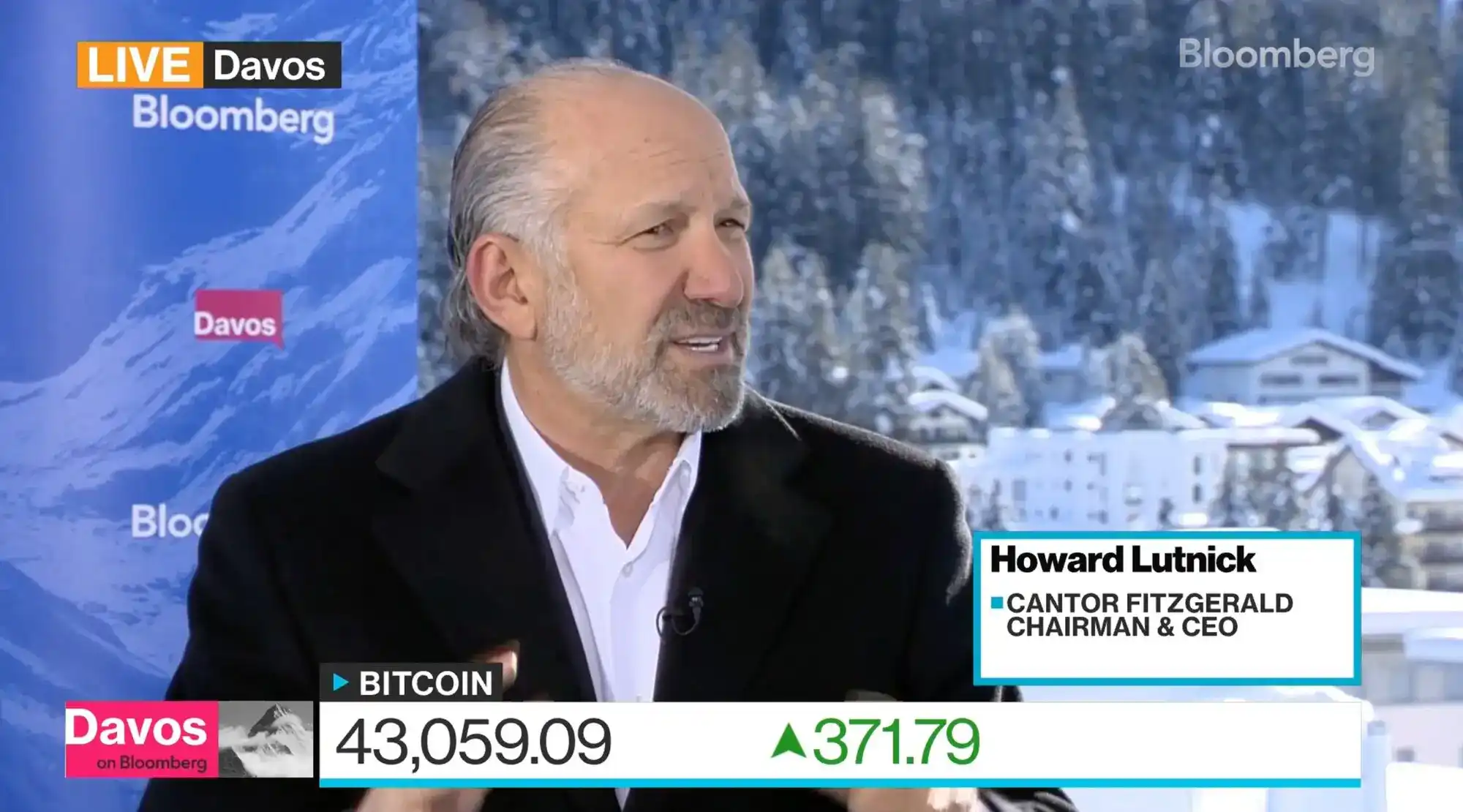
As questions about Tether’s reserves persisted, Lutnick publicly defended the company. In January 2024, at the World Economic Forum in Davos, he said on Bloomberg Television: “They have the money they say they have.”
The next month, he traveled to El Salvador and met Tether Chairman Giancarlo Devasini and President Nayib Bukele, who has promoted the country as crypto-friendly. Tether later announced plans to move its headquarters to San Salvador.
In April 2024, Cantor Fitzgerald spent $600 million on convertible debt that gave it the option to acquire a 5% stake in Tether. The transaction was not disclosed publicly until after Trump’s election victory in November 2024. Based on Tether’s own financial results and valuation methods applied to listed financial firms, Bloomberg said Tether could have been worth at least $130 billion, given net profit of about $13 billion in 2024. On that basis, the paper value of the 5% interest would have exceeded $6 billion.
Bitcoin entrepreneur Cory Klippsten, who met with Tether executives and Lutnick in 2024, said Devasini described the price as “ridiculously cheap.”
Klippsten later became embroiled in litigation with Tether. Court papers say he accused Tether executives of poaching employees, stealing code and trade secrets, and breaking a business agreement. Tether countersued and accused Klippsten of improperly using Tether investment as collateral in other transactions. During the case, Klippsten sought testimony from Lutnick and documents involving Cantor Fitzgerald and Tether. Lutnick’s lawyers argued in court that the commerce secretary had nothing to do with the dispute and that the request was meant only to “harass” and “embarrass” him.
In a March filing, Klippsten said he had kept a complete record of his conversation with Devasini, including the “ridiculously cheap” remark. That filing advanced the argument that Cantor’s convertible-debt investment was effectively hidden compensation for Lutnick’s role as Tether’s advocate in Washington and in the media.
As part of the federal ethics agreement required of Cabinet officials, Lutnick had promised to sell his Cantor Fitzgerald holdings and recuse himself from matters involving conflicts of interest. A Commerce Department spokesperson did not respond to the detailed allegations in the Bloomberg report but said Lutnick complied with his ethics commitments, divested all related assets including those tied to Tether, and “did not work on any stablecoin-related provisions of the GENIUS Act.”
Why earlier stablecoin legislation failed
Suspicion of Tether in Congress long predated the GENIUS Act. At the end of 2023, Republican Senator Cynthia Lummis of Wyoming signed a public letter urging the Justice Department to examine whether Tether had provided material support to Hamas and other terrorist groups during the October 2023 attacks in Israel.
In April 2024, Lummis and Democratic Senator Kirsten Gillibrand of New York introduced a bill that would have required every stablecoin issuer operating in the United States to follow U.S. anti-money-laundering rules and disclosure standards. Lummis said plainly at the time that Tether would need to comply with American law if it wanted access to the U.S. market. In comments to CoinDesk after the bill was released, she said that if Tether chose to stay offshore and accept another regulator, that was a business decision, but if it wanted recognition in the U.S. market, it should meet U.S. compliance standards.
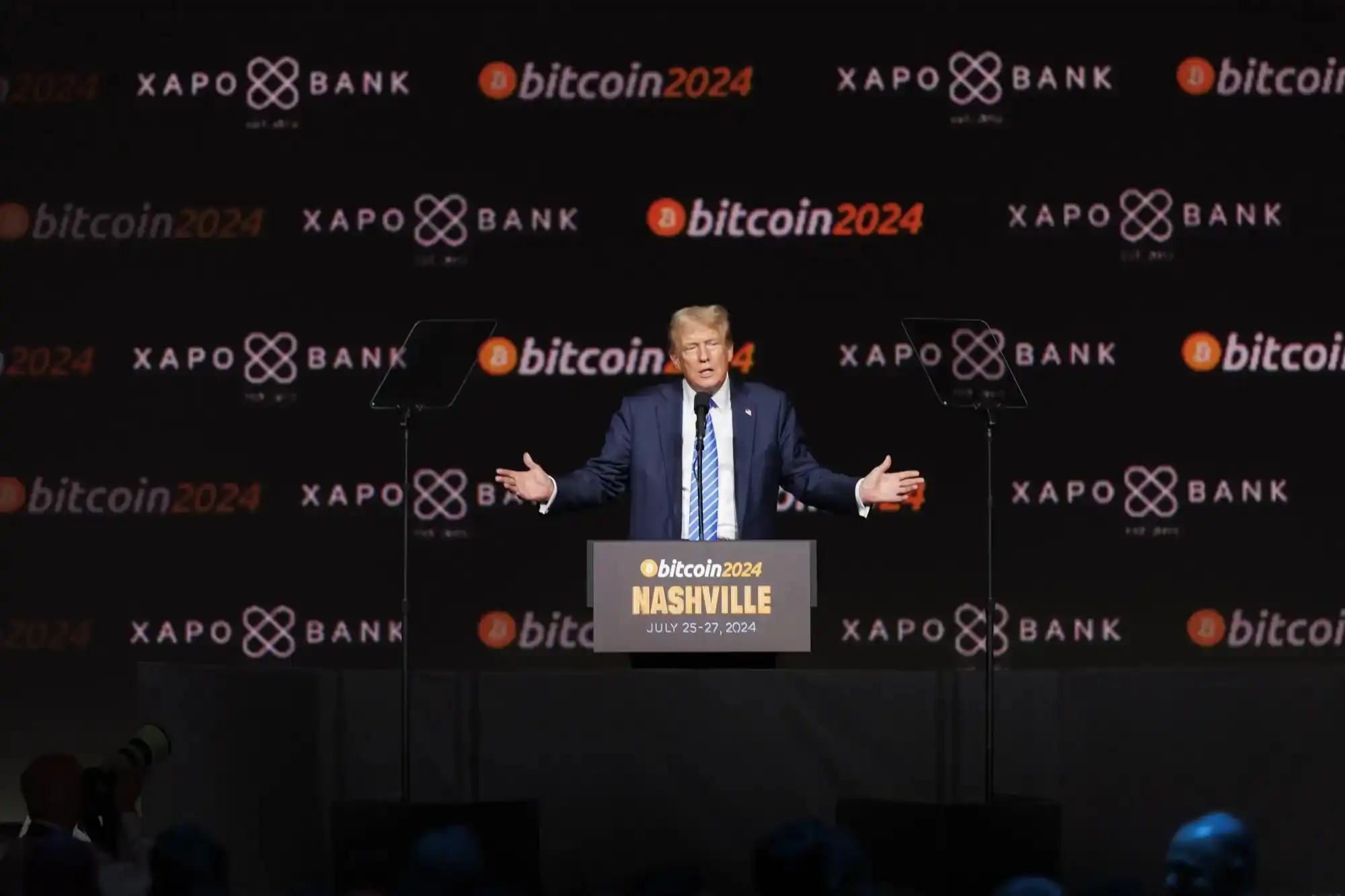
In July 2024, at the Bitcoin conference in Nashville where Trump delivered a keynote speech, Lutnick again spoke up for Tether. He told the audience, “We would never work with any company involved in jihadist terror. I find that utterly disgusting.” He reminded listeners that Cantor Fitzgerald lost more than 650 employees in the 2001 attacks on the World Trade Center, including his brother.
After that speech, Trump invited Lutnick onto his campaign plane and named him co-chair of the presidential transition committee. Bloomberg said Cantor Fitzgerald’s lobbyists kept meeting with lawmakers in Washington on several pending stablecoin bills. People familiar with the meetings said Lutnick discussed with then-House Financial Services Committee Chairman Patrick McHenry how a new law would affect foreign issuers such as Tether. McHenry declined to be interviewed.
In September 2024, Lutnick also met with Lummis. A spokesperson for the senator said the meeting focused on transition planning and only briefly touched on her concerns about Tether and financial crime. The spokesperson added that nobody tried to persuade Lummis to abandon her bill and that Lutnick or his team never pressured her to change its language.
Still, court documents quoting notes preserved by Klippsten said Devasini told him: “Howard told me he has blocked all the stablecoin and crypto bills. Congress still has time before recess, and Howard thinks nothing harmful to us will pass.”
Those earlier bills died. The next year, both Lummis and Gillibrand voted for the GENIUS Act, including its allowance for foreign issuers operating under reciprocal regulation. A spokesperson for Gillibrand declined to comment on her vote. A spokesperson for Lummis said lawmakers often support bills that do not fully match their ideal version. This year, Lummis is leading Senate work on a broader regulatory framework for crypto assets beyond stablecoins.
Tether’s growing ties to Trump’s business orbit
Bloomberg laid out a sequence of business moves by Tether over roughly 18 months.
- In April 2024, Tether gave a Lutnick-controlled financial institution the right to buy equity in the company that Bloomberg said was worth several billion dollars, in exchange for $600 million.
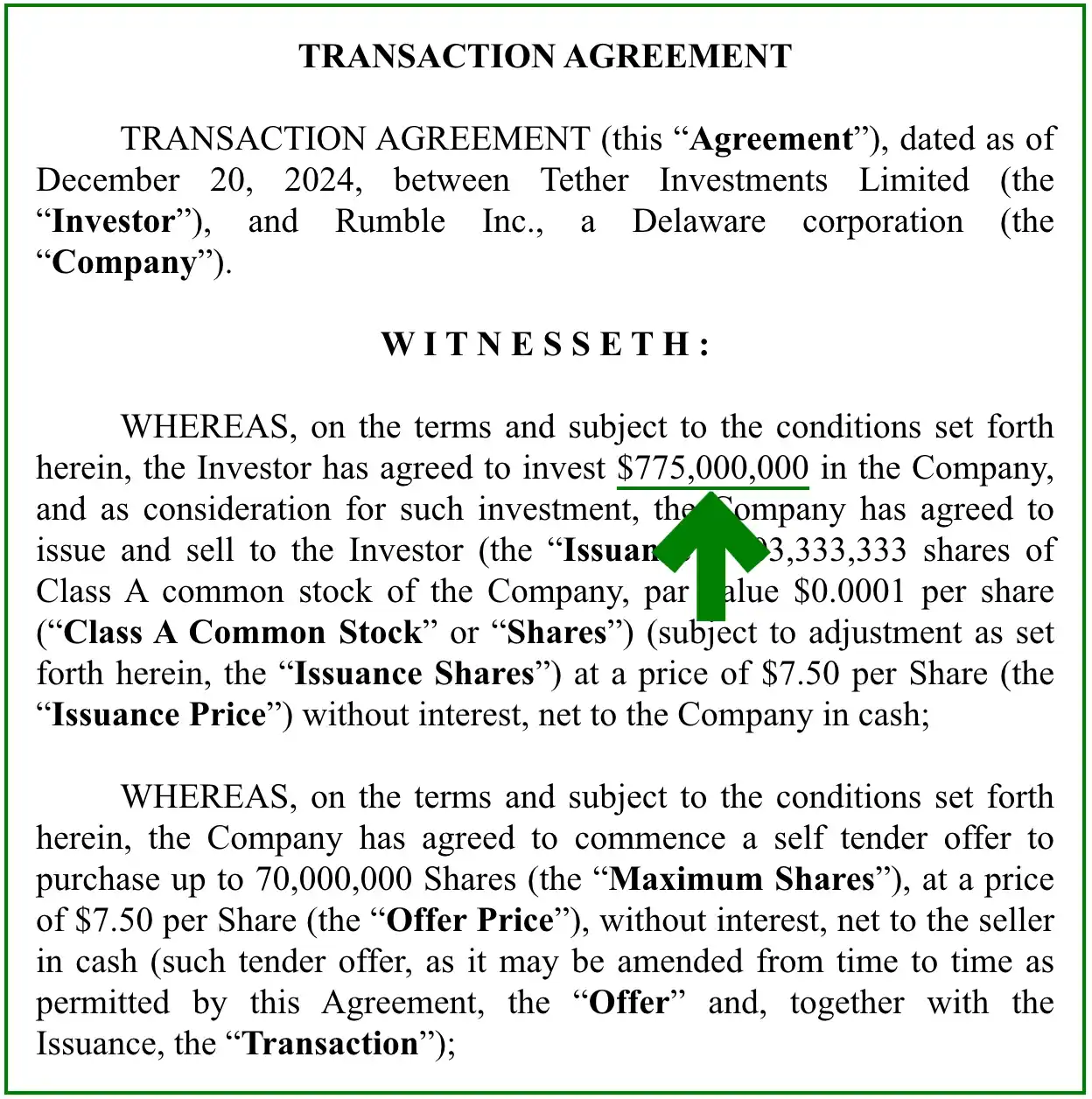
- In December 2024, Tether invested $775 million in loss-making Rumble Inc., a streaming company tied to Trump’s Truth Social platform and backed by several Trump allies.
- In August 2025, one month after the bill was signed, Tether hired Bo Hines into an executive role.
- In October 2025, Tether extended a loan to a trust benefiting Lutnick’s children as they were buying several billion dollars’ worth of their father’s business assets.
The Rumble investment drew particular attention. Under a Dec. 20, 2024 agreement filed with the U.S. Securities and Exchange Commission, Tether Investment Limited agreed to invest $775 million in Delaware-based Rumble Inc. The company would issue 103,333,333 Class A shares at $7.5 each, while also launching a voluntary tender offer to buy back up to 70 million shares at the same price.
Bloomberg said the timing stood out because Rumble had accumulated losses of $338 million. The platform describes itself as a free-speech alternative to mainstream video sites. Its investor base included several Trump allies who later joined the second Trump administration, including Vice President JD Vance, former FBI deputy director Dan Bongino and former White House AI and crypto adviser David Sacks.
After the Tether investment was announced, Rumble shares jumped. The stock closed at $16.27 on Dec. 26, up 126% from the day of the announcement. The company has since been renamed RUM Group. Bloomberg reported that $525 million of Tether’s cash, about 68% of the total, was used to repurchase shares from core management. Tether later increased its position, which is now worth about $875 million.
Tether Chief Executive Officer Paolo Ardoino said at the time that the investment reflected a shared belief in decentralization, transparent operations and free speech. The company also said about $250 million would go toward expansion efforts, including development of a crypto payments platform.
Bo Hines takes over the final push
As Trump’s second administration was taking shape, the White House handed stablecoin legislation to Bo Hines, a former college football player who said his first exposure to crypto came when he played in the 2014 Bitcoin St. Petersburg Bowl.
Bloomberg wrote that Hines entered Washington without the experience of the executives and congressional aides he would soon be negotiating with. But he fit what the Trump White House valued: camera-friendly presentation, loyalty to the MAGA movement, and a public record of rejecting the 2020 election result. In the fall of 2024, a company he ran with his father spent $1 million on billboards supporting a political action committee that backed Trump’s campaign.
Trump appointed Hines to lead the new Presidential Council of Advisers for Digital Assets. His portfolio included studying a federal crypto reserve, drafting digital-asset policy guidance and, above all, pushing the GENIUS Act through Congress.
By early February 2025, draft bill text was circulating in Washington. Later that month, crypto executives and lawmakers met at the Willard Hotel to discuss the proposal. Two attendees told Bloomberg that Paolo Ardoino appeared there unexpectedly and told people in the room that Tether was taking anti-money-laundering obligations seriously.
In March, Ardoino posted photos on social media showing visits to Congress and the White House. He told The New York Times that after Lutnick formally became commerce secretary in February, he deliberately avoided meeting him to steer clear of a possible conflict of interest.
That same month, Tether hired Washington lobbyist Jeff Miller. Bloomberg said Miller had represented Cantor Fitzgerald on stablecoin matters since 2024 and had served as a key member of Trump’s inaugural committee in two cycles. In 2025, Miller Strategies received a total of $570,000 in fees, with Cantor paying $480,000 and Tether paying $90,000. Ardoino said in a Bloomberg Television interview, “It’s important that the industry’s views are heard.”
At the same time, Hines kept pressing lawmakers and negotiators. People familiar with the talks said he believed Congress had no authority to go against the president’s wishes and pushed hard for a quick agreement. He also argued that the market overstated the risk that digital tokens are used in crime. In an April interview with Bitcoin Magazine, Hines said, “It’s not very smart to use digital assets to commit crimes. In most cases, the record is publicly traceable.”
The earliest version of the GENIUS Act already angered some of Tether’s competitors and Democratic lawmakers because the restrictions were lighter than in multiple 2024 drafts. In May 2025, a group of Democrats, including some seen as moderate on crypto policy, temporarily blocked the bill.
Two people told Bloomberg that Senator Chuck Schumer urged colleagues in a Democratic closed-door meeting to review material assembled by the Biden administration’s national security team on Tether’s operations, so that the bill would include enough safeguards against money laundering by U.S. adversaries through crypto channels.
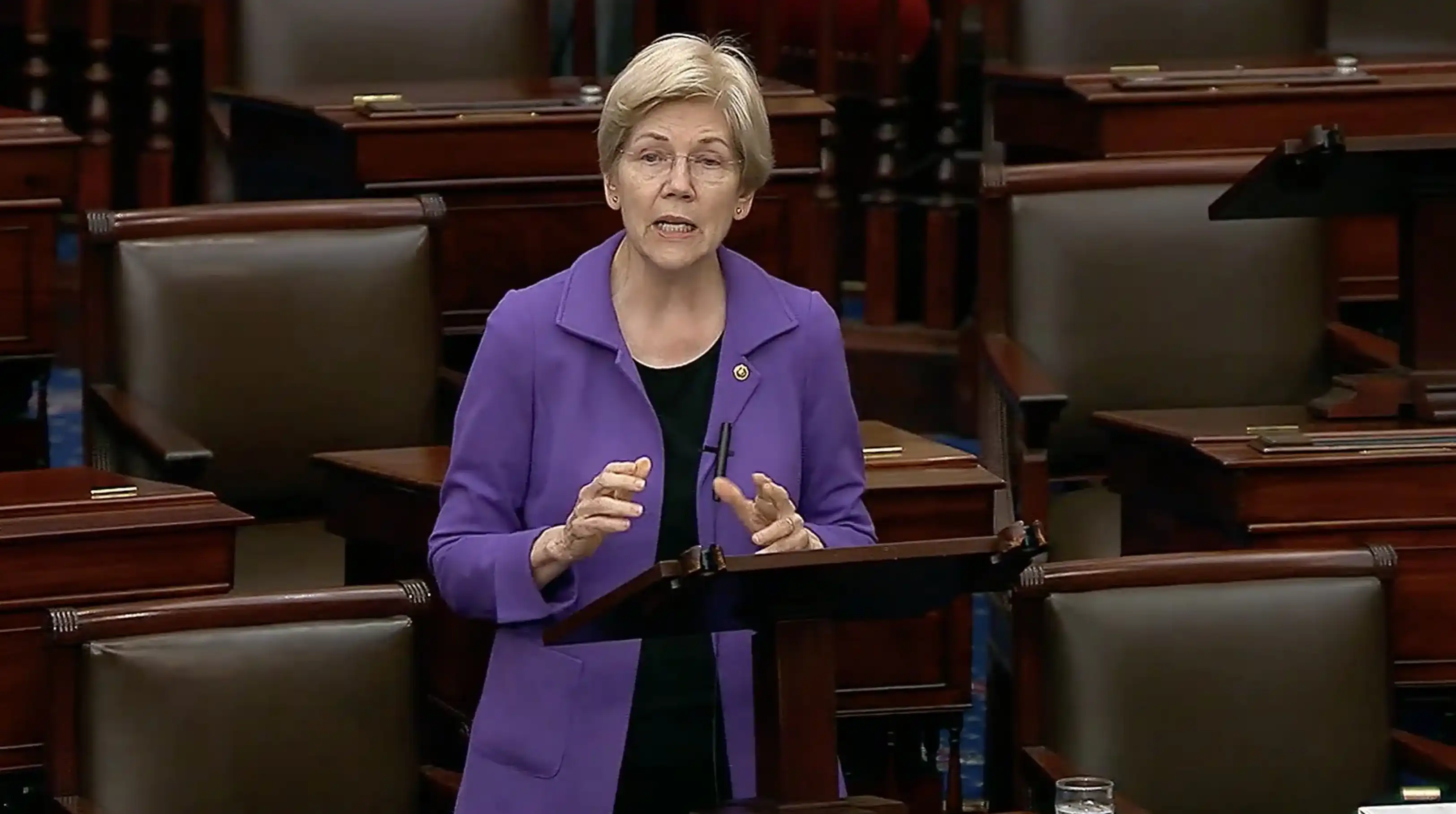
That same month, Senator Elizabeth Warren of Massachusetts called on fellow Democrats to vote down the latest version, saying it deliberately loosened oversight and benefited Tether.
People familiar with the matter said Hines brushed off those concerns and repeatedly invoked Trump’s desire to see the bill enacted quickly. Republican leaders in Congress kept the measure moving.
The last major fight centered on the transition period. In private talks, Hines insisted Republicans could not abandon the three-year grace period and rejected the Democratic proposal for 18 months. In multiple internal meetings, he said clearly that this was what Tether wanted, according to people who heard the discussions.
After the signing: appointments, loans and paper wealth
Trump signed the GENIUS Act at the White House on July 18, 2025, calling it “a major advance in strengthening America’s dominance in global finance and crypto technology.” Supporters of the bill were gathered in the room.
During the ceremony, Trump looked out at the crowd and said: “Where’s Bo Hines? Hi, Bo! Bo was a great football player, right? One of the top college football players in the country. That’s how I got to know him.” Hines stood for applause and sat back down. Directly in front of him sat Tether CEO Paolo Ardoino.
One month later, Tether announced that Hines would join the company as an adviser. Not long after that, he became chief executive of USAT, Tether’s new compliant token for the U.S. market. Bloomberg said the token remains small, with circulation of about $186 million. Hines said at a crypto conference last year that both USAT and USDT would meet the standards of the GENIUS Act.
At the same signing ceremony, Howard Lutnick sat between Hines and Vice President JD Vance. Trump called attention to him as well and praised his work on tariff negotiations.
Three months later, Lutnick completed a transaction to sell Cantor Fitzgerald to beneficial trusts established for his children. The day after the deal closed, a filing in New York showed that Tether had extended a loan of undisclosed size to one of those trusts.
Lutnick did not disclose how much his children paid for the assets and did not say whether the Tether loan was used to fund that purchase. Bloomberg also reported that Tether approached investors that same year about raising money at a $500 billion valuation. If that level were achieved, the paper value of Cantor Fitzgerald’s potential 5% stake would reach $25 billion.
Tether denied any improper lobbying in stablecoin legislation. The company said it had communicated lawfully and transparently with regulators, lawmakers and law-enforcement agencies, and that many market participants had done the same. Tether also said the GENIUS Act does not contain special treatment for the company and that the framework applies to all issuers seeking to operate under it.
Bo Hines did not respond to requests for comment. The White House also declined to comment.