Tether Capital announced on October 15, 2026 that it had made a strategic investment in AI agent services platform AIsa. AIsa offers a unified entry point that lets agents call models, data, APIs, software and compute services, with billing based on usage. Tether said the platform supports charging in fiat or stablecoins and allows enterprises to set spending limits. The announcement did not disclose the investment amount, valuation or equity stake.
The significance of the deal goes beyond the financing itself. The report frames it as part of a broader shift in AI agents, from tools that help people find answers to systems that can call and pay for services on a user’s behalf. Once an agent can buy a database, run software or request compute, a business has to answer a narrower set of questions: who authorized the spend, who set the limit, who pays the bill, and who handles a mistaken call.
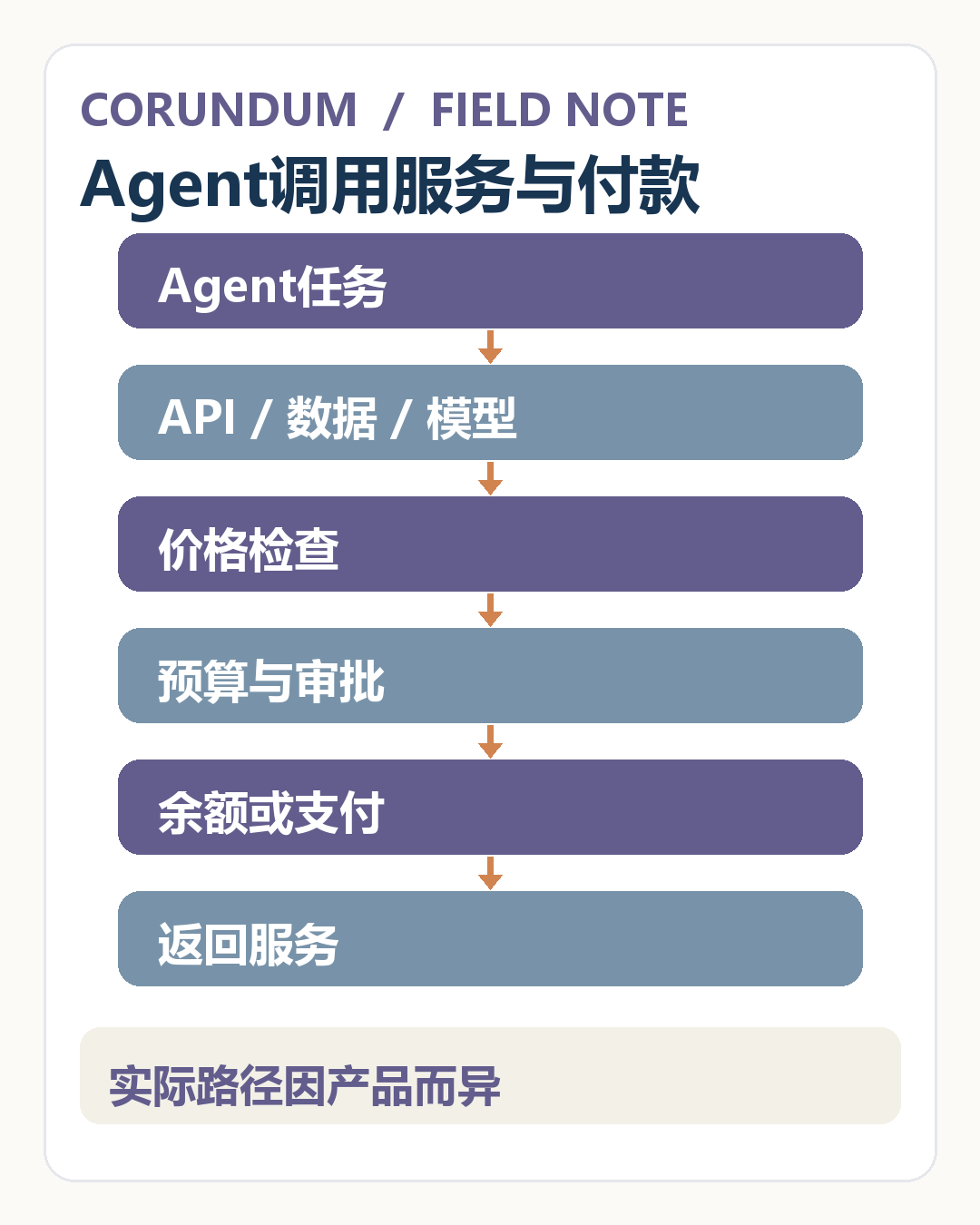
One example in the report lays out a market research task. A company asks an agent to study a new market. The agent first searches public information, then needs to buy an industry database, call a mapping API and send the results into an analysis model. In the past, those steps often meant separate registrations, payments and API key handling by employees. Platforms like AIsa are trying to place service discovery, invocation and billing inside one workflow. That removes some of the friction of opening accounts across multiple services, but it also forces companies to define spending permissions in more detail.
AIsa is trying to place service procurement inside the agent workflow
Many paid data and software services still require a user to register an account, accept terms, start a subscription and then obtain an API key. If an agent is running a research or analysis task, every service call can run into an account and payment step. AIsa’s approach is to connect those resources through a unified interface so developers can use one entry point for agents to discover and call multiple services.
According to Tether’s announcement, the AIsa network offers more than 5,000 APIs, skills and models. The platform also reports more than 250,000 agents running and over 100 million transactions processed. Those figures come from company disclosures, and the announcement did not provide a third-party audit standard behind them. The report says they should be read as platform scale indicators, while keeping in mind that the definitions of “agents running” and “transactions” matter.
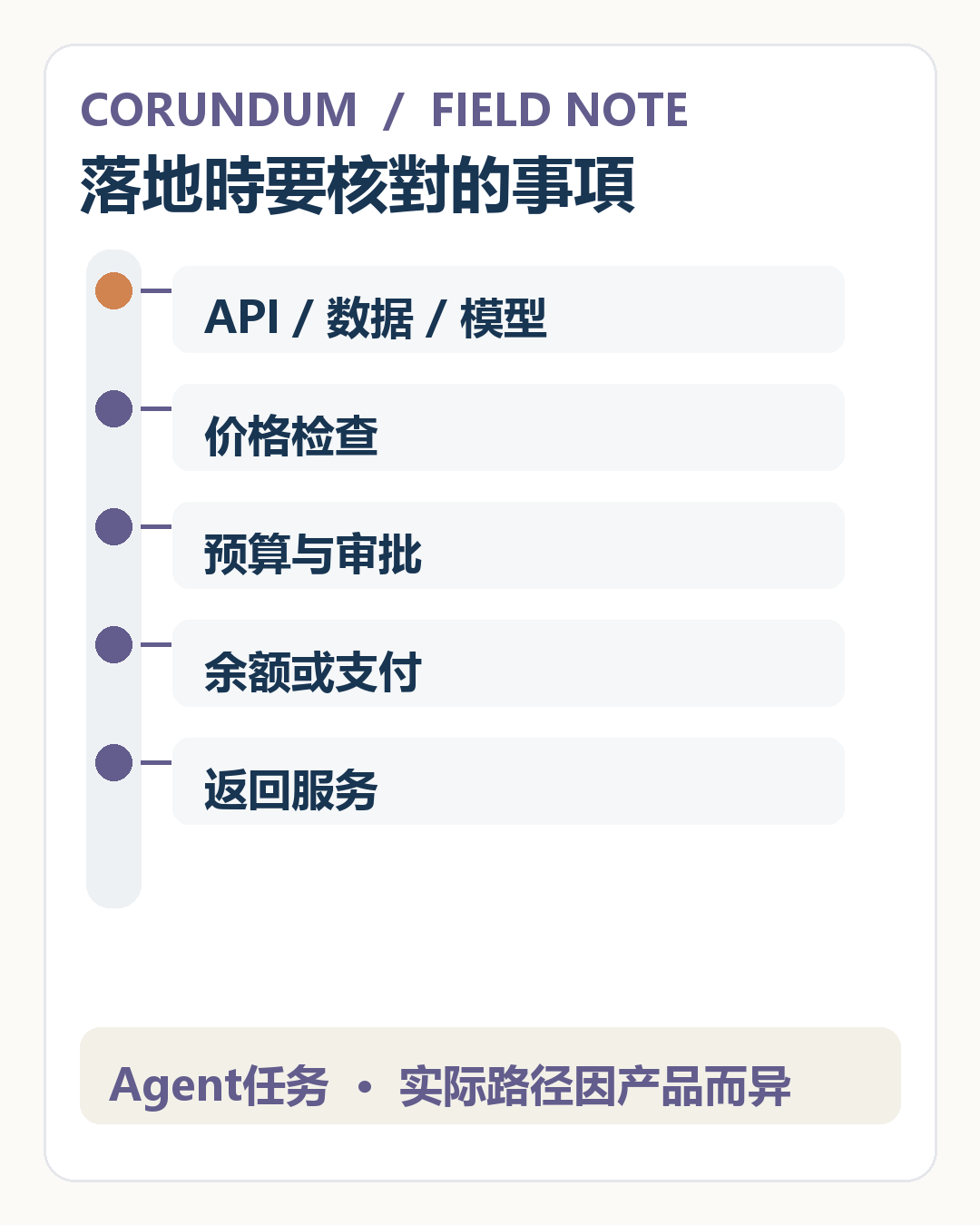
AIsa’s public developer documentation shows one pay-per-call flow: an agent requests a resource, the server returns a price or payment requirement, and the caller checks available balance before receiving the content. Price checks, balance verification and service delivery sit in the same workflow. That structure fits small, frequent purchases such as data queries, model inference and API calls.
The platform website describes the entry point as “one key” for connecting to multiple resources, and it shows modules for models, data APIs, skills and payment protocols. For developers, the value is not limited to managing fewer keys. A single task can combine search, database queries, model inference and compute services as needed. AIsa also says it provides automatic retries, vendor routing and per-call metering. The report notes that enterprises still need to test how those features behave in practice: whether failed requests are routed to another provider, whether retries trigger duplicate charges, and whether the source of a result can be traced.

Pay-per-use pricing could also change how vendors sell their products. A data service that once sold only monthly subscriptions to human users can, after joining an agent platform, price a single query, a text-processing step or a compute task on its own. For smaller teams, that reduces the need to keep paying for tools used only occasionally. For service providers, it creates a new class of machine customers. The challenge on both sides is to make sure pricing, deliverables and usage rights can be read by systems rather than buried in web terms written only for people.
This model changes the cost structure of traditional subscriptions. Enterprises can let an agent buy a single data query or model call only when a task needs it, so spending follows actual usage. Providers can plug individual resources directly into automated workflows. But small, high-frequency calls also require reliable budget accumulation, price verification and duplicate-request protection. Without that, one loop error can turn a one-time authorization into continuing spend.
The report gives a concrete example. If one market research project needs to call three data services, the company can set a total budget for the task and then define a per-call price cap, usage limit and validity period for each vendor. If the agent resubmits the same request because of a network timeout, the platform needs to detect duplicate transactions or at least let the caller reconcile them through a unique request ID. By month-end, finance teams should be able to trace each charge back to the task, the employee who initiated it and the service that was obtained. Without that audit chain, small expenses can accumulate into costs that are hard to explain.
Service quality affects spending too. If one interface returns stale data, an agent may continue calling more services based on faulty information, creating a string of charges that look normal on paper. Enterprises can set timestamps, source checks and quality feedback for critical data. If several results in a row fail to meet expectations, later paid calls can be paused before a human review. In that setup, budget control and output quality control need to sit in the same workflow rather than waiting for an alert only when the balance reaches zero.
Machine payments still rest on accounts, budgets and permissions
An agent can initiate a call, but that does not mean it has independent property rights or legal personhood. Accounts are still typically created by enterprises or developers, and the funding source, prepaid balance, budget settings and service terms still sit with a real legal or natural person. If there is overspending or a mistaken purchase, responsibility returns to account agreements, authorization relationships and platform rules.
In deployment, a company can define payment permissions for an agent through clear boundaries: which service catalog it can buy from, per-transaction and daily limits, approved vendors, allowed calling windows, human approval above a threshold, and an emergency stop method. Budget rules need to be written into executable permission controls, with approval and audit records preserved. Once call records are tied to a specific task, agent identity, requested service and final payment, teams are in a better position to spot abnormal spending.
If a company runs multiple agents at the same time, it also needs to separate whose budget is being used. A marketing agent buying social media data, a legal agent querying a case database and an R&D agent calling compute all have different purposes for both data and spend. Separate keys and budgets can be assigned to each team or task, with different vendor allowlists. When permissions change, old keys should be revoked so agents created by former employees do not keep spending from company accounts. The report compares this to a traditional corporate cost-center structure, except the approval step is moved forward to before the task begins.
For procurement and finance teams, balance management also becomes part of vendor due diligence: which entity holds the prepaid balance, whether unused funds can be refunded, what happens if an account is frozen, and how unused amounts are recovered when service ends. Companies also need to check whether an agent can accept service terms, whether it can create continuing commitments on behalf of the company, and whether the output of a call can be used as an input for later procurement or business decisions. Those details determine who ultimately authorizes machine procurement and who carries the contractual responsibility.
Public materials do not describe every payment path in the same way. Tether’s announcement refers to billing in fiat or stablecoins and to spending limits. AIsa documentation pages show prepaid balances and Stripe top-up flows, while other guides mention crypto-asset funding. The materials available now are not enough to show that agents directly hold USDT, manage wallets on their own, or that AIsa has already connected a specific onchain payment protocol to every service. The report therefore separates broad platform messaging from the mechanics of specific product modules.
Tether’s stated strategic direction is programmable payments and giving people and enterprises control over agent spending. AIsa’s current product pages, by contrast, show concrete tools such as keys, prepaid balances and pay-per-call billing. The capital injection may support further development of stablecoin payment paths. Even so, the actual payment setup still depends on how customers top up, who receives the funds, when service providers get paid and how refunds are handled. Those steps determine what role the platform actually plays in the payment relationship.
Payments, data rights and service liability all enter the compliance picture
Machine payments can raise questions around payment services, money transmission, anti-money laundering and sanctions screening. Licensing analysis depends on the platform’s operating location, the receiving entity, whether customer funds are controlled by the platform, the actual settlement path and the jurisdictions where users are located.
The platform also has to deal with the contract structure of software and data services themselves. An agent may access databases, call models or generate derivative content through a unified interface. Providers need to define the scope of the license, call frequency, data reuse, output responsibility and refund terms. Enterprise customers, for their part, can use allowlists, data classification and purpose restrictions to keep sensitive data within approved service boundaries while preserving records of external tool calls made by agents.
Data licensing could become a more specific source of disputes. A database may allow employees to read reports for internal research, but not allow a company to feed that content into a model, scrape it at scale or use it in a product sold externally. Agents move quickly, and unclear permissions can be crossed just as quickly. Procurement teams need to confirm whether the platform has the right to resell or broker access to a resource, which use cases are permitted for enterprise customers, whether suppliers retain query content, and who handles violations identified by third-party data vendors. For research teams, the report makes a simple distinction: being able to retrieve something is a technical capability; what can be done with it is still governed by contract.
If an agent connects internal company documents with external services, outbound data exposure becomes another issue. To answer one question, it may send an entire contract, customer list or source code segment into an external API. Companies should classify tools by data sensitivity: public information can be queried directly; internal operating data can be desensitized first; customer information or trade secrets may require a restricted vendor list, a defined purpose and human approval. Call logs should ideally record which categories of data were transmitted, not just that “an API was accessed,” or the impact of an incident will be difficult to determine later.
The legal analysis of payment services depends on the real flow of funds. If the platform only provides billing software and a licensed payment institution processes customer payments directly, its legal role is different from a setup in which the platform collects, holds and transfers customer balances itself. Stablecoin payments add questions around wallet control, anti-money laundering, sanctions lists and cross-border transfers. Before entering a market, enterprises should obtain a clear process map: who the customer pays, where balances are recorded, when the service provider receives funds and how failed transactions are refunded. Definitions of e-money, payment services and virtual asset services are not the same across jurisdictions, so a platform cannot be classified on the basis of “pay-per-call” alone.
When agents use prepaid balances, the legal and operational treatment of those balances also needs to be clear: who owns them, whether they can be returned, what happens when an account is closed, and how users recover remaining funds if the platform suspends service. Public product pages may show the user flow, but contract terms and fund flows determine the actual rights and obligations. For enterprise customers, those questions can be folded into vendor due diligence and procurement contracts rather than left until scale arrives.
A platform that aggregates many resources also creates a wider blast radius when something fails. Companies can run a limited test before integration by simulating vendor timeouts, sudden price increases, insufficient prepaid balances and API errors, then recording how the agent responds in each case. If a task affects external pricing or customer decisions, failed runs are better routed to human handling, with the costs and outputs already generated preserved and no infinite retries allowed. The easier service invocation becomes, the clearer the stop conditions need to be.
The report also points to an accounting issue that is easy to miss: one agent output may combine several paid sources. A company needs to know how much each source cost, how long the resulting content can be retained and whether it can be shown to customers. AIsa’s website says it itemizes charges per call and displays interface pricing before invocation. During a pilot, a team can sample 20 real calls and match the platform bill against public vendor pricing, internal task records and the final deliverable. If one result cannot be distributed externally because of licensing limits, that source should be flagged before a report is produced rather than traced after delivery.
Companies also need to decide who approves the scope of “automatic procurement.” Traditional procurement approvals focus on vendor admission, annual budgets and contracts. Agent procurement pushes many small decisions into runtime rules. Legal, finance and business teams can set two boundaries together: humans review the resource catalog and contracts in advance, while small calls inside that catalog are completed automatically by the system within budget. High-risk materials or spending above budget can then be escalated for human confirmation. That way, employees do not need to pay manually for every query, while the company keeps control over vendors and material spending.
For service providers, joining this kind of network brings both upside and trade-offs. Selling APIs per call can open access to new machine customers, but the product may also be wrapped inside a unified interface so that end users remember AIsa rather than the original supplier. Providers need to confirm how pricing changes are synchronized, who blocks abusive calls, whether the platform can alter how content is displayed and how customer disputes are allocated. Competition in the agent economy’s middle layer will show up in those details and in service quality, not only in the number of interfaces connected.
Tether extends its investment reach into agent spending infrastructure
Tether has in recent years been building across local AI, robotics and digital asset infrastructure. This investment places the focus on the channel through which agents obtain data, software and compute. For Tether, that lines up with programmable payments and stablecoin use cases. For AIsa, the strategic investment could help expand platform resources and payment capabilities, though the practical effect still depends on product integrations, service quality and enterprise adoption.
Machines can call services faster, but they also turn procurement steps once handled one by one by people into a permissions problem inside software. Before an agent starts working, enterprises need to define what it can buy, how much it can spend, when human confirmation is required and how it should stop when something goes wrong. The report says the AIsa segment is still taking shape. Areas to watch include how payment methods are implemented in practice, how prepaid balances and refunds are handled, what supply-chain information is available for services, and how the platform provides call and audit records to enterprise users.
Viewed through Tether’s broader investment map, the transaction also fits with the route it has previously described around local AI, robotics and wallet development tools: an agent completes tasks on a device or in software, then buys outside information or compute through a unified entry point when needed. Tether’s announcement mentions NEURA Robotics, the wallet development kit WDK and QVAC, but the degree of commercial integration among those projects remains a matter for later products. For enterprise customers, the immediate evaluation point is still AIsa itself: whether the resources are actually available, whether pricing is clear, whether payments and refunds can be traced, and whether permission controls can keep agent spending inside defined boundaries.