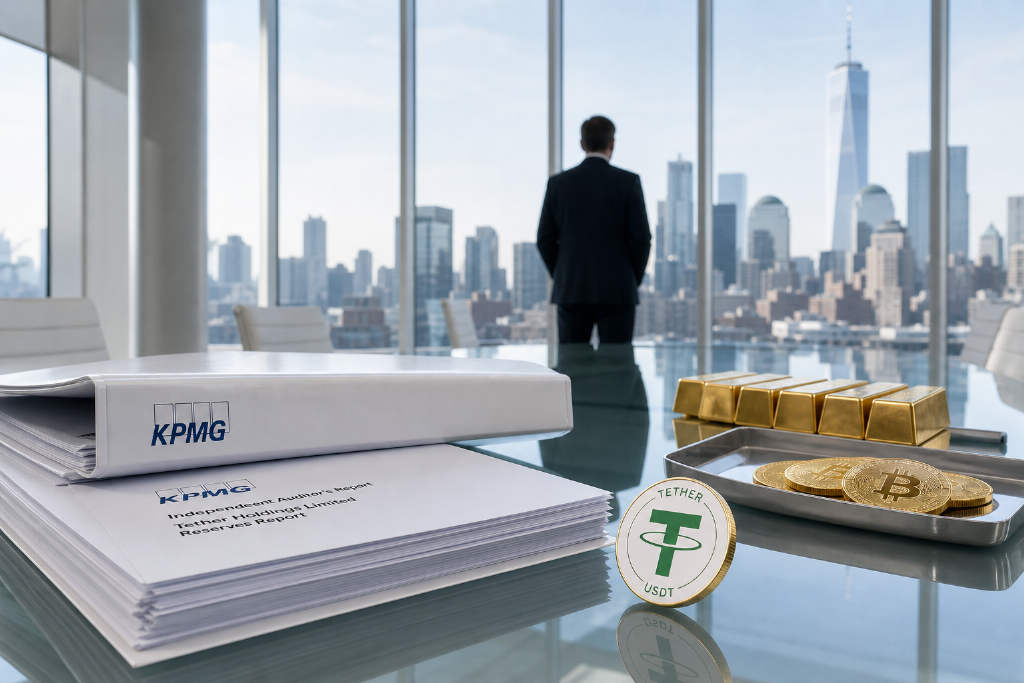
On Aug. 14, Tether CEO Paolo Ardoino said KPMG U.S. has completed a full independent audit of the financial statements of Tether International, S.A. de C.V., the issuer of USDT, for the year ended Dec. 31, 2025. He made the remarks in an interview on The Starting Block.
Ardoino described the audit as a major milestone for Tether. He said the company, founded in 2014, had worked toward this point for years and that the completion of a full audit by one of the Big Four accounting firms carried special weight for both the company and its team.
Why Tether says a full audit took so long
Host Gareth Jenkinson noted that Tether had faced criticism for years over the absence of a full audit and asked why it had been so difficult to get one done.
Ardoino said the audited entity was Tether International, S.A. de C.V., the company that issues USDT. From a technical standpoint, he said, auditing that entity is relatively straightforward because its balance sheet contains only a limited number of asset classes. He added that Tether has maintained robust bookkeeping processes, strict management practices, and a low-risk posture.
Still, he argued that the bigger obstacle was the external environment rather than the mechanics of the audit itself. Ardoino said the digital asset industry went through severe stress in 2022 and 2023, and that one of Tether’s main competitors came close to crisis because of exposure to several banks and the risks tied to them, while Tether made it through those periods.
He said the previous U.S. administration’s hostile posture toward the industry had a more direct effect on Tether’s efforts to secure a full audit. Ardoino specifically referred to Elizabeth Warren, saying she had publicly criticized Tether and even suggested that audit firms should stay away from the company. In his account, that created uncertainty for accounting firms considering engagement.
Ardoino said the current U.S. government has made clear that digital assets matter for the future of the United States and the world, and that the U.S. wants to lead in the sector. After that change in stance, he said, Tether quickly resumed talks with several Big Four firms and ultimately signed with KPMG U.S.
KPMG U.S. and what Ardoino called the strictest possible scrutiny
Ardoino said Tether had faced controversy in the past even when it used non-U.S. accounting firm BDO for attestation reports. For that reason, he said, the company chose to work with KPMG U.S. and subject itself to what he described as the strictest possible scrutiny.
He said the entire team had been focused on completing the audit and that he had repeatedly identified a full audit as Tether’s top priority. In his view, the shift in the U.S. government’s posture helped bring major accounting firms back to the table.
Discussing Tether’s financial structure, Ardoino said the company’s balance sheet is not complex. On one side are liabilities in the form of tokens issued; on the other are the reserves backing those tokens. Based on attestation data as of Dec. 31, 2025, he said Tether had more than $6 billion in excess equity, a figure he said was also confirmed by the auditor.
He added that Tether plans to undergo a full financial audit every year and continue publishing quarterly attestation reports. In his words, that represents the highest level of transparency the sector can reach.
Response to reserve and transparency criticism
Jenkinson said one of the long-standing concerns around Tether has been whether the company could have minted large amounts of USDT without adequate collateral, which is why many in the market had viewed a full audit as necessary. He also noted that even after the audit, some critics were still calling for more disclosure about Tether’s ownership structure and the parties involved.
Ardoino said many critics simply struggle to admit they were wrong and keep looking for new lines of attack. He said he had replied that day to Bitfinex’ed, a long-time critic of Tether, and referenced the television show Happy Days, saying the character Fonzie could never quite say, “I was wrong.” He used that as an analogy for people who cannot acknowledge a mistake.
Even so, Ardoino said he is not particularly concerned by the criticism because, in his view, Tether has already proved itself many times. He said the company has handled concentrated redemptions on a scale larger than any historical financial institution within a day, 24 hours, or 48 hours.
As an example, he said Tether redeemed about $7 billion in 48 hours in 2022, equal to roughly 10% of its reserves at the time. According to Ardoino, any financial institution or bank facing a redemption wave of 10% or more over such a short period would fall into crisis, while Tether was able to process those redemptions.
He also said criticism keeps the company alert and can make it stronger. Ardoino said that even if some people see Tether as a “villain,” the company still aims to be a hero to about 650 million users worldwide who are not fully served by the traditional financial system.
Auditors counted Tether’s gold bars one by one
The interview also covered Tether’s gold holdings. Jenkinson asked about a detail that had circulated publicly: whether Ardoino had auditors count every gold bar in reserve one by one.
Ardoino said Tether’s goal was to eliminate every legitimate point of doubt. He cited a well-known Bitcoin phrase: “Don’t trust, verify.”
He said Tether has accumulated about 150 tons of gold over the past few years and also holds a substantial Bitcoin position of more than 100,000 BTC. Bitcoin is comparatively easy to verify, he said, because ownership of an address can be demonstrated. Gold is different. Its existence and the identifying information attached to each bar have to be checked physically.
That meant auditors had to handle the bars and verify the relevant information one by one. Ardoino said the work was necessary and, in his view, showed that Tether had nothing to hide.
No need for outside capital, but strong interest in Tether equity
Jenkinson also asked about earlier media reports that Tether was pursuing a private equity financing round and whether those plans had been shelved.
Ardoino said Tether had never formally announced anything of the sort and that some media outlets had built their own narrative, asking and answering their own questions. He said the company generally does not comment on that type of reporting.
At the same time, he confirmed that there is strong market interest in Tether shares. He said Bitcoin has a supply cap of 21 million coins, while Tether equity is also scarce because the company currently has only a small number of shareholders. He added that he likes that arrangement.
According to Ardoino, people continue to approach the company about buying Tether shares, though not literally every day. Even so, he said Tether does not need capital. He described the company as highly profitable, able to choose where to deploy resources, and capable of building strong technology on its own.
QVAC, AI tools, and users outside traditional finance
Ardoino also discussed Tether’s direction in artificial intelligence, referring to the company’s QVAC initiative.
He said that even when people think the AI industry’s outcome is already settled or that the winners are already known, Tether still has its own vision, narrative, and technology. The goal, he said, is to build AI tools for about 4 billion people outside the traditional financial system.
In his telling, those users may also be overlooked by large AI companies, because people who cannot afford the costs tied to a bank account may also be unable to pay for subscriptions to services from OpenAI or Anthropic. Tether wants to build tools that can run on edge devices and serve those users directly.
Ardoino said many of those people are already part of the roughly 650 million USDT users worldwide today, which he presented as one of Tether’s distinguishing characteristics. He said he would rather wake up every day focused on that mission than spend his time optimizing every last cent to satisfy an unhappy shareholder.
That is why, he said, anyone joining Tether as an investor needs to be mission-aligned. He acknowledged ongoing investor interest, including from investors who share that orientation, but said the company would be very careful in deciding who, if anyone, joins the shareholder base.
Ardoino added that execution has been one of Tether’s core strengths for the past 12 years. He said the company chose to remain private rather than list publicly, arguing that public companies face quarterly earnings pressure. Tether, he said, wants to optimize around financial inclusion instead.
He went so far as to describe Tether as the largest financial inclusion success story in human history, saying there is no close second in that respect.
Tether open to funding Bitcoin code and wallet security work
Near the end of the interview, Jenkinson turned to recent security issues in the Bitcoin ecosystem, especially the Coldcard security incident, and to research efforts using advanced AI models to review Bitcoin’s open-source code and identify, disclose, and fix bugs more quickly.
Asked whether Tether, Ardoino himself, or affiliated companies would be interested in supporting that work, Ardoino said everyone should be grateful for what Bitcoin developers had done in recent weeks and that Tether is indeed willing to allocate budget to help the work continue.
He said the current risk from quantum computing is lower than the risk posed by software vulnerabilities. With AI tools, he argued, software bugs may now be easier to detect. On Bitcoin specifically, he said there is a viable path to addressing future quantum risks by adding new quantum-resistant signature schemes and allowing users to move funds to addresses that use them.
Before that, however, he said the immediate task is to make sure Bitcoin’s codebase itself, as well as the tools and wallets people use every day, are secure and reliable. Ardoino said what happened with Coinkite and Coldcard made many people recognize the real dangers present in this area.
What comes next: annual audits and quarterly attestations
Jenkinson closed by asking whether Tether intends to make this kind of KPMG U.S. audit an annual exercise.
Ardoino’s answer was yes. He said Tether plans to continue down this path, with one full financial audit each year and quarterly attestation reports in between, and that the company hopes this will set the highest transparency standard for the industry.