
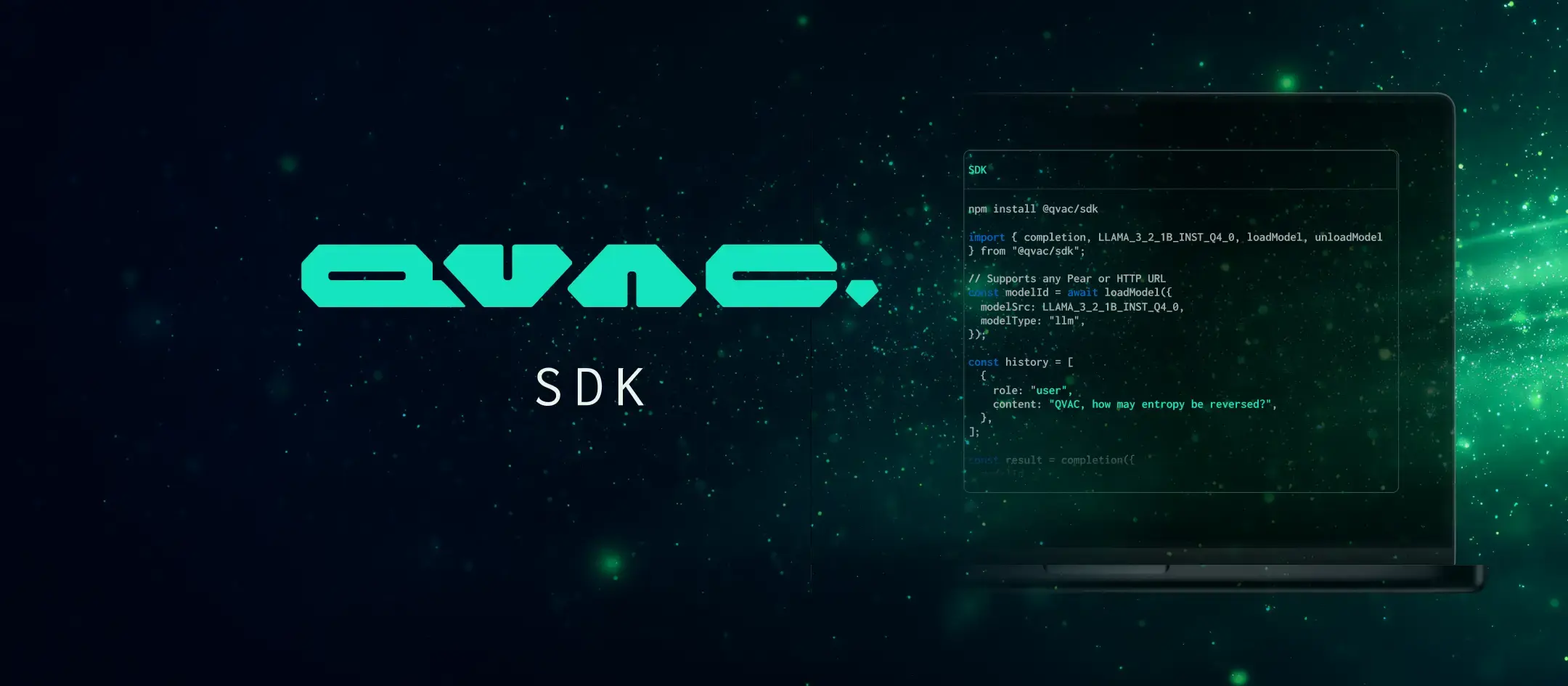
Tether has introduced QVAC SDK, a fully open-source and cross-platform software development kit built by its data and AI team. The company says the toolkit is meant to let AI models run directly on phones, computers, and other local devices instead of depending on centralized cloud servers for every task.
Known primarily as the issuer of USDT, Tether is pushing deeper into AI and decentralized infrastructure. In its announcement, the company described QVAC as a “universal building block” for future AI systems. It also framed that future in expansive terms, saying a coming era could include 10 billion humans, 10 billion autonomous machines, and trillions of AI agents sharing the same world.
Paolo Ardoino attacks the centralized API model
Tether CEO Paolo Ardoino took aim at the cloud-based API approach used by major tech companies including Microsoft, OpenAI, and Google. He said a model that routes every decision through centralized servers cannot scale for what lies ahead.
Ardoino argued that centralized AI runs into hard limits at the physical level. He pointed to latency tied to the speed of light, vulnerability created by single points of failure, and concentration of control. In his view, those weaknesses belong to systems built for a much smaller world, while QVAC is being designed for the next stage of computing.
Local-first deployment with offline availability
QVAC SDK follows a local-first design. Developers can deploy large language models and other AI applications directly onto consumer devices, while also extending to industrial servers and small embedded hardware. Tether said the framework can even operate on tiny chips inside smart light bulbs.
The company highlighted two practical benefits. One is privacy and resilience: tasks such as writing assistance, speech transcription, image generation, and personal financial planning can be completed instantly on-device, without sending sensitive data to the cloud. If a network connection drops or a remote server goes offline, the AI functions can keep running. The other is platform consistency. Developers can write once and deploy across iOS, Android, Windows, macOS, and Linux rather than rebuilding the same application for each operating system.
Built on llama.cpp and linked to Holepunch
On the technical side, the SDK is built on a unified abstraction layer. Its core component, called QVAC Fabric, is a fork of the open-source project llama.cpp and supports text generation as well as multimodal workloads. Tether said the toolkit also integrates local engines including whisper.cpp, Parakeet, and Bergamot for capabilities such as speech-to-text and on-device translation.
QVAC also ties into Holepunch, the P2P networking stack backed by Tether. According to the announcement, the SDK includes decentralized model distribution and delegated inference without centralized infrastructure. The company also said it plans to add “P2P swarms” for decentralized training and fine-tuning. Tether stated that it will keep investing in the QVAC open-source ecosystem over the coming months and years, with future toolkits aimed at robotics and brain-computer interfaces.