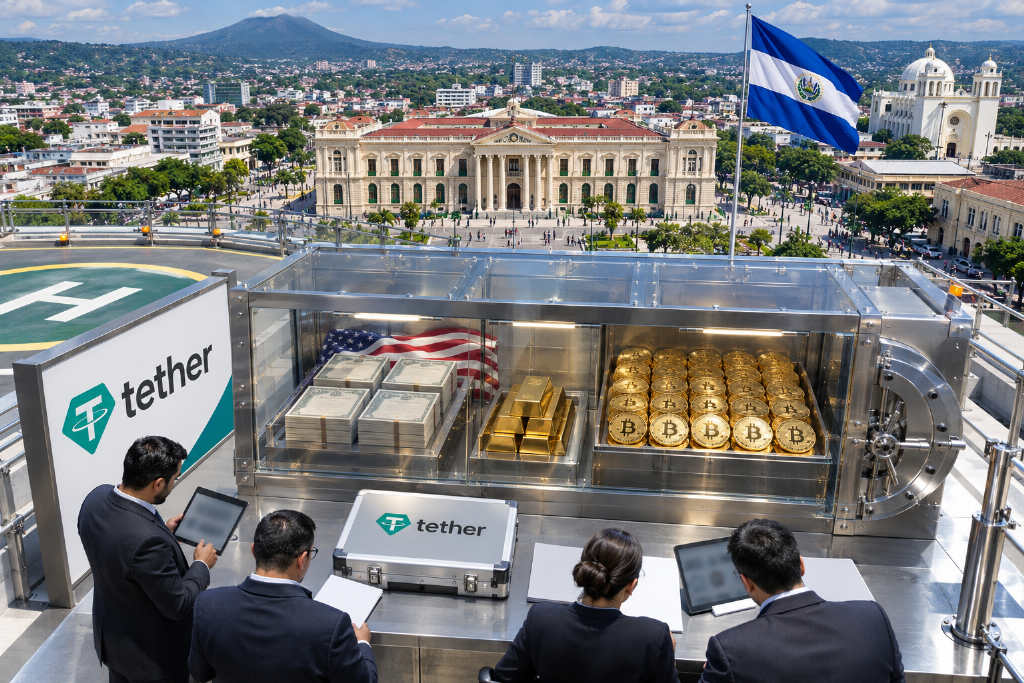
Tether’s independent assurance report for the third quarter of 2026 showed that, as of Sept. 30, reserve assets held by its El Salvador issuing entity, Tether International, S.A. de C.V., stood at about $191.451 billion, up $3.7 billion from $187.75 billion at the end of the second quarter. Total liabilities were about $183.496 billion, including net issued digital token liabilities of $183.47 billion.
The report was signed by an entity under BDO Italy. Based on the disclosed figures, Tether’s excess reserve buffer, or net equity, climbed from $4.11 billion at the end of June to about $7.955 billion three months later, an increase of $3.84 billion in a single quarter.
Tether also said in its official filing that it generated $1.5 billion in net operating profit in the third quarter. Operating profit for the first nine months of 2026 reached $4.5 billion.
U.S. Treasury exposure reached $132.4 billion
For USDT holders, the most liquid part of the reserve base remains central to redemption confidence. As of Sept. 30, Tether directly held $122.840 billion in U.S. Treasury bills with a weighted average maturity of less than 90 days, up $7.88 billion from the end of the second quarter.
It also held $9.519 billion in overnight reverse repurchase agreements fully backed by U.S. Treasuries, with the fair value of the underlying Treasury collateral listed at $9.509 billion. Combined, Tether’s direct and indirect exposure to U.S. government debt reached $132.4 billion, equal to 69.1% of total assets.
A closer look at cash and cash-equivalent items showed a notable portfolio shift during the quarter. While direct Treasury holdings increased, overnight reverse repos fell from $18.63 billion at the end of the second quarter to $9.519 billion, a decline of $9.11 billion over the period. Adding $7.178 billion in term reverse repos, $21.98 million in non-U.S. Treasury bills, and just $20.43 million in cash and bank deposits, total cash and cash-equivalent assets came to $139.578 billion in the third quarter, down slightly from $140.64 billion at the end of June.
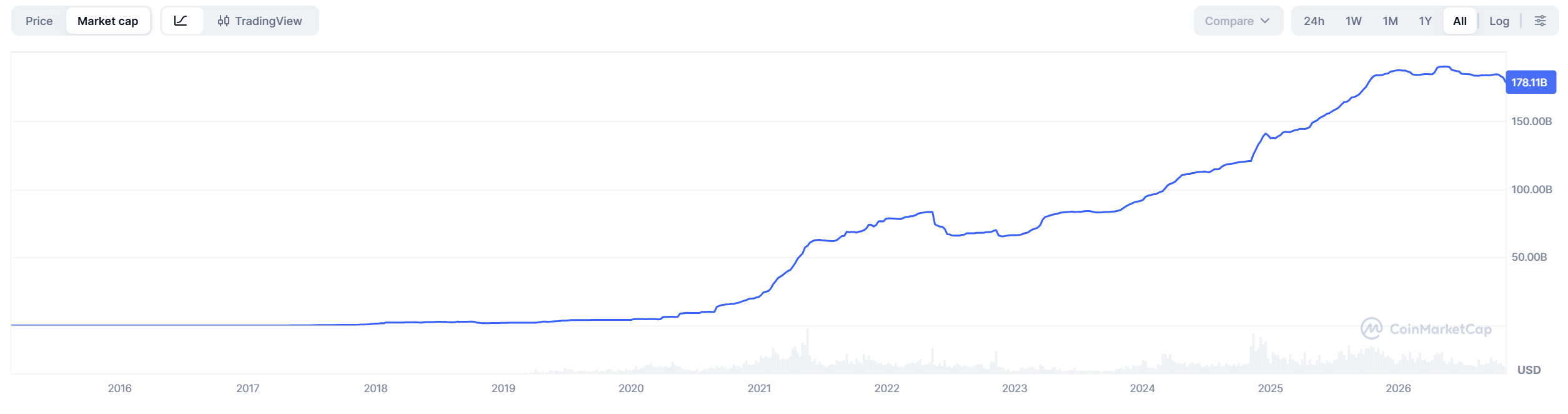
CoinMarketCap data cited in the article showed USDT with a market capitalization of $178.1 billion, while its issuance size had been declining after reaching a peak.
Reserve-pool Bitcoin rose to 100,060.36 BTC
With cash-like assets down by $1.06 billion, the quarter’s $3.84 billion increase in the excess reserve buffer was largely tied to the fair-value revaluation of Bitcoin.
According to the BDO report, the value of Bitcoin held in the reserve pool rose from $5.80 billion at the end of the second quarter to $8.367 billion at the end of the third quarter. Using the Bloomberg closing price disclosed in the notes for Sept. 30, $83,621.23 per BTC, the Bitcoin balance in Tether’s reserve pool increased from about 98,930 BTC at the end of June to 100,060.36 BTC.
That implies Tether added about 1,130 BTC net to the reserve pool during the quarter. The article said a 42.6% rise in Bitcoin’s price over the period contributed about $2.47 billion in unrealized gains, accounting for more than 60% of the increase in the excess reserve buffer.
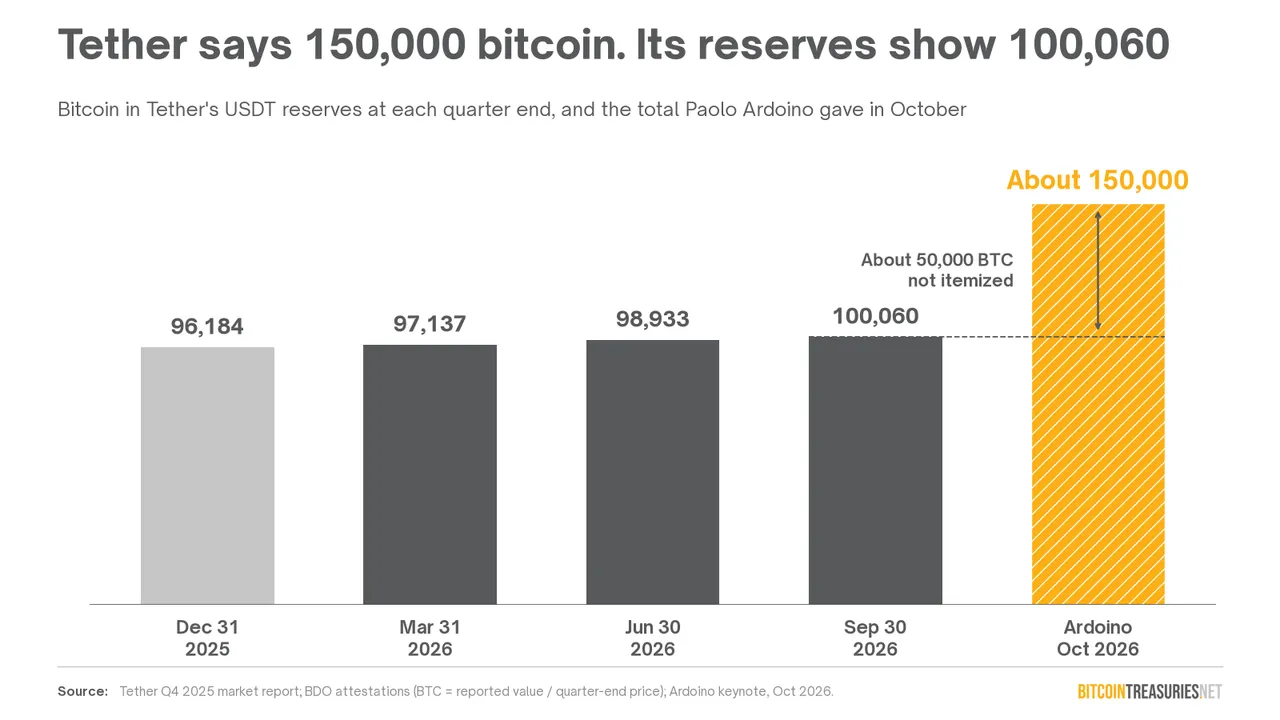
Days after the report was released, Tether CEO Paolo Ardoino said at the Plan ₿ Forum in Lugano, Switzerland, that Tether actually holds about 150,000 BTC, worth more than $11.5 billion at early-November market prices. The gap between that figure and the roughly 100,060 BTC shown in the BDO report stems from scope: the BDO review covered only the legal reserve pool of the El Salvador issuing entity, while another roughly 50,000 BTC sits with proprietary investment entities across the group, including Tether Investments.
Gold holdings fell by about 3.4 metric tons
Tether’s move in precious metals was more restrained. At the end of the third quarter, the value of its LBMA-standard physical gold bars edged up from $18.84 billion to $19.085 billion. But using the period-end gold valuation price of $4,157.41 per ounce, the company’s physical gold holdings amounted to 4.5905 million troy ounces, or about 142.8 metric tons, down from 146.2 metric tons at the end of the second quarter. That was a reduction of about 3.4 metric tons.
Other non-cash assets continued to expand. Overcollateralized secured loans rose from $13.45 billion to $14.175 billion. Other investments increased from $5.24 billion to $6.004 billion. Listed equities with indirect exposure to gold and Bitcoin rose to $4.178 billion, and the reserve pool also included $63.88 million in corporate bonds.
By the end of September, total non-cash assets in reserves had reached $51.873 billion. Based on the figures cited in the article, the $7.955 billion buffer lifted the maximum tolerable drawdown on that risk-asset bucket from 8.7% at the end of June to 15.3%. The report also disclosed that the company still faces a class-action lawsuit in New York tied to the decline in Bitcoin prices during 2017 and 2018, and that no provision has been booked so far.
Mining and compliance efforts widened beyond stablecoin issuance
Outside the quarterly figures, Ardoino said in Lugano that Tether and its partners had built a Bitcoin mining operation with total hashrate above 50 EH/s.
On the stablecoin side, Tether has been pushing what the article described as a dual-track structure. On one side, it has been scaling back offshore legacy lines. Notes in the BDO report confirmed that the company had stopped redemptions on five older chains including Omni and EOS, as well as on the euro stablecoin EURt, while concentrating USDT issuance across 13 independent blockchains including Ethereum, TRON and Solana. Tether also said it will end redemption obligations for the offshore yuan stablecoin CNHt on Feb. 20, 2027.
In the United States, Tether is moving through Anchorage Digital to launch USAT, a compliant stablecoin with an Office of the Comptroller of the Currency charter, targeting domestic institutional clients.
The article also said Tether has been acting closely with on-chain enforcement efforts in hacking cases. From late October to early November this year, Tether froze $1.5 billion in USDT linked to the Binance theft case. It also helped block more than $4.5 million in USDT tied to the Mercado Bitcoin hack in Brazil.