
Tether, the issuer of the USDT stablecoin, has unveiled QVAC BotPsy, an 800-million-parameter AI agent built to handle everyday tasks on personal devices. The company says the model outperformed competitors with up to 2.5 times as many parameters in its own tests.
Parameters are numerical values a model learns during training. A smaller parameter count generally means less memory is needed to run a model, while frontier AI systems today operate at trillion-parameter scale. BotPsy is designed to do more than answer questions: it can identify which tools an application needs, carry out commands in sequence and adjust its approach when an operation fails.
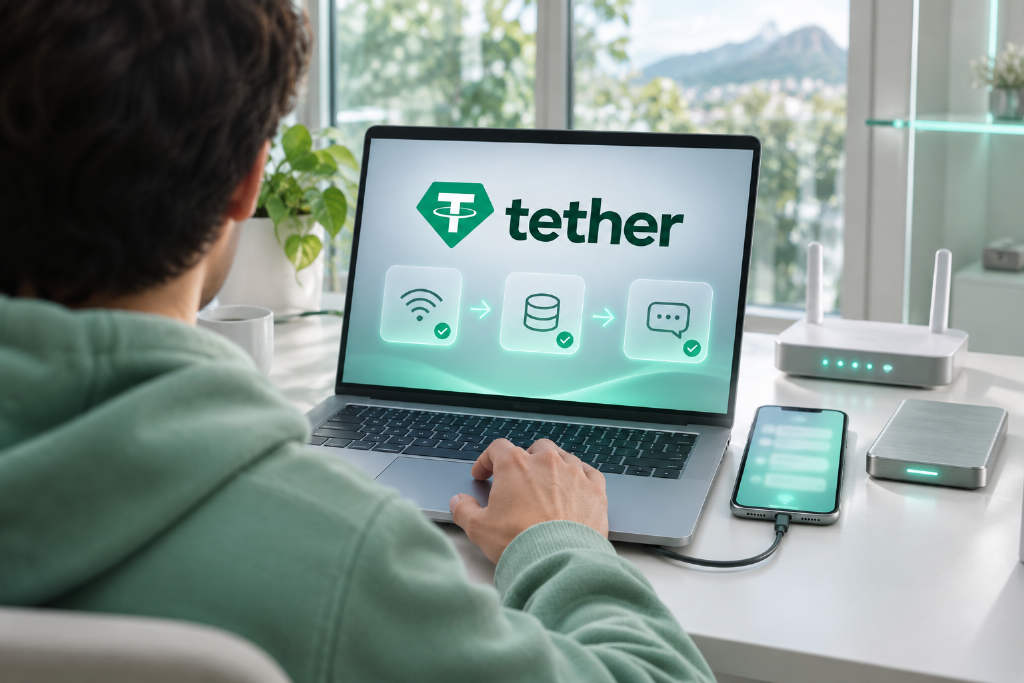
In one benchmark scenario described by Tether, an assistant had to send a message while Wi-Fi was disabled and the inbox was full. BotPsy switched on Wi-Fi, cleared enough storage and completed the task. The underlying model repeatedly tried the same operation, which continued to fail. The example illustrates how BotPsy handles actions inside applications.
Scores lead larger models on tool-use tests
BotPsy is built on Alibaba’s Qwen3.5-0.8B architecture. Tether trained it further to specialize in interactions with software tools. According to Tether’s technical documentation, the model scored 44.0% on BFCL v4, a benchmark that tests whether an AI system can select and execute software functions across different tasks and conversations. The score is a weighted measure of successful performance across tool-use categories.
The underlying Qwen3.5-0.8B model scored 23.4% on BFCL v4, while the larger Qwen3.5-2B reached 37.7%. BotPsy also scored 58.7% on ACEBench, which measures function-call accuracy, including whether a system selects the appropriate tools and arguments. Qwen3.5-0.8B scored 30.1%, and Qwen3.5-2B scored 55.4%.
Tether tested five models across six tool-use evaluations. BotPsy posted the top result in five of the six, with an average score of 45.0%. The larger Qwen model averaged 38.8% across those tests.
BotPsy joins Tether’s QVAC effort
BotPsy is the latest addition to QVAC, Tether’s initiative to build an AI ecosystem that runs on devices controlled by users rather than relying entirely on centralized cloud infrastructure. Tether first introduced QVAC in May 2025, presenting it as an alternative to AI services operated by technology giants. The project’s longer-term ambitions included autonomous agents that could interact with applications and potentially make payments using Bitcoin and USDT.
In October 2025, Tether expanded the initiative with a 41-billion-token dataset for training science and engineering models, as well as QVAC Workbench, an application for running AI models locally. Earlier this year, the company released its SDK, giving developers tools to build offline AI applications for mobile and desktop operating systems.
Tether has also developed QVAC MedPsy, a medical AI system designed to run on consumer hardware. Its 1.7-billion-parameter version outperformed Google’s much larger MedGemma-27B on HealthBench Hard, a benchmark that evaluates realistic clinical conversations using criteria developed by physicians.
Open-weight release does not include training materials
BotPsy is available as an open-weight model under the Apache 2.0 license. Developers can download it, modify it and integrate it into their own applications. Tether has also released compressed versions intended to reduce the memory requirements for local deployment.
Tether has not announced when it will release a finished consumer assistant powered by BotPsy. The published model card also states that the release does not include the training code or training data.



