
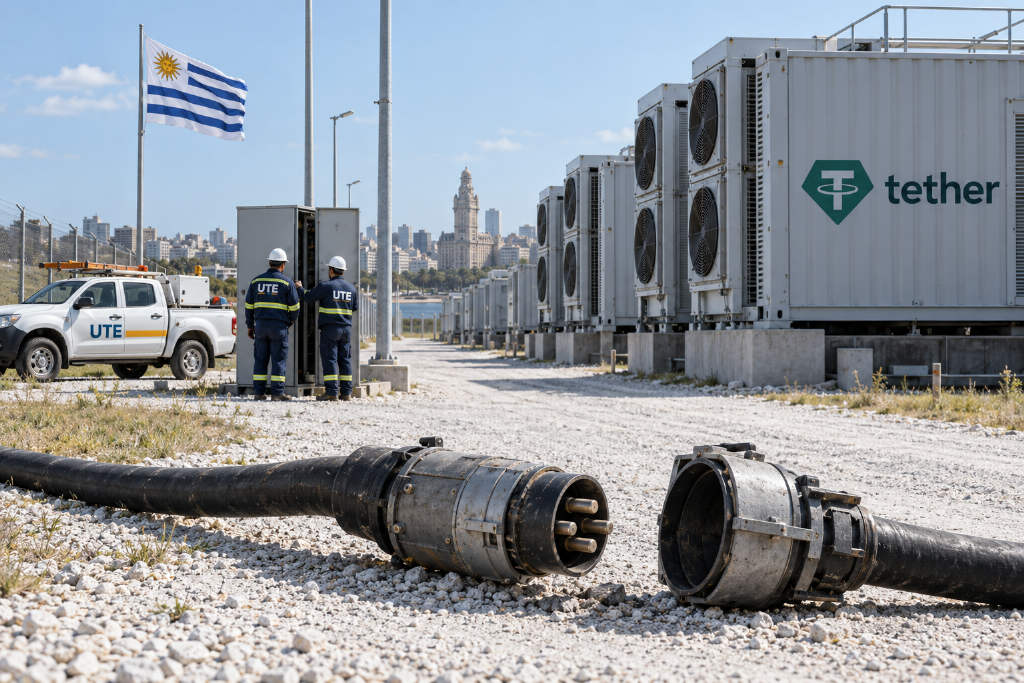
On July 25, 2025, engineers from Uruguay’s state power company UTE cut electricity to a Bitcoin mine in the rural part of Florida Department, ending operations at a site that had been running for two years. The project involved about $120 million in investment, and 30 of its 38 local employees lost their jobs after the shutdown.
The operation had once been presented as a green-energy mining project in South America. It ended with an unsigned revised contract and arrears that at one point were close to $5 million.
Tether’s 2023 move into Uruguay
According to the report, Tether announced in May 2023 that it was entering Uruguay and planned to work with local licensed company Microfin to build two Bitcoin mining sites in Florida Department.
Uruguay’s appeal was clear at the time. The country’s power mix was described as 98% renewable, mainly from hydro and wind, with a stable grid and a friendly regulatory setting. A former contractor estimated that Tether later spent about $60 million on each site, bringing total investment to roughly $120 million.
For Tether, the project was framed as more than a mining operation. It was also part of a push to put profits into real-world energy infrastructure. The article said Tether posted about $6.2 billion in profit for full-year 2023 and was expanding into areas including energy and AI.
The early phase ran smoothly. Former contractors cited by Reuters said both sites were producing normally and generating revenue, while the local team grew to 38 people.
A contract number became the breaking point
The dispute centered on electricity supply. Both sides read the same figure in the power contract differently.
Tether’s side treated the number as a guaranteed minimum supply and believed additional power could be requested as the mine expanded. UTE, by contrast, viewed that figure as a maximum ceiling that could not be exceeded.
That difference mattered because Bitcoin mining machines need to run around the clock. As the project scaled and power demand rose, both sites began facing repeated restrictions. At times, they went days without enough electricity, cutting into mining revenue.
The report said tensions were already present by the end of 2024. In 2025, leftist President Yamandú Orsi took office in Uruguay, UTE changed management, and the utility adopted a tougher stance in negotiations. Communication stalled, and trust between the parties broke down.
The project unraveled within months
Once that trust was gone, the project moved quickly toward closure.
In May 2025, Microfin stopped paying electricity bills. In June, it formally notified UTE that it was terminating the contract. Reuters, citing internal briefing documents it reviewed, reported that UTE had prepared a revised contract in an attempt to save the project, but Tether representatives did not attend the signing ceremony.
On July 25, 2025, UTE formally disconnected the power supply. Local outlet El Observador reported that Microfin’s unpaid balance had reached nearly $5 million by then. Monthly electricity bills were about $2 million, and the arrears had exceeded the guarantee previously posted.
On Nov. 25, 2025, Tether formally notified local labor authorities that it was ceasing operations. Broadcaster Teledoce later confirmed that 30 of the 38 employees had been laid off. By December 2025, Microfin had settled all outstanding debt.
Green power did not mean cheap power
The shutdown highlighted the constraints facing capital-intensive mining projects overseas.
One issue was cost. Uruguay’s electricity supply was green, but the report said it did not hold a clear advantage in global mining power-price comparisons. After Bitcoin’s 2024 halving cut the block reward from 6.25 BTC to 3.125 BTC, profit margins across the sector narrowed, making higher electricity costs harder to absorb.
The other issue was rule certainty. Tether had entered Uruguay for both its renewable energy base and its political stability. But the article noted that management at public utilities can change with a new government, and negotiating positions can shift with it, something not unusual in Latin America.
The report added that a $120 million loss remained manageable for Tether, which it described as having annual profit above $10 billion and an investment portfolio of more than $20 billion, while its expansion in places including El Salvador is still continuing. Even so, the Uruguay project showed that large-scale mining operations still depend on clear contract alignment and a real cost advantage.



