
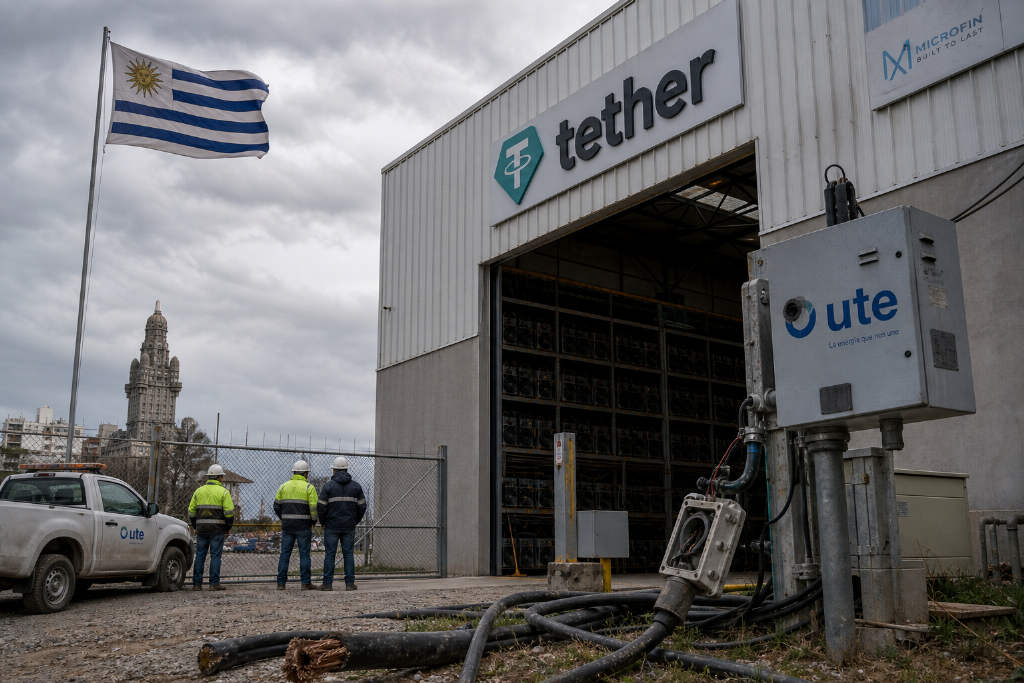
Uruguay’s state power company, UTE, cut electricity to a bitcoin mining facility in Florida department on July 25, 2025, shutting down an operation that had run for two years. The project, tied to Tether and local licensed company Microfin, represented an investment of about $120 million, according to the source material. Of 38 local employees, 30 lost their jobs.
What had been framed as a South American green-energy mining project ended with an unsigned revised contract and unpaid power bills that at one point neared $5 million.
Tether entered Uruguay in 2023
Tether, the issuer of the world’s largest stablecoin, announced its move into Uruguay in May 2023. The company pointed to the country’s power mix, which it said was 98% renewable, led by hydro and wind, along with a stable grid and a friendly regulatory setting.
The plan was to work with Microfin, a locally licensed company, to build two mining sites in Florida department. Former contractors interviewed by Reuters estimated that Tether later spent about $60 million on each site, or roughly $120 million in total.
For Tether, the project was not only about mining. The source material says it was also part of a wider push to direct profits into real-world energy infrastructure. Tether posted about $6.2 billion in profit for 2023 and was expanding into areas including energy and AI.
Early operations were described as smooth. Former contractors cited by Reuters said both sites were producing normally and generating revenue, while the local team grew to 38 employees.
A contract number became the central dispute
The conflict later turned on a single issue in the electricity agreement. According to the source material, Tether’s side read the supply figure in the contract as a guaranteed minimum, meaning additional power could be requested once the mining facilities expanded.
UTE took the opposite view and treated the same figure as a maximum ceiling that could not be exceeded. That difference mattered because bitcoin mining machines need uninterrupted, around-the-clock power.
As the sites scaled up and electricity demand climbed, both facilities began to face repeated restrictions. At times, they reportedly went several days without enough supply, cutting into mining output and revenue.
By late 2024, tensions were already present. In 2025, leftist President Yamandú Orsi took office in Uruguay, the utility changed management, and the stance in negotiations became tougher, according to the source material. Communication stalled, and trust between the parties weakened.
The project unraveled within five months
Microfin stopped paying electricity bills in May 2025. In June, it formally notified UTE that it would terminate the contract.
Reuters, citing an internal brief it reviewed, reported that UTE had prepared a revised contract in an attempt to preserve the project, but Tether representatives did not attend the signing ceremony.
UTE then disconnected power on July 25, 2025. Local media outlet El Observador reported that Microfin’s arrears had nearly reached $5 million at that point. Monthly electricity bills were about $2 million, and the outstanding balance had exceeded the guarantee previously provided.
On Nov. 25, 2025, Tether formally notified local labor authorities that operations were stopping. Broadcaster Teledoce later confirmed that 30 of the 38 employees had been laid off. Microfin did not clear all outstanding payments until December 2025.
What the shutdown showed
The source material ties the outcome to two issues that matter in heavy-asset overseas projects.
One is cost. Uruguay’s electricity supply may be green, but the source says it does not hold a clear edge on mining power prices globally. That became more visible after bitcoin’s 2024 halving, when the block reward fell from 6.25 BTC to 3.125 BTC and industry margins narrowed.
The other is rule certainty. Tether entered Uruguay attracted by renewable energy and political stability, but leadership at public utilities can change with a new government, and negotiating positions can shift with it. For projects that depend on long-term, stable electricity supply, the source says policy continuity can be harder to predict than the nominal power price itself.
The source material adds that a $120 million loss remains manageable for Tether, given annual profit above $10 billion and an investment portfolio above $20 billion, while its expansion in places including El Salvador continues. Even so, the Uruguay shutdown showed that large mining operations still depend on clear contract alignment and a cost structure that holds up in practice.