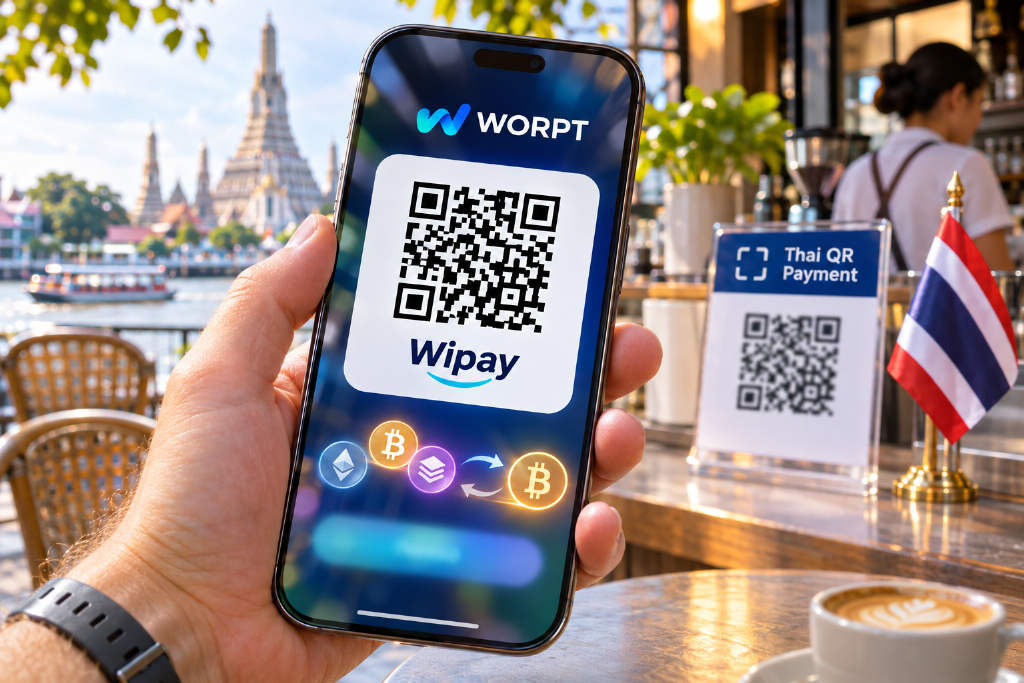
Thailand payment app WORPT lets foreign visitors convert cryptocurrency into Thai baht and pay at shops and restaurants by scanning commonly used local payment codes, without opening a Thai bank account. Wipay Co and Waan Exchange Co developed the app, which operates under TouristDigiPay, a regulatory pilot launched by Thailand’s Securities and Exchange Commission. Wipay founder Pavin Jittiwongsamarn said the target users are crypto holders from South Korea, Japan, the Middle East and Southeast Asia. The company expects WORPT to reach 200,000 users in its first year and estimates it will generate 15 billion baht, or about $440 million, in spending during the 18-month pilot. The launch comes as foreign arrivals to Thailand face a second consecutive annual decline and international tourism revenue is also falling.
WORPT, a payment app in Thailand, allows foreign visitors to convert cryptocurrency into Thai baht and pay at shops and restaurants by scanning commonly used local payment codes. Users do not need to open a Thai bank account.
Wipay Co and Waan Exchange Co developed the app. It operates under TouristDigiPay, a regulatory pilot launched by Thailand’s Securities and Exchange Commission. Wipay founder Pavin Jittiwongsamarn said WORPT targets crypto holders from South Korea, Japan, the Middle East and Southeast Asia. The company expects to reach 200,000 users in its first year and projects 15 billion baht, about $440 million, in spending during the 18-month pilot.
Foreign tourist arrivals in Thailand are facing a second consecutive annual decline, while international tourism revenue is also falling.
This article was originally published by Bit.Fan. For more cryptocurrency news and market insights, visit www.bit.fan. Disclaimer:
The market information, project data, and third-party content displayed on this platform are for industry information sharing only and do not constitute any form of investment advice or return commitment.
Cryptocurrency trading carries high risks. Users should fully assess their risk tolerance and make independent decisions. All profits, losses, and legal responsibilities are borne by the users themselves.