
Author: Claude, TechFlow
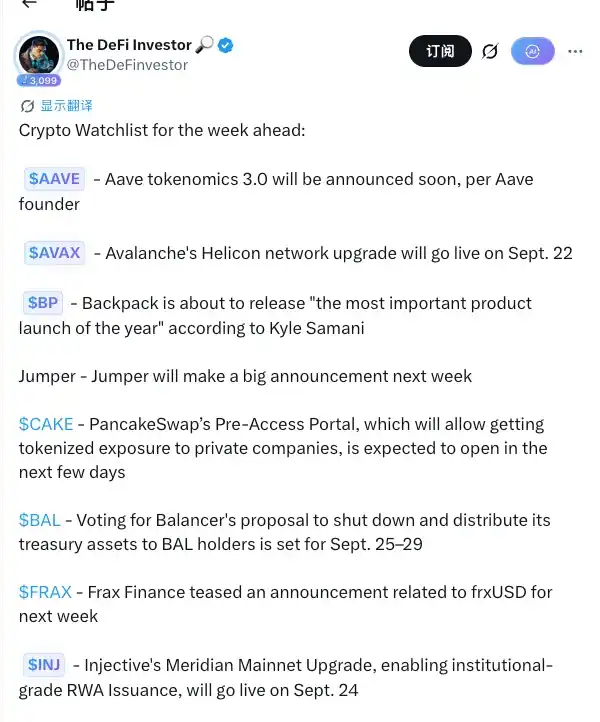
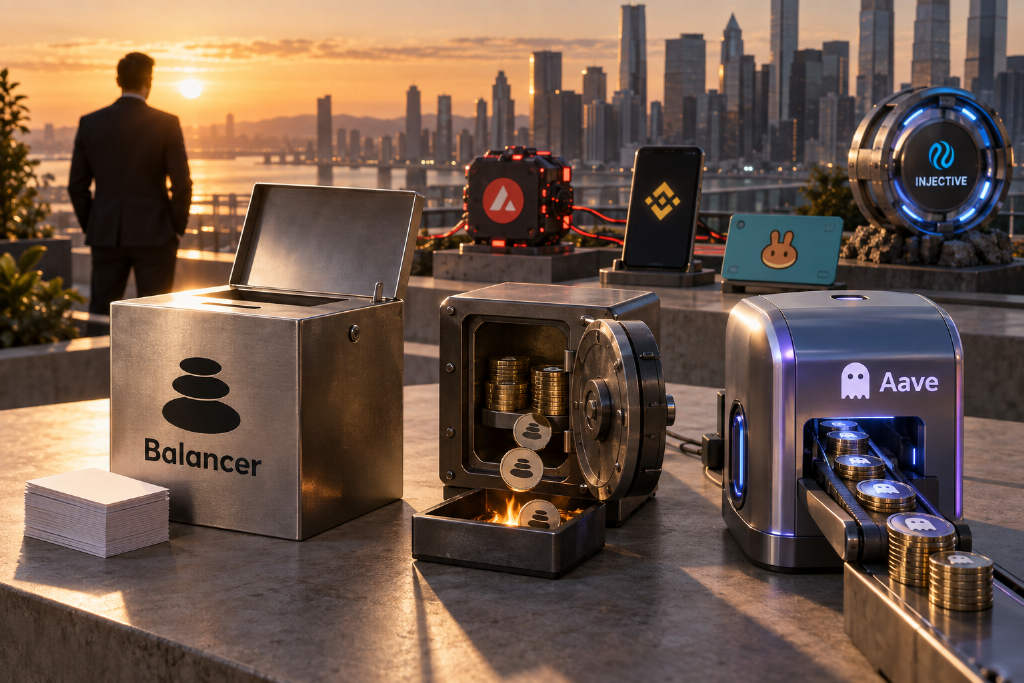
Crypto KOL @TheDeFiInvestor put out a rundown of this week’s main market catalysts in digital assets. On the list: Balancer’s shutdown proposal, Aave’s planned move toward automated buybacks, Avalanche’s Helicon upgrade, Binance Wallet’s new Pre-Access subscription route with PancakeSwap, and Injective’s Meridian mainnet upgrade.
Balancer heads to a Sept. 25 vote on a shutdown plan
Balancer used to be one of the bigger decentralized exchanges, with total value locked topping $3 billion at its high point. Now it is getting ready to vote on how to close the protocol down.
A proposal posted to the governance forum on Sept. 14 lays it out. Marcus Hardt, a Balancer treasury committee member and former Balancer Labs CEO, proposed an orderly shutdown. The plan would halt new business development, dissolve the DAO where that is legally possible, and hand out treasury assets in kind on a pro rata basis to BAL holders who burn their tokens. Treasury manager kpk said the treasury is currently worth at least $9 million, with around $400,000 set aside for liquidation costs. A BAL buyback program approved earlier would be scrapped too.
The roots of this go back to the Nov. 3, 2025 exploit. Attackers used a rounding flaw in the upscale function and drained more than $128 million from v2 stable pools across several chains. Balancer Labs shut down in March this year. The protocol kept going in a leaner form, but the money never really came back. DefiLlama data shows monthly protocol revenue dropped from $1.13 million before the exploit to $56,800 in August this year. Hardt wrote on X, "The product is built, but no one is buying it." He also said he had underestimated how badly the exploit would weigh on adoption over time.
If the vote passes, liquidity providers would have to withdraw by Oct. 30. After that, pools would switch to withdrawal-only mode. The first redemption window would open at the end of May 2027 and run for six months, letting users burn BAL for a share of the treasury. If the proposal does not pass, the protocol keeps operating under the current lean setup.
The article said BAL is trading around $0.11, down 99.85% from its all-time high of $74.92 in May 2021. Its market capitalization is about $7 million, which is below the treasury’s size.
Aave signals Aavenomics 3.0 and a move to protocol-level buybacks
The Defiant reported that Aave founder Stani Kulechov said on X on Sept. 18 that Aavenomics 3.0 is coming. The new setup would replace the current committee-run buyback model with an automated, non-discretionary onchain mechanism. It would be financed by protocol revenue and revenue from the GHO stablecoin, and it would keep running unless governance votes to stop it.
The current model dates back to phase one of Aavenomics, which governance approved in early 2025. Under that system, Aave’s finance committee buys back $1 million of AAVE each week on the secondary market, or about $50 million annualized. The committee can change or pause the program whenever it wants. Version 3.0 changes the core design: buybacks would sit inside the protocol’s own economic structure instead of needing committee approval every cycle.
The bigger backdrop is the Aave Will Win framework that passed in April this year. Under that plan, 100% of revenue from the Aave protocol, GHO, and branded products such as Aave App, Aave Pro, and Swaps goes to the DAO treasury, while Aave Labs gets only a development budget. Kulechov said revenue currently comes to about $134 million a year. DefiLlama data puts GHO supply at about $599 million, while Aave’s cumulative historical protocol fees have gone past $2.2 billion.
Full specs and the governance schedule will come out on Aave’s next quarterly call. Kulechov said that would happen in "the coming weeks." After the news, AAVE climbed from $79 to as high as $98, then eased back to around $89. Even so, it remained up about 20% on the week.
Avalanche’s Helicon upgrade goes live on Sept. 22
Avalanche’s official developer blog says the Helicon mainnet upgrade is set to activate at 11:00 a.m. Eastern Time on Sept. 22, or 15:00 UTC. Validators need to upgrade to AvalancheGo v1.15.0 before then or they will not follow the new chain. It is the first major technical milestone since Avalanche Summit wrapped up in New York.
The upgrade bundles six community proposals. For regular token holders, three changes stand out. First, the minimum validation period drops from 336 hours to 48 hours. Paired with auto-renewing staking, validators will be able to keep producing blocks after a single stake, with rewards automatically compounded based on preset ratios. Second, the reward threshold for a new validation period rises from 80% uptime to 90%. Validators that miss that mark lose rewards for the period, though their principal will not be slashed. Third, the minimum consumption rate falls linearly from 10% to 7.5% over 90 days. Avalanche’s model says annualized rewards for the shortest validation period will decline by about 1.3 percentage points, while annual inflation will fall by 0.5% to 1%.
There is a technical side too. ACP-194 splits consensus from execution on the C-Chain. Blocks get accepted by consensus first, then move into a parallel execution flow, aiming to cut execution bottlenecks during busy periods. Delegated staking will not get auto-renewal, and each delegation has to fit within a single validation period.
Binance Wallet and PancakeSwap open Pre-Access subscriptions
Binance Wallet said in a Sept. 20 announcement that the new Pre-Access subscription program is being run through PancakeSwap. Users join through self-custody accounts in Binance Wallet, and allocation is based on Binance Alpha points, onchain trading volume in bStocks, and holdings. The first project has not been named. The issue price, implied valuation, redemption mechanism, and legal structure are also still unknown.
The structure is the part that really matters. PancakeSwap is the access point. A third-party service provider handles the underlying tokenized exposure. User assets stay in self-custody wallets. Once the event ends, the process shifts into redemption or refund under the stated rules. And this is not the same thing as buying stock. Binance Research said most tokenized pre-IPO tools are contractual claims linked to shares in private companies. That means holders could end up as creditors, indirect beneficiaries, or derivatives holders instead of appearing on a company’s shareholder register.
Market demand is already building. Binance Research data shows open interest in pre-IPO perpetual contracts tied to Anthropic and OpenAI passed $160 million in September, up from roughly $1 million in April. By comparison, the combined market capitalization of tokenized pre-IPO products from Republic and PreStocks is just $41 million. So Binance entering through the subscription side means traders will be watching closely for the first disclosed company name and token structure.
Injective’s Meridian upgrade targets compliant RWA issuance
Injective’s governance page says that if the Meridian proposal passes, the chain will pause at around 15:00 UTC on Sept. 24 at block height 184,394,000 and resume after upgrading to v1.20.4.
The upgrade comes in three main pieces. It adds regulated token implementations to support compliant issuance of tokenized real-world assets. It also sets up a unified RWA perpetual market so those assets can trade through a single order flow. And it starts testing private RFQ, or request-for-quote, infrastructure to connect institutional participants with onchain pricing ahead of the privacy-focused CypherOS platform. INJ will be the settlement asset for all of this, and the chain pause around the upgrade is a window short-term traders may prefer to avoid.
Other catalysts on the watchlist
Backpack
Kyle Samani said Backpack is about to release its most important product of the year. He joined the Backpack US board on Sept. 2 and made his largest personal angel investment in the company in July. Backpack launched four stock perpetual contracts on Sept. 1 and turned on a shared margin pool across real U.S. equities and crypto derivatives. Samani said the product "will reshape the nature of onchain and offchain trading," but he did not share any more details.
Jumper
Cross-chain aggregator Jumper said a major announcement is coming next week. No details were given. The article called the signal-to-noise ratio low.
FRAX
Frax Finance said it will put out an announcement related to the frxUSD stablecoin next week, without saying anything more specific.