

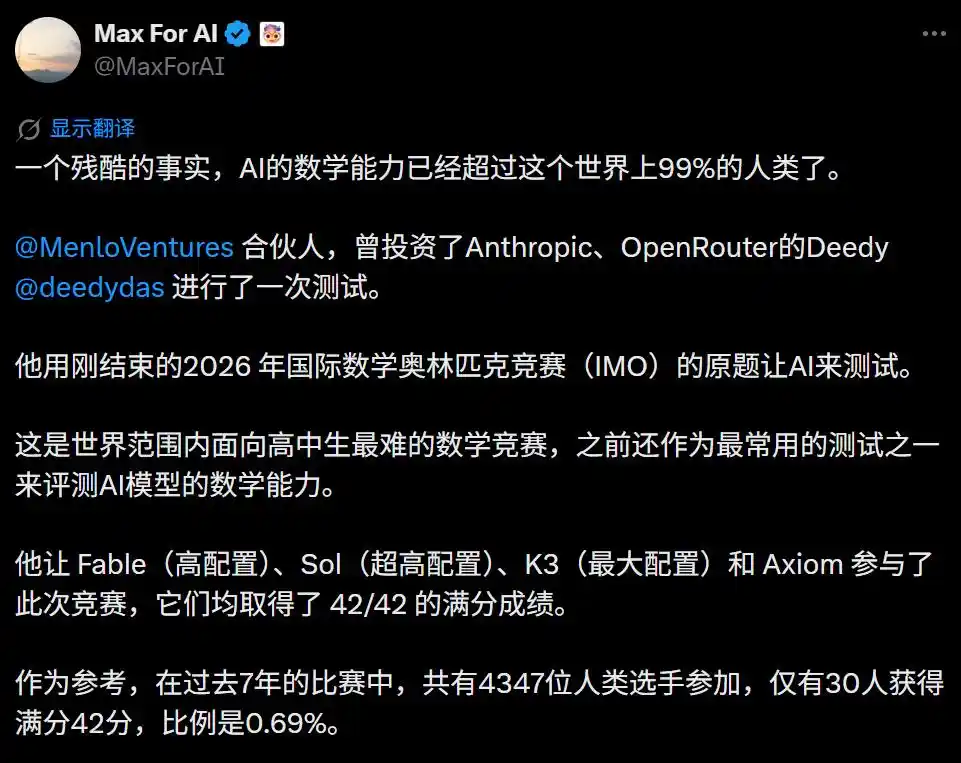
Just as the 67th International Mathematical Olympiad ended with China’s team taking first place on 232 points and three students scoring a perfect 42, another scoreboard appeared on GitHub. In a separate AI benchmark covering all six IMO 2026 problems, three frontier language models and one standalone prover reached full marks.
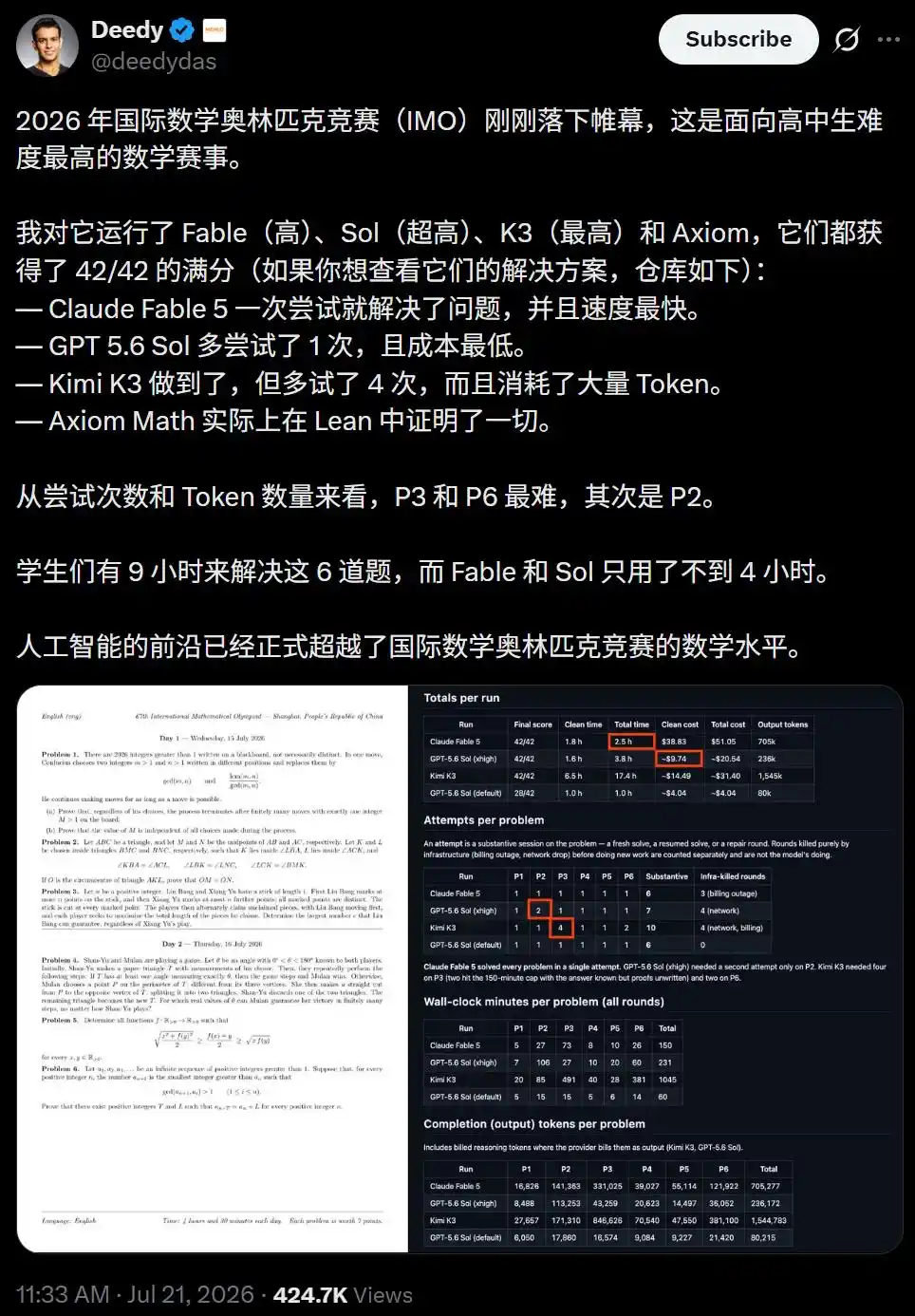
The evaluation was published by former Google engineer Deedy Das. Seven leading models were tested in a fully autonomous setup on the entire IMO 2026 problem set. Claude Fable 5, GPT-5.6 Sol xhigh, and Kimi K3 each scored 42 points, and AxiomProver also turned in a separate perfect result.
Perfect scores from four systems
Claude Fable 5 completed the benchmark in 2.5 hours at a cost of $51 and finished with 42 points. GPT-5.6 Sol xhigh also posted 42 points, taking 3.8 hours and costing $20. Kimi K3 reached the same score after 17.4 hours, with a reported cost of $31.
Counting AxiomProver’s independent submission, four separate systems reached the top score.
The comparison with human performance was stark. Over the past seven years of the IMO, 4,347 human contestants took part, and only 30 recorded perfect scores, or 0.69%.

A wide gap below the leaders
The article said the spread was not close: the perfect-score group at 42 stood 14 points above the fourth-place result of 28. The way the top three got there also varied sharply.
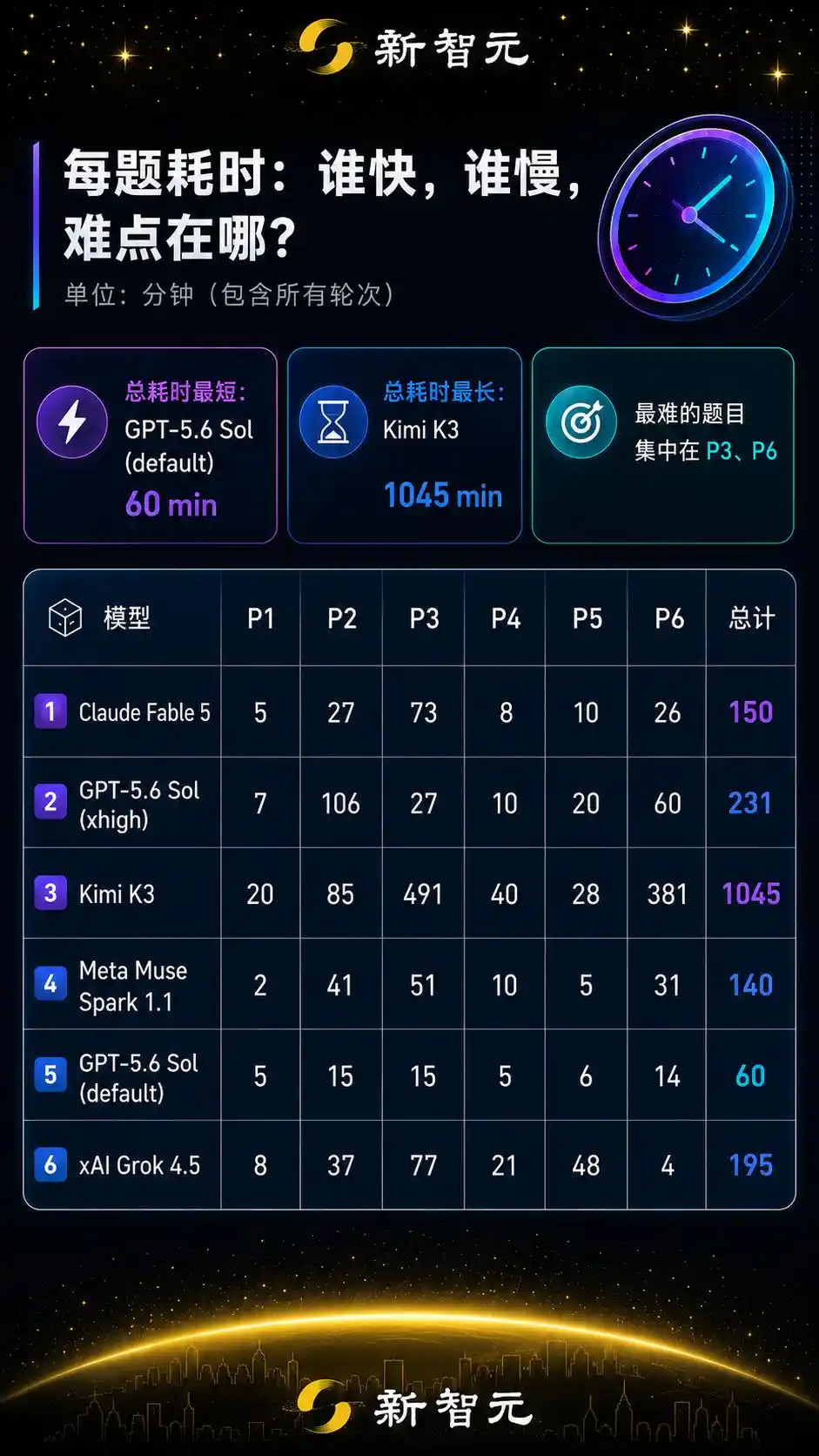
Claude Fable 5 was the cleanest run. It used nine dialogue turns, with six effective outputs. Its longest single stretch was 73 minutes on problem P3, and the full run produced 700,000 tokens.
GPT-5.6 Sol looked less smooth. It spent 106 minutes over four rounds on P2 and was interrupted twice by network failures. Even so, its compute profile was unusually tight: total output came to 230,000 tokens, the lowest among the three perfect-score models.
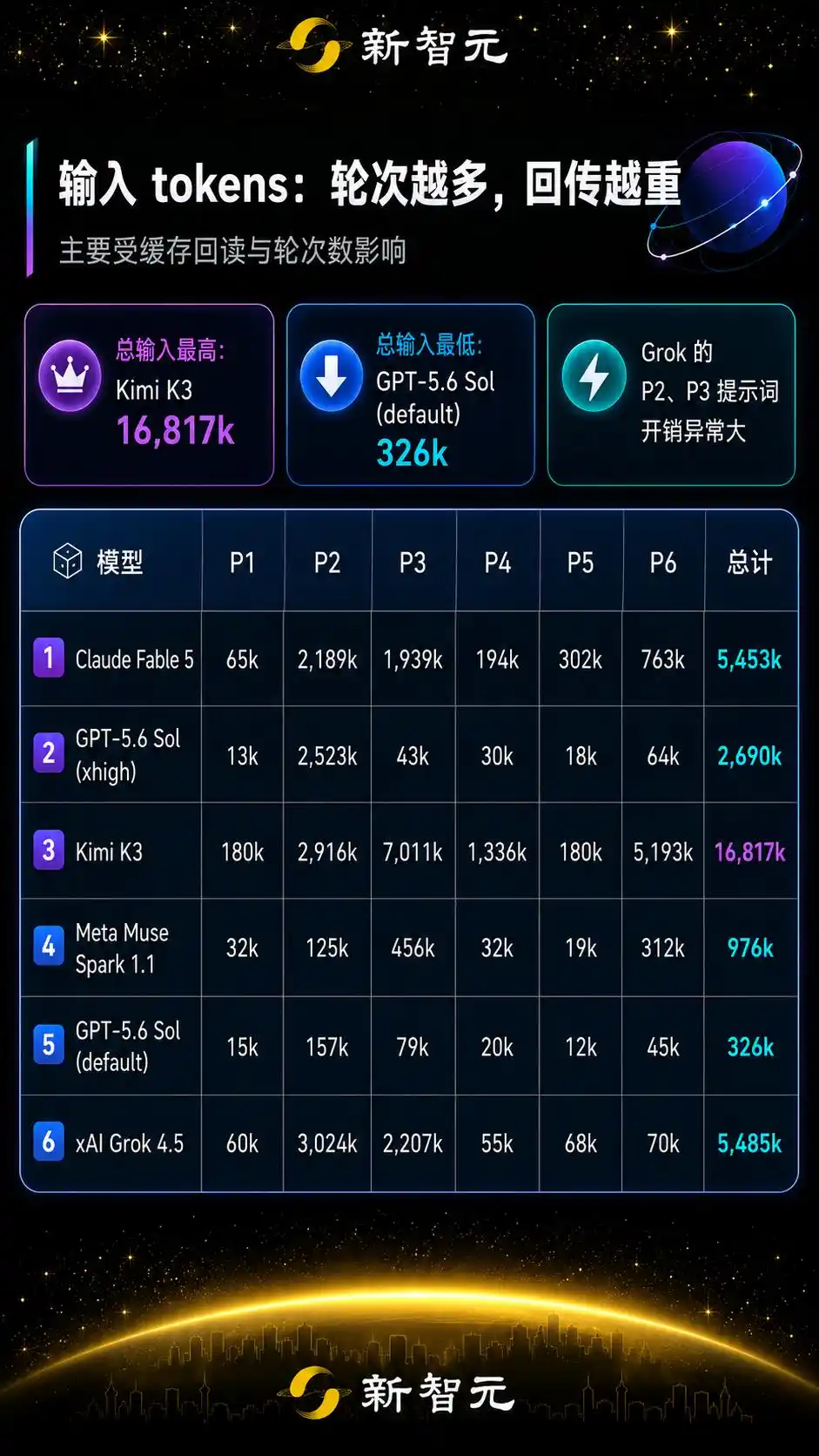
Kimi K3 took the opposite approach. The 2.8 trillion-parameter mixture-of-experts model generated 1.54 million tokens, roughly 6.5 times Sol’s total. On P3 alone, it made six attempts and spent 491 minutes.
Problem P1 exposed different mathematical instincts
P1 was described as the gentlest entry point in the set. The problem starts with 2,026 integers greater than 1 written on a board. At each step, two numbers m and n are removed and replaced with gcd(m,n) and lcm(m,n)/gcd(m,n). The task is to prove two claims: first, that the process must end and leaves exactly one number greater than 1, called M; second, that M does not depend on the order of operations.
The article used a small example with 12 and 18. Since 12 = 2² × 3 and 18 = 2 × 3², the first step gives gcd(12,18) = 6 and lcm(12,18)/6 = 6, so the board becomes [6, 6]. The second step gives gcd(6,6) = 6 and lcm(6,6)/6 = 1, leaving [6, 1]. Only one number greater than 1 remains, so M = 6.
Claude Fable 5 and GPT-5.6 Sol proved termination in different ways.
Claude Fable 5 introduced a single quantity Φ = T + N, where T is the total number of prime factors across all board entries, counted with multiplicity, and N is the number of entries greater than 1. For [12,18], T = 6 and N = 2, so Φ = 8. It then showed that every operation reduces Φ by at least 1. If gcd(m,n) > 1, then T drops. If gcd(m,n) = 1, T stays the same but N drops by 1. Since Φ is a positive integer and falls at every step, the process must terminate.
GPT-5.6 Sol tracked a pair instead: P, the product of all numbers on the board, and K, the count of numbers greater than 1. If gcd(m,n) = d > 1, the product of the two replacement numbers becomes mn/d, which is strictly smaller than before, so the global product P falls. If d = 1, then P stays unchanged but K decreases by 1. The ordered pair (P, K) therefore decreases strictly in lexicographic order, which gives termination.
For part (b), the three models converged on the same invariant. For each prime p, the greatest common divisor of the p-adic valuations across all numbers on the board remains unchanged throughout the process. That invariant determines the final value of M uniquely.
The 12-and-18 example checks out under the same rule. For p = 2, v₂(12) = 2 and v₂(18) = 1, so the gcd is 1 and contributes 2¹. For p = 3, v₃(12) = 1 and v₃(18) = 2, so the gcd is again 1 and contributes 3¹. The result is M = 2 × 3 = 6.
P6 showed both strong finishes and a cheap blank submission
P6, a number theory problem on Day 2, asked for a proof that a recursively defined sequence eventually becomes periodic. The article noted that only six human contestants worldwide solved P6 at IMO 2025.
On this problem, Claude Fable 5 finished in 26 minutes over two rounds for full marks. GPT-5.6 Sol took 60 minutes and two rounds, also for full marks. Kimi K3 needed 381 minutes and four rounds and still got full marks.

Grok 4.5, by contrast, produced only 7,053 tokens on P6. Its submitted file included the line: "Full proof: (Not yet complete.)" The reported cost of that failed attempt was just $0.18.
The article argued that Grok’s issue was not purely mathematical. It was an agent problem. The model repeatedly claimed that the proof had already been written to a file, while the backend showed that it had not actually invoked the writing tool. In other words, it knew what action was required and said it had taken it, but did not execute it at the tool layer.
A three-year jump
The article placed the benchmark in a short timeline of rapid progress.
In 2024, DeepMind’s AlphaProof first reached the silver-medal threshold on IMO-level problems.
In 2025, OpenAI and DeepMind both pushed ahead. An undisclosed OpenAI model solved five problems for a gold-level score of 35, while Gemini Deep Think reached the same tier.
In 2026, three general-purpose large models posted perfect scores. The article stressed that this time the models had not gone through specialized mathematics training, and that the capability was no longer limited to a lab setting. One of the systems was also open source.
Axiom Math supplied the machine-readable IMO problems
The benchmark started with Axiom Math, the company that translated all six IMO 2026 problems into formal Lean 4 statements that machines could read directly.
That formalization let AI systems produce Lean proofs that could be graded automatically by a compiler, removing the need for human judges to score the papers. Once the machine-readable statements were ready, Deedy Das built an automated framework to run the models across the full six-problem track. AxiomProver also recorded a perfect score inside that setup.
The article added that Axiom Math founder Hong Letong is 25 years old and was born in Guangzhou. It said she completed MIT degrees in mathematics and physics in three years and is a Morgan Prize winner. Late last year, AxiomProver, which she built, achieved a perfect score in the Putnam competition, described in the article as only the sixth perfect result in the contest’s 98-year history. In March this year, the company completed a $200 million Series A round at a $1.6 billion valuation.
Why the article says this matters outside mathematics
The closing section argued that a model capable of writing 4,229 lines of strict proof is demonstrating more than olympiad problem-solving skill. The core capability is long-chain logical reasoning, where steps cannot be skipped, errors cannot be glossed over, and answers cannot be approximately right.
The article linked that capability to areas such as contract review, insurance claim conditions, and tax compliance analysis. Those tasks, it said, share the same structure: they require point-by-point verification. Work of that kind has traditionally been done by professionals billing by the hour. As such systems move into consumer products, the article suggested that ordinary users may eventually handle difficult cases directly from a phone.
The cited reference was Deedy Das’s post on X. The original Chinese article was published by the WeChat account Xinzhiyuan, written by "ASI Qishilu" and edited by "Moxi."