
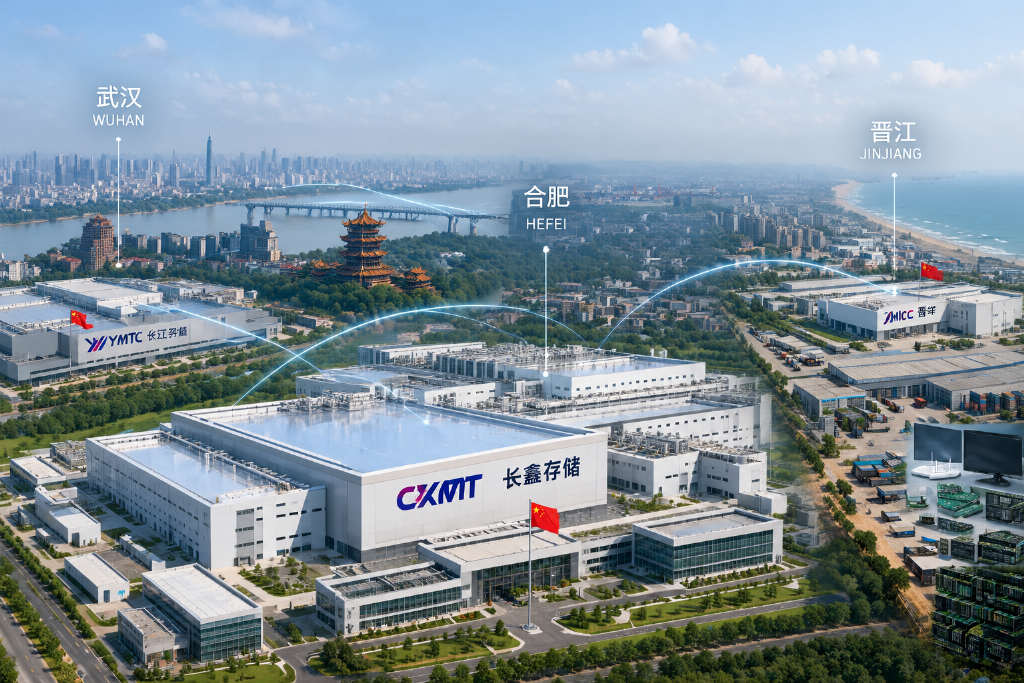
Back in 2016, three Chinese cities went after the same business in a big way: memory chips.
At that point, 96% of the world market sat in the hands of Samsung, SK Hynix, and Micron. Mainland China had almost nothing. Ten years on, the three stories went in completely different directions: one company got so big that on its listing debut it overtook Industrial and Commercial Bank of China in market value, one has already submitted for an IPO, and one has shifted toward memory used in routers and other consumer gadgets.
The three cities were Wuhan, Hefei, and Jinjiang in Fujian.
Wuhan: ten years of waiting before Yangtze Memory really emerged
Wuhan was the first to jump.
In April 2006, the Hubei provincial government, the Wuhan municipal government, and the East Lake High-tech Zone together put in RMB 10 billion to build Wuhan Xinxin. It was central China’s first 12-inch chip project. At the time, it was also the country’s only chip plant mainly aimed at memory.
Then came trouble. Fast.
Wuhan Xinxin officially began production in September 2008 with capacity of 3,000 wafers per month. For a sense of scale, the source article says ChangXin in Hefei now produces 300,000 wafers a month. So Wuhan Xinxin back then was running at less than 1% of ChangXin’s current level.
Its customer structure was shaky too. Almost all orders came from Spansion, a joint venture between AMD and Fujitsu. In the very month Wuhan Xinxin started production, Lehman Brothers collapsed, the 2008 financial crisis hit, and Spansion filed for bankruptcy protection. The fab was there. Its main customer was not.
Operations stayed weak, and Wuhan Xinxin was later put under the management of Semiconductor Manufacturing International Corp. (SMIC).
Around 2011, Micron came knocking and discussed a $200 million investment that would have made it the controlling shareholder. The deal went nowhere. After that, Wuhan Xinxin spent another five years just hanging on by making NOR Flash chips for other customers.
The real shift came in 2016, when China decided to build a national memory base. Hubei revised its application more than 30 times. In March 2016, the project was awarded to Wuhan Optics Valley, with total planned investment of $24 billion, the biggest single high-tech investment in Hubei at the time.
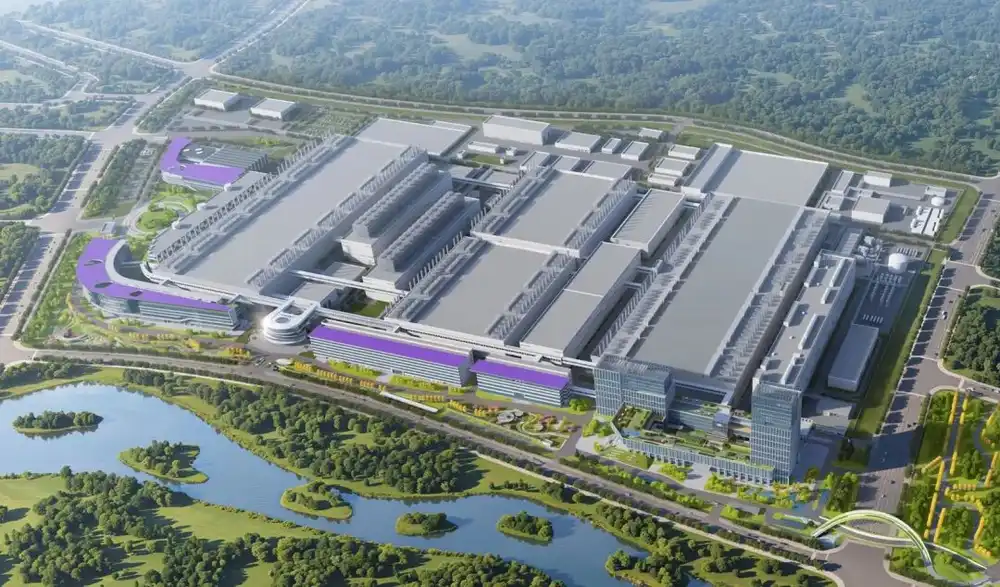
That July, Yangtze Memory Technologies Co. (YMTC) was set up on the base of Wuhan Xinxin. Its focus was NAND flash, the kind used in USB drives and solid-state drives.
The money mix changed too. The first phase of the National Integrated Circuit Industry Investment Fund put in about RMB 13.6 billion, and the second phase added about RMB 12.9 billion. State-owned capital from Hubei, Wuhan, and Optics Valley contributed more than RMB 30 billion combined.
According to the article, YMTC now holds about 12% of the global NAND market, putting it close to the top three. Its first-quarter 2026 revenue topped RMB 20 billion, up 100% from a year earlier, and its STAR Market IPO application was formally accepted on Aug. 21, 2026.
Hefei: no national slot, so it built its own
There was only one opening for the national memory base. Wuhan got it. Hefei got shut out.
But Hefei had already made one huge industrial wager before memory. In 2008, the city had a large home-appliance sector but relied heavily on imported display panels, so it used nearly one-third of its annual fiscal revenue to invest in BOE Technology Group, which was then losing more than RMB 1 billion. That bet paid off.
From there, Hefei built what the article calls its local formula: chips, displays, autos, and integrated development. It had displays already, but still needed chips to drive them. So in 2015 it brought in Nexchip to fill that hole. The company did not chase the most advanced process nodes. It went after local supply-chain demand.
When memory came up, Hefei kept it simple: if it could not join a national project, it would find someone and build one itself.
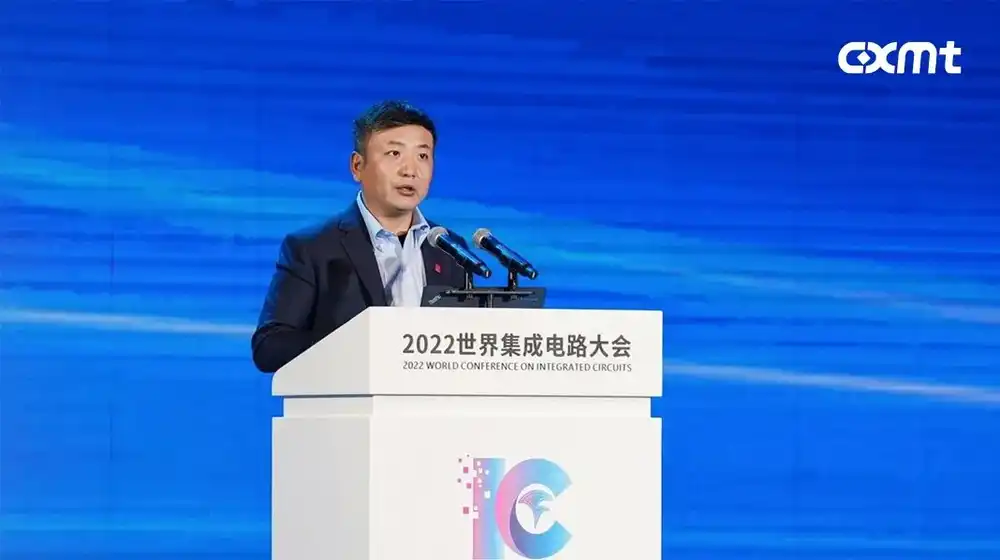
That someone was Zhu Yiming. Born in 1972, Zhu studied physics at Tsinghua University for both undergraduate and graduate school, then headed to Silicon Valley. He returned to China in 2005 and started what later became GigaDevice in a small office in Tsinghua Science Park. He chose NOR Flash, a smaller niche that let him avoid a head-on fight with the global giants, and built the company into one of the world’s top three in that segment.
In August 2016, GigaDevice listed in Shanghai and its market value climbed past RMB 20 billion. Around the same time, Zhu turned toward a much tougher arena. The article puts the global NOR Flash market at about $3 billion, while DRAM, the chip used in memory modules, was worth more than $90 billion. Mainland China had no foothold there at all.
Hefei’s talks with Zhu happened at what the article describes as exactly the right moment. Internally, the project was reportedly called the “506 Project,” because the earliest special consultation happened on May 6, 2016.
The first phase was budgeted at RMB 18 billion in total investment, with Hefei Industrial Investment and GigaDevice contributing in a 4:1 ratio. Hefei Industrial Investment put up RMB 14.4 billion. GigaDevice put up RMB 3.6 billion. So yes, a provincial capital in central China was supplying 80% of the startup money to enter a field that only three companies in the world knew how to do at the time.
The opening goal was modest. Really modest. By the end of 2018, the project only had to finish R&D and reach a 10% yield. If 10 out of 100 chips worked, that would be counted as success.
In July 2018, Zhu made a move that stunned the capital market. He stepped down as GigaDevice’s general manager and shifted full-time to ChangXin Memory Technologies (CXMT) as chairman and CEO. He also promised that if the project did not become profitable, he would not take a salary.
The article says ChangXin’s earliest technology base came from a cross-border purchase of process documents and patent rights. After German memory maker Qimonda went bankrupt in 2009, more than 7,000 DRAM patents ended up with a Canadian company. Zhu’s team negotiated for a long time and completed the transaction in two steps in 2019: first obtaining 10 million files totaling 2.8 TB of complete process documentation, then later that year signing patent licensing and buyout agreements.
In September 2019, ChangXin’s first-generation 8Gb DDR4 entered production, giving mainland China its first genuine step from zero to one in DRAM.
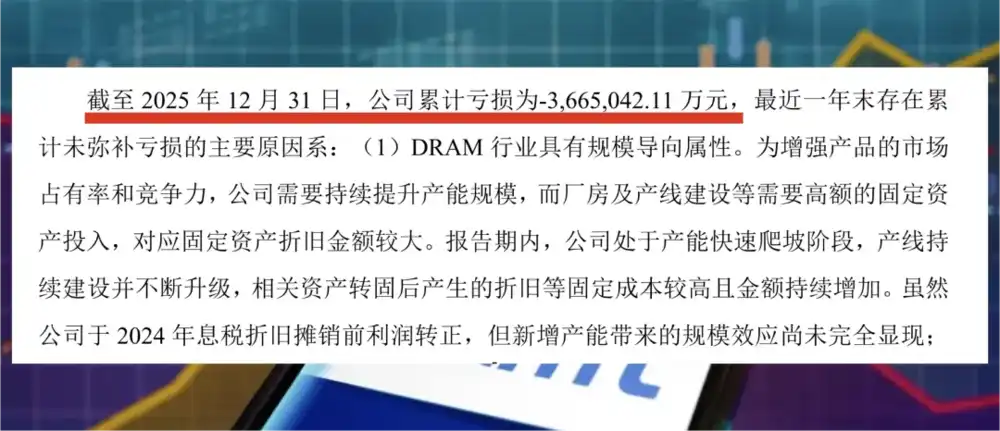
The price was brutal. From 2016 to 2019, ChangXin had no product revenue at all and piled up losses of more than RMB 10 billion. From the first phase landing in 2017 through 2025, cumulative losses exceeded RMB 36.6 billion. The article says that comes to an average loss of more than RMB 10 million a day over eight years.
And through all of that, Hefei’s state capital did not skip a single financing round. At the end of 2024, when Country Garden Venture Capital wanted out, municipal state capital in Hefei spent nearly RMB 2 billion to take over the old shares.
Jinjiang: the fastest route, then a sudden halt
The third city may have been the least expected of the three: Jinjiang in Fujian.
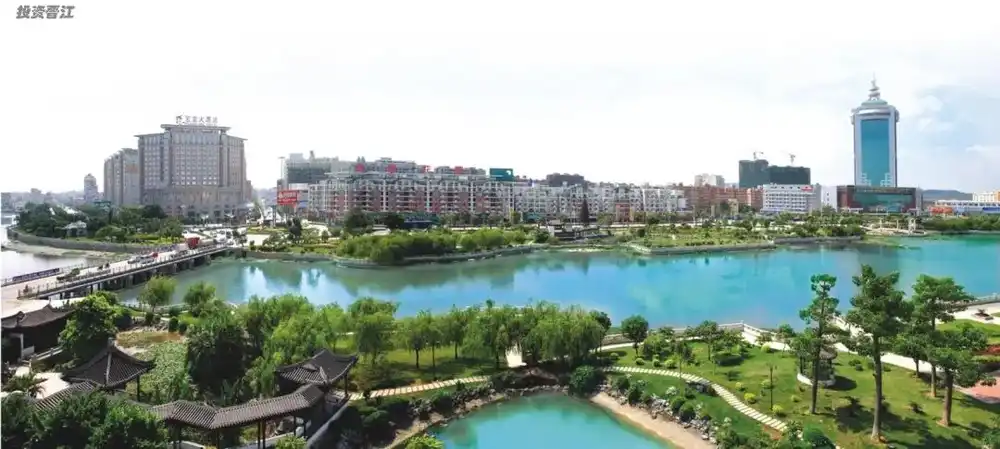
Jinjiang is known for private-sector brands like Anta, Xtep, 361 Degrees, Erke, and Panpan. More than 90% of its GDP comes from the private economy. The article says one out of every seven people in Jinjiang is a business owner. And this city also decided to enter memory chips.
Fujian Jinhua Integrated Circuit Co. was established in February 2016 by Fujian Electronics & Information Group and Jinjiang Energy Investment Group. Unlike Wuhan and Hefei, Jinhua did not intend to build every piece from scratch.
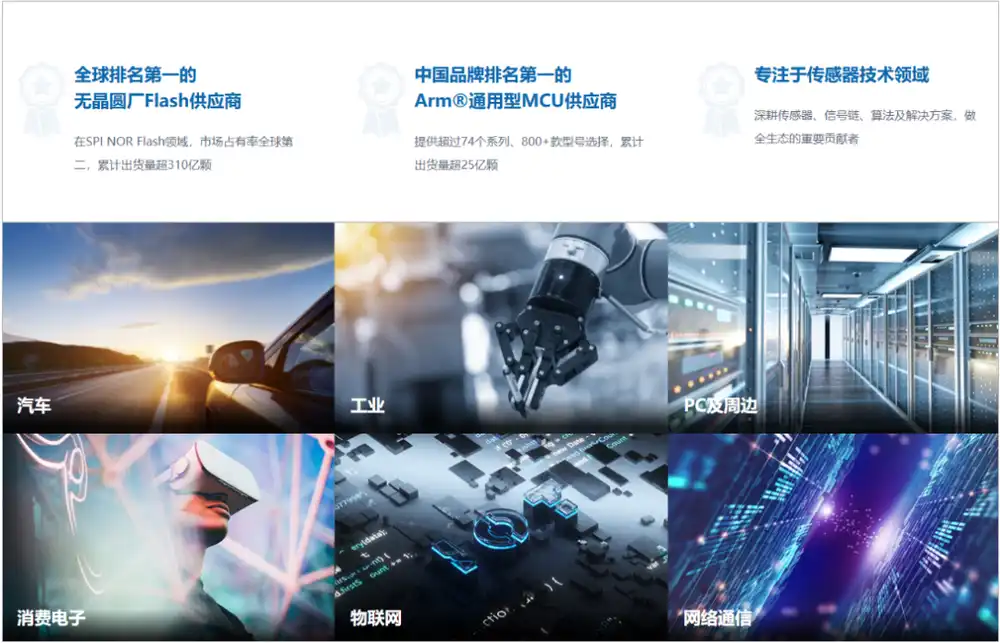
Only three months after its founding, in May 2016, it signed a technology cooperation agreement with Taiwan’s United Microelectronics Corp. (UMC). UMC would supply the technology. Jinhua would supply the money and the fab. Construction began on July 16. The industrial park covered 594 mu, first-phase investment was set at RMB 37 billion, and the target was monthly output of 60,000 wafers by September 2018.
That was the shortest route of the three. If it had worked, Jinhua probably would have been first into mass production.
In the first half of 2018, it really looked like Jinhua might win that race. It sued Micron in Fuzhou over patent infringement. On July 3, 2018, the Fuzhou Intermediate People’s Court ruled that more than a dozen Micron SSD and memory products should immediately stop being sold in China. The article calls that the first time a Chinese memory company had pinned down one of the three global giants.
Then it flipped. Hard.
On Oct. 29, 2018, the U.S. Commerce Department put Jinhua on the Entity List. Three days later, the U.S. Justice Department charged Jinhua and UMC with stealing Micron trade secrets. Equipment supplies were cut off, and Jinhua’s production line stalled just one step short of mass production.
Ten years later: three roads, three endings
ChangXin came out ahead.
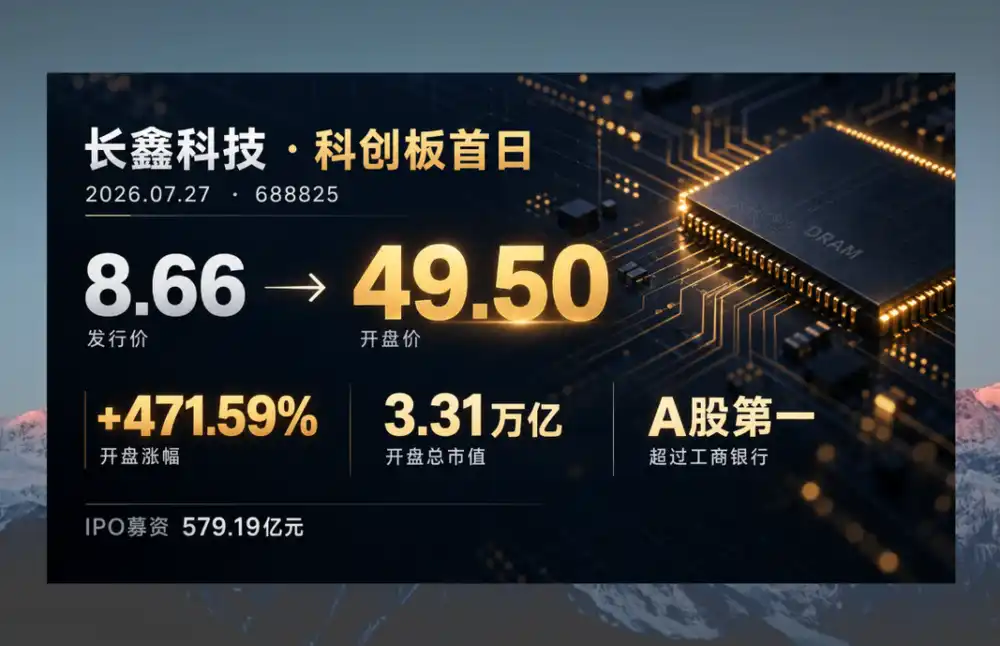
On July 27, 2026, it listed on the STAR Market with an issue price of RMB 8.66 and an opening price of RMB 49.5, a jump of 471.59%. Its market capitalization hit RMB 3.31 trillion. The article says that put it above Industrial and Commercial Bank of China at the open, making it the largest A-share company by market value. The IPO raised RMB 66.6 billion, the biggest in Asia in 2026.
The years of losses were quickly swallowed by earnings. In the first quarter of 2026, ChangXin reported revenue of RMB 50.8 billion, up more than sevenfold year over year. For the first half, it expected revenue of RMB 110 billion to RMB 120 billion and net profit of RMB 50 billion to RMB 57 billion. In the article’s words, half a year was enough to earn back what had been lost over the previous decade.
YMTC is on another path. It is pushing toward the global top three in NAND and is now waiting in the IPO line. Wuhan’s integrated-circuit industry also passed RMB 100 billion in annual scale for the first time last year.
Jinhua took a different turn. In 2023, it reached a global settlement with Micron, clearing its legal hurdles, though it is still on the Entity List. After supplies were cut, Jinhua began dismantling imported equipment and, together with Advanced Micro-Fabrication Equipment Inc. China (AMEC) and NAURA Technology Group, assembled a fully domestic mature-process production line. It has accumulated 1,007 patents.
Its current monthly capacity is 40,000 wafers, and it plans to expand to 60,000 this year. Instead of fighting ChangXin in high-end DRAM, it now goes after memory used in smart TVs, set-top boxes, printers, and routers. In 2025, Jinhua posted revenue of RMB 753 million and net profit of RMB 247 million.
The article adds one plain line: the memory chip inside a home router may very well come from Jinhua.
In the same period, some projects never even really started
The article sets those three against a string of failed semiconductor projects.
One example is Wuhan Hongxin. Founded in November 2017, it claimed total planned investment of RMB 128 billion. It brought in Chiang Shang-yi, the veteran executive who had worked at both TSMC and SMIC, as general manager, and at one point ranked first among Wuhan’s major city-level construction projects.
By 2020, though, the project had ground to a halt. Most of its land was seized by the court, and 240 employees were told they were “required to resign” without compensation.
Other failures from the same stretch included Chengdu GlobalFoundries, which planned to invest $9.053 billion; Nanjing Decoma, a $3 billion project that later went bankrupt; Guizhou HXT Semiconductor, a joint venture with Qualcomm that shut down in January 2019; and Shaanxi Kuntong, a nearly RMB 40 billion project that ran into wage arrears.
So within the same window, with local governments all throwing money into the sector, the results split into four tiers: one company reached RMB 3.31 trillion in market value, one is preparing to list, one makes router memory, and a batch of others did not even finish their buildings.
Wuhan itself ended up holding both extremes at once: one of China’s most successful memory projects, and one of its best-known unfinished semiconductor projects.
Hefei’s paper gains and the employee jackpot
The article also points to a striking set of figures.
From 2015 to 2021, during the hottest seven years of China’s property market, Hefei took in about RMB 551.6 billion from land sales. On the day ChangXin listed, the roughly 37% stake held by Hefei state capital was worth more than RMB 1.2 trillion on paper, implying nearly RMB 1 trillion in unrealized gains.
Put differently, the paper gain from this one company was worth more than twice seven years of land-sale revenue.
Employee shareholding delivered even bigger percentage returns. ChangXin ran two employee stock ownership plans. In the second plan, the grant price was RMB 0.108 per share. Based on the listing price cited in the article, the paper return was more than 450 times. Among the 377 executives and core employees who joined the strategic placement, at least 237 became paper millionaires in RMB terms.
The article also makes clear that the RMB 1.2 trillion number is a paper valuation, not cash in hand.
What other cities failed to copy
Many cities went to Hefei to study its model, then went home and tried to invest the same way. But, the article says, none of them produced a second Hefei. In its telling, most places copied the willingness to spend, but not the deeper mechanism underneath.
That mechanism was tolerance for failure.
As early as 2014, Hefei was among the earlier Chinese cities to put forward a framework of “due-diligence exemption” and “tolerance for failure.” It set explicit loss-tolerance ratios for different fund types: 30% for angel funds and 10% for guidance funds.
Those thresholds were raised later. In 2021, the angel-fund tolerance ratio was lifted to 40%. In 2022, the seed-fund ratio was raised to 50%.
Hefei also created an operating list for due-diligence-based exemption from liability. As long as an investment decision followed the required due-diligence procedures, disclosure rules, and collective decision-making process, the officials in charge would not be excessively pursued even if the project failed.
Citing reports, the article says Hefei has never punished any unit or individual for an investment failure. One local state-backed venture investor is quoted as saying, “Losses in corporate investment are normal. That is how the market works.”
Jiang Xin, chairman of Hefei Industrial Investment, offered a similar way of looking at it: some projects will fail, but the gains from the winners may be ten times or even dozens of times larger, enough to cover the losses from the failures.
The real value of that system was not proved on the day ChangXin listed. It was proved in years five, six, and seven of losses. That is the hard part. A project that loses money for eight straight years may run across two or three different local administrations. If losses automatically trigger accountability, the easiest move is obvious: stop the project, cut the damage, and switch to something that pays back faster.
Hefei did not do that. When ChangXin had gone three years without revenue and had already lost more than RMB 10 billion, the city did not cut the budget and did not shut the project down.
The article quotes a line often attributed to former Hefei party secretary Yu Aihua: “This was not venture capital. It was industrial investment; not gambling, but hard effort.”
The rules changed
But the story does not stop there.
In January 2025, a State Council General Office document referred to in the article as “Document No. 1” said government investment funds should not be set up for the purpose of attracting investment. It also encouraged local governments to reduce or remove return-investment requirements, and said party and government organs as well as public institutions must not establish new funds in any form.
The industry view at the time, according to the article, was that local special-fund models built around investment attraction would become hard to sustain, and that “fund-based investment attraction” might become a thing of the past.
Then in June 2026, another set of rules tightened things again, explicitly banning city- and county-level governments from using funds as a disguised form of fiscal subsidy and warning against disorderly expansion of hidden local debt.
Seen that way, Hefei’s 18-year path from BOE to ChangXin looks unusually specific. The article’s takeaway is simple: the city won a particular game, in a particular time window, with a particular institutional setup, and the rules of that game have since been rewritten.
The original piece was published by the WeChat public account TOP Innovation Zone Research Institute and credited to its Industry Research Group.