
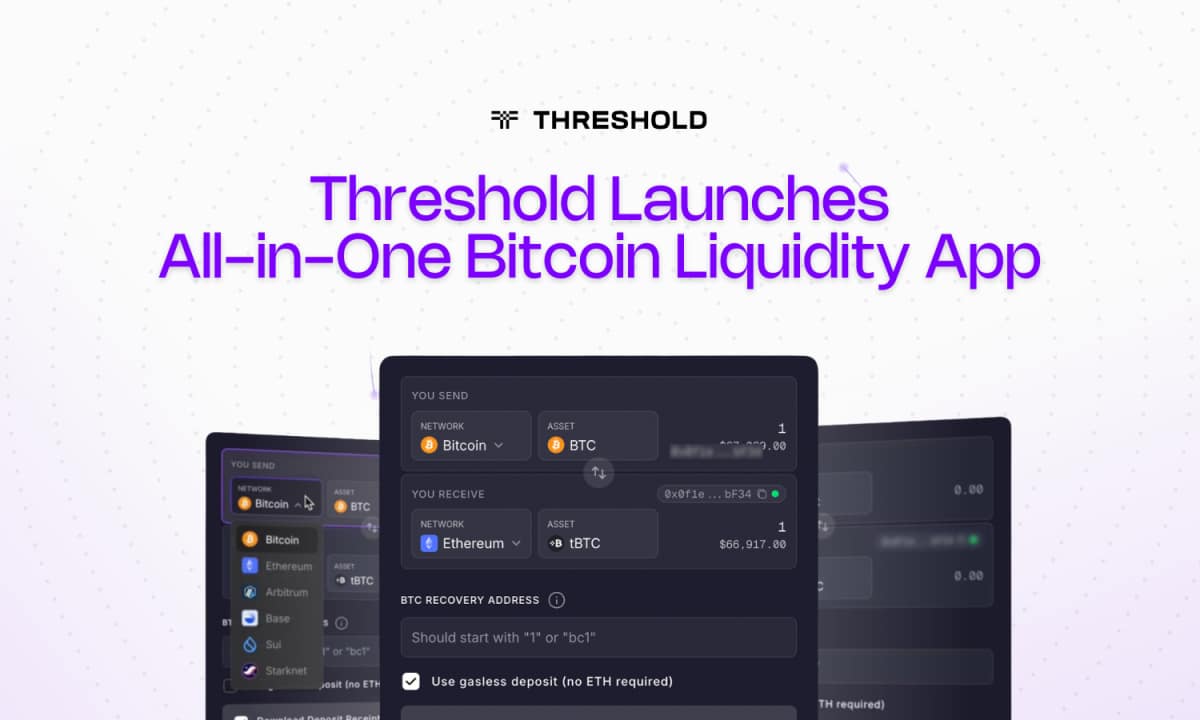
Threshold Network has rolled out an updated decentralized application centered on a Unified Bitcoin App, bringing minting, redeeming, bridging, tracking, and native BTC swaps into a single interface. The release is designed to let users move Bitcoin across connected ecosystems without stitching together separate tools and protocols for each step.
The app is built around tBTC. According to Threshold, getting BTC into tBTC and moving it across chains previously required several disconnected workflows: minting in one app, bridging through another protocol, swapping on separate venues, and manually checking pricing along the way. That fragmented setup added friction, extra cost, execution risk, and operational complexity for users trying to access DeFi with Bitcoin.
One interface handles routing across multiple chains
With the new router, users choose a source asset and a destination asset, and the system assembles the execution path automatically. Threshold says available routes are evaluated and ranked by cost, speed, reliability, and simplicity, with clearly labeled options shown inside the app instead of requiring manual comparison across bridges and liquidity venues.
The framework currently connects Bitcoin, Ethereum, Arbitrum, Base, Sui, and Starknet. It combines native tBTC mint and redeem flows with established bridging infrastructure and DEX aggregation, allowing multi-step transactions to be coordinated from one place. For trades that require a swap, a bridge, or several sequential actions, execution is handled through that unified interface.
Direct conversion from WBTC and cbBTC into tBTC
The update also adds more direct conversion paths for wrapped Bitcoin assets. The router supports streamlined conversions from WBTC and cbBTC into tBTC on the destination chain, giving users a shorter route into Bitcoin liquidity across DeFi ecosystems. Native BTC swaps are integrated directly into the routing engine as well. Threshold says the feature taps deep Ethereum liquidity to improve pricing and execution efficiency compared with fragmented pools on individual chains.
In a statement included with the release, the project said capital should move across chains efficiently without forcing users to manage infrastructure decisions themselves. The new app coordinates liquidity sourcing and settlement behind the interface so Bitcoin can be deployed more efficiently across ecosystems.
Staked T status is reflected in fee handling
Threshold also tied the update to the utility of its token, T. The app tracks staked T from a connected wallet and reflects staking-aware fee logic inside the interface. Eligible T stakers can see applicable redemption fee waivers surfaced directly in the app. Gasless minting remains available as an opt-in feature, aimed at lowering transaction costs.
Another addition is persistence for in-flight operations. If a user refreshes, disconnects, or leaves a session before completion, progress is preserved rather than lost. Threshold says this is meant to reduce failed cross-chain flows and cut operational friction. A new explorer section also consolidates historical mint, redeem, bridge, and swap activity into one view for easier tracking.
tBTC utility expands across six ecosystems
Threshold says the launch expands tBTC utility across six ecosystems and increases throughput across minting, bridging, and swap flows. The project describes tBTC as a non-custodial, 1:1 Bitcoin-backed asset secured by a 51-of-100 threshold signer model. In the background information attached to the release, Threshold says its infrastructure has logged more than six years of proven security and about $5.1 billion in bridge volume.