
Texas Instruments and Analog Devices both delivered stronger quarterly results, but the latest numbers point to two distinct recovery paths inside the analog chip market.
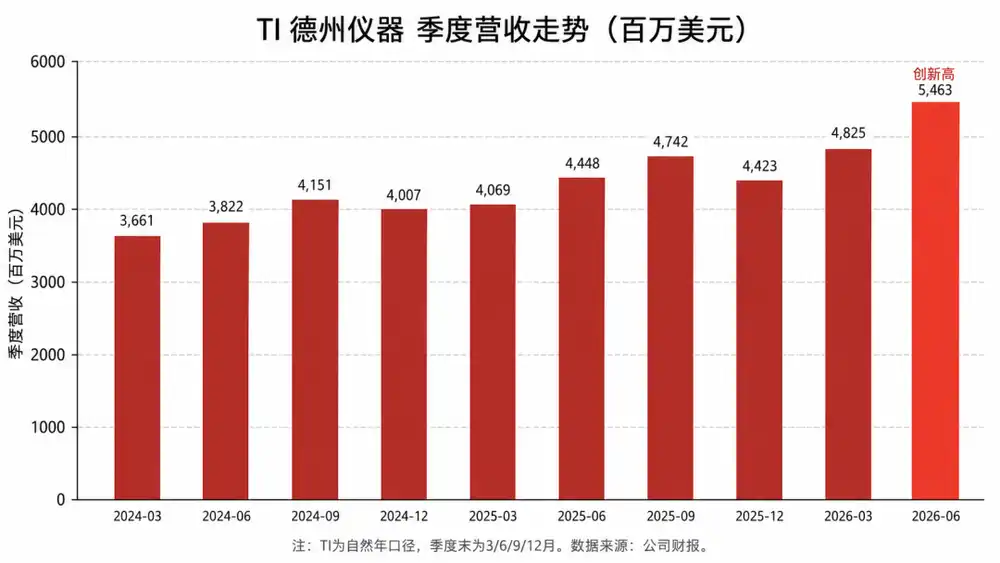
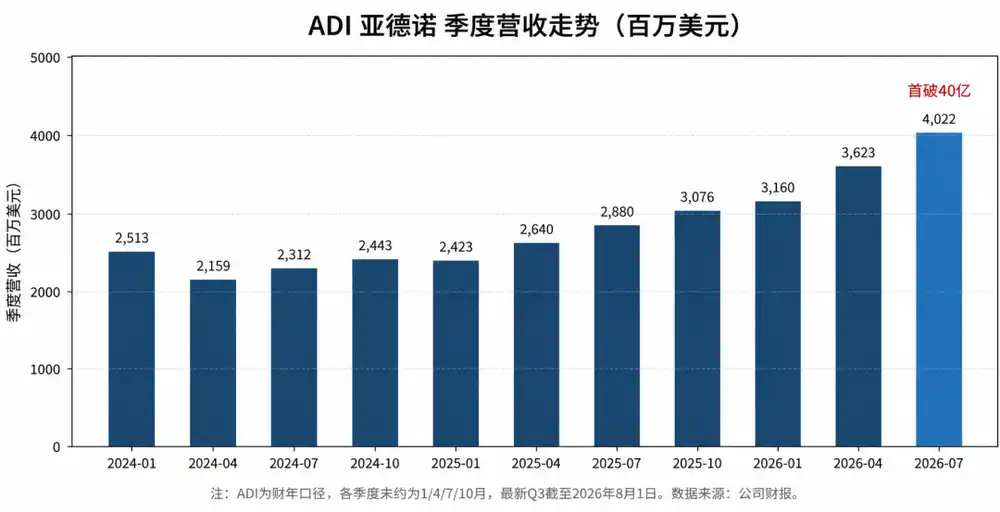
Texas Instruments, or TI, reported $5.463 billion in revenue for the second quarter of 2026 ended June 30, up 23% from a year earlier and 13% from the prior quarter. Analog Devices, or ADI, reported $4.022 billion in revenue for its fiscal third quarter of 2026 ended Aug. 1, up 40% year over year and 11% sequentially. It was ADI’s first quarter above $4 billion in revenue and a record for the company.
Both companies benefited from stronger demand in industrial markets and data centers. The overlap ends there. Their revenue mix, margin trends, inventory posture, supply conditions and pricing commentary show that the current rebound is not being driven in quite the same way.
Growth accelerated at both companies, but scale and timing were different
On a year-over-year basis, ADI grew faster than TI. On a sequential basis, the gap was much smaller. TI still operates on a larger scale, with quarterly revenue about 1.36 times ADI’s latest figure.
Over a longer period, the shape of the recovery also differs. TI’s quarterly revenue bottomed in the first quarter of 2024 at $3.661 billion. ADI hit its low in fiscal second quarter 2024, at $2.159 billion for the quarter ended in late April. Both companies recovered from those troughs, but not at the same pace. TI went through a choppier stretch over the previous two years and only posted a clear two-quarter surge this year. ADI spent roughly a year hovering near the bottom, then began to rise more visibly and moved in a steadier line through 2025 until topping $4 billion.
Industrial and data centers lifted both, though the mix was not the same
TI described the quarter as broad-based. Industrial, which accounted for 33% of total revenue in 2025, rose about 30% from a year earlier. Data center revenue, representing 9% of the total, doubled year over year. Automotive, also 33% of revenue, increased by the mid-teens and improved noticeably during the quarter. Personal electronics, at 21%, was flat. Communications equipment, at 3%, increased both year over year and sequentially.
ADI also posted year-over-year growth across all four end markets, but the strongest gains came from industrial and communications. Industrial made up 49% of total revenue and rose 53% from a year earlier. Communications represented 16% and jumped 84%, with data center business making up 80% of that segment’s revenue. Automotive was 25% of total revenue and grew 16%. Consumer accounted for 10% and increased 6%.
The common thread is easy to spot: industrial and data center demand were central to both sets of results. The distinction lies in emphasis. TI pointed to improvement across several end markets at once, with autos shifting from weak to stronger during the quarter. ADI’s surge was more concentrated in industrial and communications, particularly where data center demand was involved.
Margins improved, but ADI remained well ahead on profitability
The two companies present margin data differently. ADI often highlights adjusted, or non-GAAP, figures and reported gross margin of 72.5% on that basis in the latest quarter. TI has long used GAAP reporting. Using the same GAAP basis for comparison, ADI posted gross margin of 67.3% while TI reported 61%.
ADI’s gross margin has been climbing steadily since fiscal fourth quarter 2024. TI’s gross margin fell below 60% in the fourth quarter of 2023, then moved unevenly before returning above the 60% mark this quarter.
Inventory told a different story. TI ended the second quarter with $4.6 billion in inventory, down $90 million from the prior quarter. Days of inventory fell by 13 days sequentially to 196, marking a second straight quarterly decline. ADI’s inventory continued to rise and reached a record of about $1.93 billion, while days of inventory dropped to 156. The company also said channel inventory weeks were below its target range of six to seven weeks.
Guidance from both companies moved higher
Both companies projected more growth ahead. ADI guided for about $4.3 billion in revenue next quarter, plus or minus $100 million. If reached, that would set another quarterly record. TI guided for third-quarter revenue of $5.65 billion to $6.15 billion, implying sequential growth of about 3% to 13%, and said it expects strength across all markets in the third quarter.
TI highlighted a broad recovery, while ADI leaned harder on AI exposure
TI attributed much of its latest strength to a recovery in industrial demand and to a wider improvement across several product lines. Management said the industrial market is still in recovery. Growth has become visible, but the business remains below its 2022 peak. At the same time, data center construction is supporting related demand in energy infrastructure and test-and-measurement.
Automotive was the new element in TI’s quarter. The company linked the rebound to China, especially demand tied to electric vehicles and hybrids. It also said inventory at automakers had previously fallen to lower levels, so once demand returned, restocking demand showed up as well.
ADI’s framing gave AI a larger role. Management combines data centers and automated test equipment, or ATE, into what it calls the company’s AI exposure. Together, those businesses now account for 20% of ADI’s overall business. Inside data centers, ADI said both its optical and power products posted year-over-year growth above 100%. The company also pointed to opportunities tied to defense and to rising long-term chip content.
Unlike TI, ADI also laid out a longer-range view. Management said its estimate for serviceable addressable market, or SAM, in data centers and energy for 2030 is now more than double the level it projected a year ago.
Set side by side, the overlap is clear. Industrial recovery, data center and AI demand, and longer-term market expansion are supporting both companies. Each also argued that the current upswing is not simply restocking, but reflects real demand. The difference is where the weight sits: TI’s growth is more diversified, while ADI is leaning more heavily on the AI theme.
Inventory strategy exposed a deeper split in operating posture
ADI’s inventory reached a record this quarter. Management described it as strategic inventory built to support future growth. It also said channel inventory had fallen below the normal six-to-seven-week range. That combination suggests end demand has recovered faster than the channel could refill, while ADI’s own inventory build signals a more positive stance on future demand.
TI’s inventory stayed near a high level, slipping only $90 million while remaining around $4.6 billion. Its decline in days of inventory to 196 should not be read as a straightforward drawdown. The improvement came partly from lower inventory, but also from faster revenue growth lifting turnover efficiency.
The inventory split also points to differences in supply chain conditions, including lead times, capacity and pricing.
ADI is feeling supply pressure, while TI remains more comfortable
On the supply side, ADI has begun to feel strain. In July, the company notified customers that lead times for some products had stretched to as long as six months and advised them to place orders through channel partners at least six months in advance to secure supply. In the spot market, chip distributors also said ADI lead times have lengthened and that some orders placed months ago still had not been delivered.
TI sounded more relaxed. It said second-quarter lead times remained below 13 weeks, though they had increased by several weeks as demand improved. Management said TI still had the most competitive lead-time position in the industry. On capacity, factory utilization rose in the second quarter from the first and kept improving as the quarter progressed. Management even said that, based on TI’s current capacity setup, the company should be fine on capacity for the next three years.
Pricing had different effects on each company
Both companies raised prices this year. TI issued two price increase notices, effective in April and July. ADI’s price increases took effect in February and September.
They also described the impact differently. TI management said pricing contribution to its expected revenue growth next quarter was almost negligible, with the vast majority of growth coming from higher shipment volume. ADI, by contrast, said price increases were one factor supporting gross margin improvement and that the full benefit has not yet been reflected, with more impact expected in coming quarters.
Spot-market reaction was mixed as well. After ADI’s price increase letter surfaced in December 2025, the market saw a wave of sentiment-driven gains. Some participants said certain customers brought purchases forward, while others described the response as relatively muted. After the increase formally took effect in February 2026, some distributors said customers kept normal purchasing rhythms, though others saw stronger ADI demand and slightly longer lead times. After a new increase letter in July, quiksol said demand for both popular and niche models edged higher and prices for some parts were still rising.
For TI, the market response was different. After price increase news spread in early March, quotations for some popular part numbers, especially general-purpose components, rose quickly and signs of tightness appeared. Demand, however, did not heat up across the board. By mid-to-late March, the trend began to reverse and prices for previously hot chips started to fall. After the Qingming holiday, prices for some models were reportedly cut in half. Following TI’s new increase notice in July, prices rose for some models, but there was no broad-based visible jump. quiksol also noted that TI lead times in general had stretched from 8 to 12 weeks to 16 to 20 weeks.
One recovery cycle, two operating models
The analog semiconductor sector spent the last several years dealing with inventory correction and weak demand. With industrial markets, data centers and AI infrastructure improving, the industry is showing clearer signs of recovery.
Even within that same cycle, TI and ADI are taking different routes. TI is relying on wider end-market coverage and capacity prepared in advance to absorb returning demand. ADI is using strategic inventory as a way to position for future growth. As AI infrastructure continues to expand, the next question is how effectively each company can turn that demand into sustained growth.
This article was originally published by the WeChat public account Xinshixiang and written by Sanfenqiantu. Its original headline was 「模拟芯片大厂TI、ADI,支棱起来了!」.