
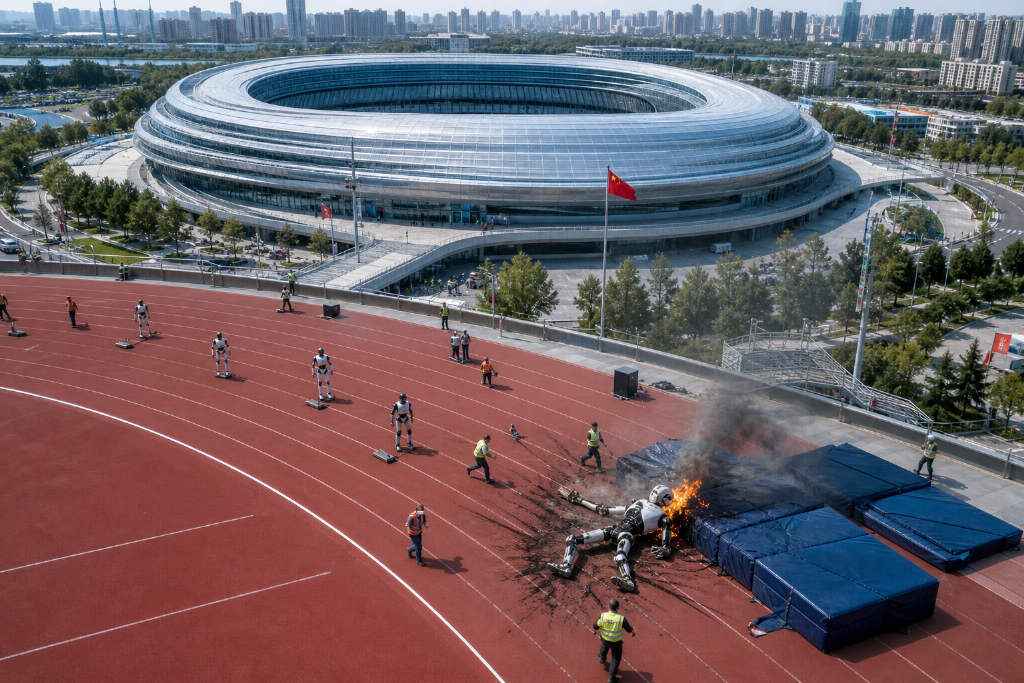
Tiangong, a humanoid robot from the Beijing Humanoid Robot Innovation Center, ran the 100 meters in 8.86 seconds on Aug. 25 in the large-group semifinal at the second World Humanoid Robot Games, setting a new mark that was 0.72 seconds faster than the human 100-meter world record.
The clip spread widely on social media, though not only because of the time. After crossing the line, Tiangong failed to stop, crashed into a protective pad, fell, and sparks burst from its waist before it caught fire.
The event drew 666 teams and more than 2,000 humanoid robots
The competition was held from Aug. 22 to Aug. 26 at Beijing’s National Speed Skating Oval. The source article said 666 teams and more than 2,000 humanoid robots entered the event, which featured 51 competition categories and 1,301 matches.
This year’s program added weightlifting, tug-of-war, and table tennis. It also introduced two-robot and four-robot simultaneous competition formats for the first time. The report described the event as larger than the first edition, with rules designed to more closely resemble real athletic settings.
Other records were also broken during the meet
The 100-meter race was only one of several headline results in the same competition. According to the report, the 400 meters was completed in 38.15 seconds, nearly five seconds faster than the human record of 43.03 seconds. In the standing high jump, a robot reached 2.88 meters, above the 2.45-meter human record set by Sotomayor in 1993.
The article also said the 100-meter mark was broken twice within three days, reflecting how multiple teams were pushing toward the same benchmark.
Scholar says speed gains come with heavier demands on control and stability
UCLA robotics scholar Dennis Hong commented: 「This is an important milestone. What matters is not only that robots can run faster than humans, but what it takes to get a bipedal robot to that speed.」
As speed rises, he said, the pressure on balance, control, and mechanical stability rises with it. The report presented Tiangong’s post-finish loss of control, fall, and fire as a vivid example of that tradeoff.
Failures appeared across multiple events
Viewed more broadly, the source article portrayed the meet as a showcase not just for performance gains but also for malfunctions. In the 400 meters, one robot fell mid-race and a mechanical arm flew off. In boxing, some robots fell out of bounds on their own or threw punches into empty space. In gymnastics, robots staggered and then collapsed. In long jump, one machine appeared to suffer circuit damage after landing and did not get back up. In weightlifting, a robot picked up a barbell, lost control, dropped it, and rushed toward the judges’ area.
Dexterous-hand tasks remain a weak point
The report also highlighted problems in dexterous-hand events. Robots struggled with fingertip tasks such as stacking blocks and using tweezers to pick up objects. Small changes in material, texture, or object placement were enough to cause failure.
One example in the article said a robot trained only to carry an empty cup could not successfully lift a cup filled with water. A member of the event committee described these record-breaking machines as less reliable than preschool children when it came to fine motor tasks.
Debate centers on limited generalization in embodied intelligence
Much of the outside discussion, according to the article, has focused on weak generalization in embodied intelligence models. If a robot is trained only in a specific setting, it may fail when the object or environment changes. The article used that point to explain why a robot may run a 100-meter race well yet still struggle to carry a cup.
The industry often compares embodied intelligence today with autonomous driving a decade ago: demo after demo appears, but the technical path has not yet converged. The report said the missing piece is a stronger grasp of physical rules, rather than matching new situations to previously seen images.
The People’s Daily also noted that care-oriented robots remain in the pilot and validation stage. The article concluded that, in the view of most experts, the technology is still mainly suited to demonstration and performance for now, and remains some distance from large-scale real-world deployment. On that reading, eye-catching speed records alone do not prove that the field has crossed that line.