

Tiger Research says the race to build wallet infrastructure for AI agents is already underway, even though the business case has yet to show up in current revenue. The firm argues that much of the market’s attention has gone to autonomous trading and agent-led payments, while the more important early move is happening lower in the stack: crypto wallet providers are building the rails that agents would need before usage scales.
According to the report, more than 10 companies are already developing wallets specifically for AI agents. The goal is not immediate monetization. It is to secure the future user base before large-scale agent transactions arrive.
Why wallets sit at the center of agent payments
Tiger Research says AI agents that browse the web, buy goods, or pay for information on a user’s behalf could eventually trigger hundreds or thousands of micropayments, many worth only a few cents or less. In that environment, existing card systems are a poor fit. They were built around human users, fixed transaction fees, chargeback procedures, and manual dispute resolution.
The report frames the issue as a question of whether money itself can be programmed. Cards can automate payment entry, but they cannot be programmed to split funds by condition, stream payments, or settle flows instantly. Wallet-based rails, by contrast, are designed with those functions in mind.
Tiger Research says this is the backdrop for x402 payment rails. If the internet shifts from human-triggered transactions to machine-executed ones, wallets become the foundation of the payment system rather than a simple storage layer.
Early activity is showing up in crypto first
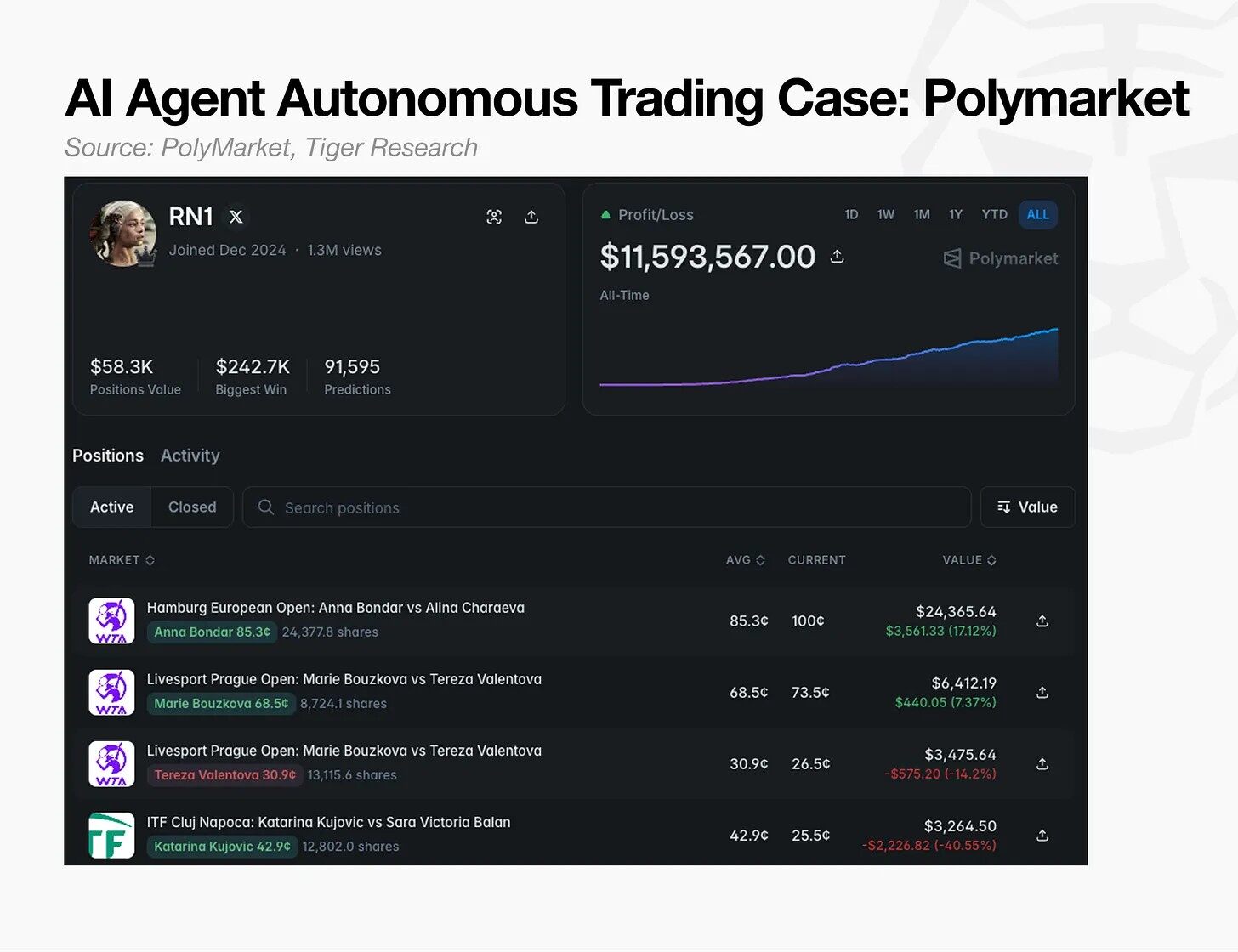
The report points to an experiment on Polymarket earlier this year that drew broad attention. An AI agent was given $50 in starting capital and allowed to trade on its own. If it failed to earn enough to cover API and server costs, it would “disappear.” Tiger Research says the agent traded successfully, and similar agents later entered the market using the same basic setup.
That does not mean AI agents are already part of everyday consumer payments. The report says their most active use case remains inside crypto, especially in trading bots that operate outside traditional payment rails and focus on digital asset markets.

Still, Tiger Research argues that the direction is clear. A single user request, such as asking an agent to produce a research report, could trigger 20 to 30 or more separate payments as the agent pulls paid information from multiple sources.
Micropayments could change the economics of payments
The report says AI is changing the basic structure of payment behavior. Once agents, not humans, are acting directly online, average transaction size could fall sharply. One API call may cost as little as $0.001, and in extreme cases one data query may cost just $0.00001.
If agents are making thousands of payments per second at those price points, the economics of card-based systems break down. Fixed fees measured in tens of cents do not work when the underlying transaction value is a tiny fraction of a dollar.
That is why Tiger Research sees wallets as the natural starting point for machine-to-machine commerce. In its view, this is not a minor upgrade to existing payments. It is a different system built for different actors, different frequency, and different unit economics.
Why firms are investing before revenue appears
Tiger Research says the companies entering this segment are not limited to one category. Wallet providers span exchanges and stablecoin issuers, among others. The common thread is that they are preparing for future business rather than current profits.
The report specifically mentions Coinbase and Binance as firms continuing to invest in AI wallet infrastructure even though short-term revenue is close to nonexistent. Their calculation, Tiger Research says, is straightforward: build the capacity now so they can absorb large transaction volumes once agents begin operating at scale.
Coinbase model points to a possible 7x revenue outcome
Using Coinbase’s disclosed data, Tiger Research models what agent-driven payment activity could mean for revenue. The base is Coinbase’s 9.2 million monthly transacting users, not its roughly 120 million registered users.

The model uses three variables: adoption rate, the number of agents per user, and daily call frequency.
- Conservative case: 10% adoption, 1 agent per user, and 50 calls per day. Estimated annual revenue increase: about $84 million, or 1.2%.
- Base case: 50% adoption, 2 agents per user, and 200 calls per day. Estimated additional annual revenue: about $3.36 billion, or 46.8%.
- Aggressive case: 100% adoption, 3 agents per user, and 1,000 calls per day. Estimated annual revenue: about $50.37 billion, or roughly 7x Coinbase’s current total revenue.
Tiger Research says the gap between those scenarios expands geometrically rather than linearly. Adoption rising from 10% to 100% is a 10x change, but because the three variables multiply against one another, the revenue spread grows by about 600x, from $84 million to $50.37 billion.
That, the firm says, helps explain why Coinbase is pushing agent wallet infrastructure despite limited direct revenue today. The bet is on future payment flow, not present fees.
Wallet data could support agent financing later
Tiger Research also argues that wallet infrastructure may become valuable beyond payments. Transaction histories stored in wallets could serve as a way to evaluate whether an AI agent is generating income, which in turn could support a new lending model.
The report uses Stripe Capital as a reference point. When Stripe launched Stripe Capital in September 2019, it did not rely on outside credit bureaus or long application files. It used real-time sales data from merchants in its own payment network to assess eligibility and loan size.
For Tiger Research, that example shows how a company can build a high-value financial product on top of an existing operational data pipeline. Agent wallet providers could follow a similar path. If wallet systems accumulate reliable records of agent income, providers may be able to extend into revenue-based financing, or RBF, tailored to agents.
The report is clear about the condition attached to that idea: AI agents would need to evolve from payment executors into income-generating, asset-holding entities with enough real revenue to repay borrowing.

The upside is still hypothetical
Tiger Research says both the 7x Coinbase revenue outcome and the expansion into RBF depend on broad adoption of agent payments that has not been proven in the real economy.
The report lists several obstacles. AI agents still suffer from “hallucinations” during autonomous ordering, which can lead to mistaken payments. Some transactions are also blocked by fraud detection systems, or FDS, used by card issuers, leaving completion rates low.
On top of that, payment protocols such as x402, AP2, and MPP remain fragmented rather than standardized. AI agents are not legal persons, and there is still no clear framework around KYC or financial regulation for them.
What companies are really competing for
Tiger Research says wallet providers are not fighting over near-term fee income. It compares the timeline to other ecosystems: Apple’s App Store took 15 years to build an annual fee market worth $10 billion, while WeChat Pay took 7 years to establish a large mini-program ecosystem.
Agent wallets, the report says, are on a similarly long path. The real contest today is over who can capture the payment-flow data of an AI agent economy if that economy takes shape over the next five to 10 years.
In Tiger Research’s framing, firms are building the ecosystem now. The revenue, if it comes, comes later.