
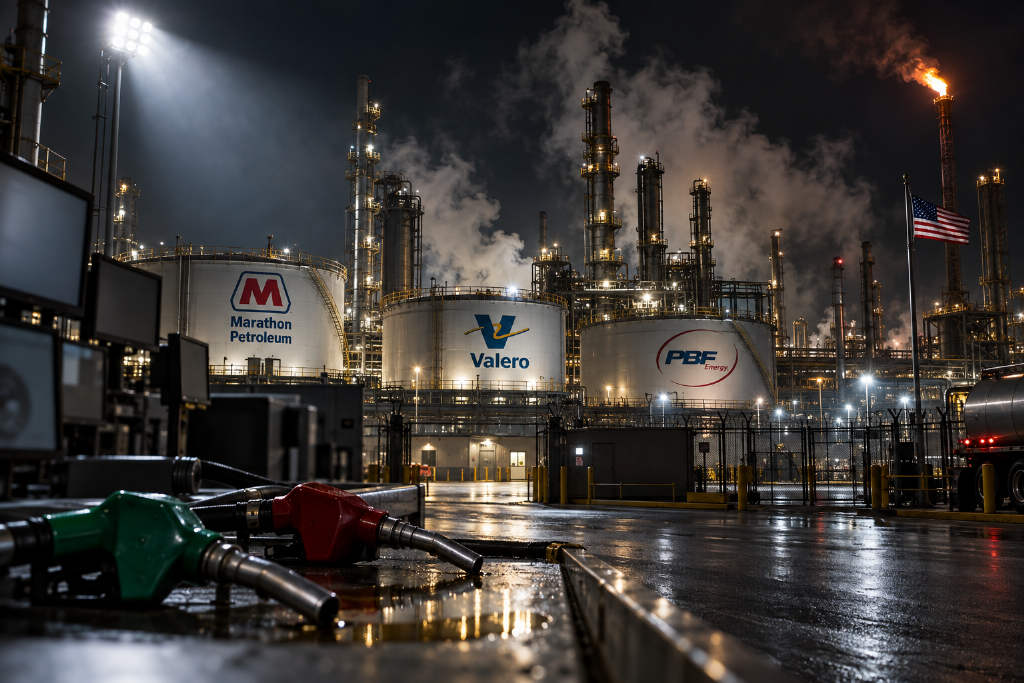
A Seeking Alpha Quant Team analysis says the global fuel supply shock has already arrived, with diesel futures and retail prices hitting record levels and product prices outpacing crude. That move has pushed the diesel-to-crude crack spread to a new high and put U.S. refiners near the center of the trade.

Refining margins move back into focus
The article argues that the story is no longer just about higher crude prices. Tight gasoline and diesel supplies, along with growing constraints in California, are lifting refining margins. Even if crude prices pull back, refining opportunities could remain as long as crack spreads stay elevated.
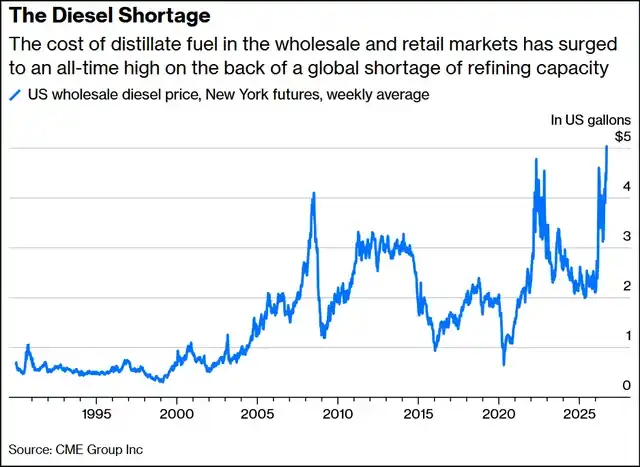
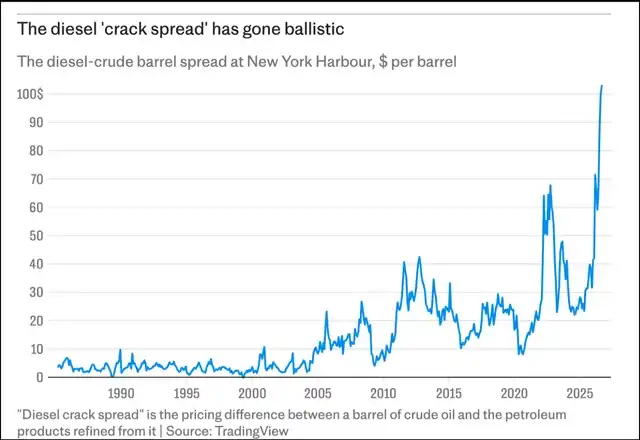
According to the piece, multiple geopolitical conflicts continue to squeeze refining capacity and disrupt supply chains. U.S. refineries are running close to full utilization, yet inventories are falling. This week, U.S. diesel futures settled at a record, and retail diesel prices also reached a fresh high. Because refined products have risen faster than crude, the diesel-crude crack spread has climbed to a record level.
At the same time, average U.S. gasoline retail prices remain above $4.40 a gallon. Goldman Sachs expects diesel prices and margins to keep rising and says gasoline may have even more upside because refiners are likely to prioritize diesel output. In either case, the analysis says U.S. refiners are positioned on the benefiting side of the market.
Three refinery stocks selected for the fuel crunch
The report highlights three U.S. refiners that it says are well placed to capture the widening crack spread, the gap between crude input costs and refined product selling prices. The selection process started with Seeking Alpha’s stock screener for refinery names rated Strong Buy, then narrowed to companies with meaningful exposure to tight U.S. and global fuel markets.
Each of the three, the author says, has asset and geographic advantages that line up with strong demand and a tightening supply picture, including the increasingly constrained U.S. West Coast market.
Marathon Petroleum
Marathon Petroleum (NYSE: MPC) has a market capitalization of $116.24 billion and operates in oil and gas refining and marketing. As of Sept. 17, 2026, it ranked No. 3 out of 226 energy stocks in the Quant universe and No. 3 out of 17 refining names.
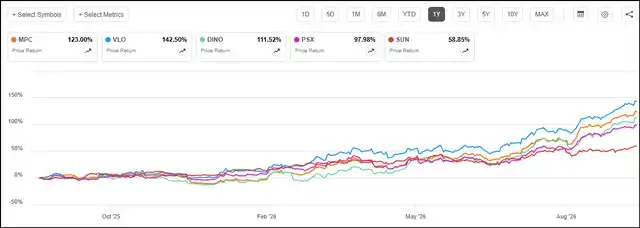
The article says MPC, along with two other refining stocks, has been among the best performers in the Quant Growth & Income portfolio. Since that portfolio launched in June, Marathon has returned 56.82%, Valero Energy (NYSE: VLO) 56.07%, and Phillips 66 (NYSE: PSX) 46.85%, with all three sharply outperforming the sector over the past year.
The author ties Marathon’s setup to what is described as a constructive macro backdrop. Conflicts in the Middle East and between Russia and Ukraine have constrained global refining capacity, while U.S. gasoline inventories remain well below historical averages. With West Coast assets and an integrated logistics network, MPC is seen as able to serve California demand if imports from Asia decline.
After wider crack spreads lifted refining profits, Marathon reported adjusted EBITDA of $8.5 billion in the second quarter of 2026, up from $3.2 billion a year earlier. On its earnings call, the company said domestic and international demand for gasoline, diesel and jet fuel remained strong, and it expects favorable refining conditions to continue through the rest of the year and into 2027.
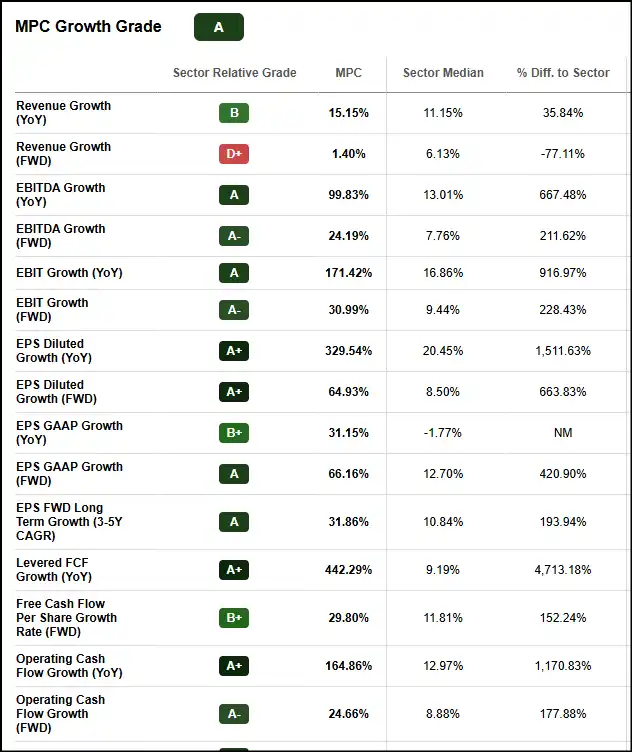
The growth case also rests on forward EPS growth of more than 64%, far above the sector’s roughly 8%, according to the article. Over the past 90 days, EPS estimates were revised upward 16 times, with no downward revisions.
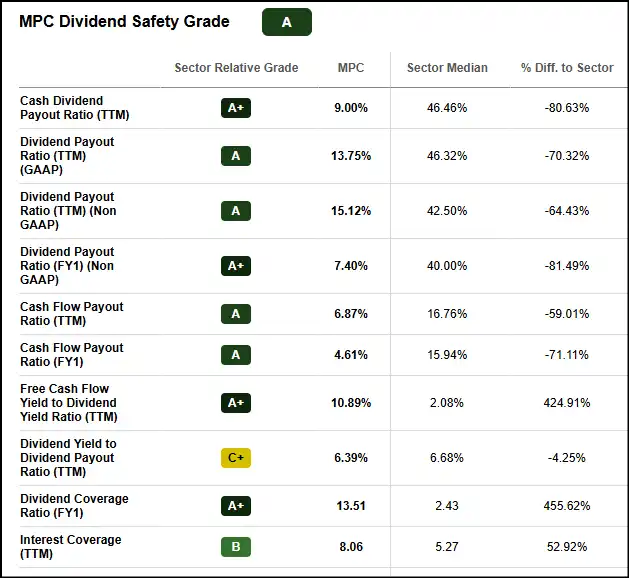
MPC has paid dividends for 14 straight years. The report says strong cash flow and a conservative payout ratio support an A dividend safety grade. Although the stock’s rally has pushed the dividend yield below 1%, its five-year dividend growth rate stands at 11.51%, and consensus expectations point to further increases over the next three years.
On valuation, the article says Marathon still looks attractive on a PEG basis, with a forward PEG of 0.24, about a 78% discount to the sector.
Valero Energy
Valero Energy (NYSE: VLO) has a market capitalization of $116.12 billion and also operates in oil and gas refining and marketing. As of Sept. 17, 2026, it ranked No. 2 out of 226 energy stocks and No. 2 out of 17 refining companies in the Quant rankings cited in the piece.
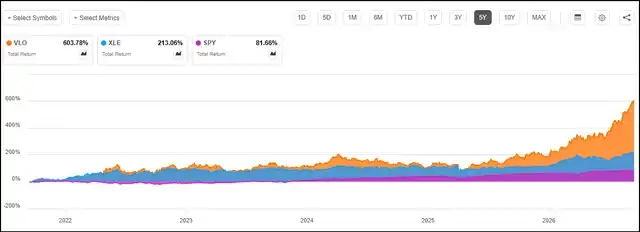
The author presents Valero as a combination of growth and dividend stability. Over the past five years, total shareholder return has exceeded 600%, well ahead of the broader market and the energy sector. The article notes that VLO was previously held in Alpha Picks and contributed to portfolio gains during the early phase of the Russia-Ukraine conflict, when energy supplies were tight and demand was strong. It then continued to beat expectations and post record profits, extending the stock’s advance.
In the second quarter of 2026, Valero’s profit rose more than fivefold year over year to $3.72 billion, while refining margins nearly doubled. The company expects refining crack spreads to remain above historical mid-cycle levels, citing resilient demand, a favorable global refined-products supply-demand balance and constrained capacity.
Over the past 90 days, EPS estimates for VLO were revised upward 19 times, with no downward revisions. The article says that supports sharply higher expectations for fiscal 2026 EPS and revenue, including the next two quarters. Strong operating leverage has also lifted its growth profile, with EBIT rising quickly and forward EPS and cash flow growth remaining strong.
Valero has paid dividends for 28 consecutive years, and its forward dividend yield is about 1.19%. The report assigns it an A+ dividend safety grade based on strong coverage, conservative leverage and sustainable growth.
On valuation, the article says several metrics remain attractive, though the overall score is held back by a relatively high price-to-book ratio. On a forward PEG basis, VLO trades at about a 72% discount to the sector. The author says that mix of dividend safety and solid fundamentals makes Valero a way to gain upside exposure during a prolonged fuel crunch.
PBF Energy
PBF Energy (NYSE: PBF) has a market capitalization of $9.07 billion and operates in oil and gas refining and marketing. As of Sept. 17, 2026, it ranked No. 1 out of 226 energy stocks and No. 1 out of 17 refining names in the Quant rankings referenced in the article.
The piece describes PBF as the top-ranked energy stock in the Quant system and says it was recently added to both Alpha Picks and the PRO Quant portfolio. PBF is identified as a leading independent U.S. refiner and transportation fuels supplier. Two of its six refineries are in California, a market where roughly one-third of gasoline demand depends on imports, leaving local supply tight and giving the company a favorable position.
In the second quarter of 2026, PBF reported revenue of $11.68 billion, up 56% year over year, and EPS that came in well above expectations. The article says favorable crack spreads and higher throughput widened refining margins. The company also improved its balance sheet, cutting net debt by $1.4 billion and ending the quarter with about $900 million in cash.
Growth scores are supported by gains in forward operating cash flow and EBITDA. The article adds that Wall Street has become increasingly constructive on PBF’s fiscal 2026 outlook, with earnings estimates moving higher in a series of revisions.
PBF’s forward dividend yield is about 1.45%, and the report says cash flow plus a conservative payout ratio provide solid coverage, supporting its dividend safety profile. Even after a sharp share-price rise, valuation is still described as reasonable, with a forward P/E of about 3.7x.
The author uses PBF to round out the basket of refinery names tied to the global fuel-crisis thesis, arguing that all three combine profitable growth with strong momentum.
Crack spreads sit at the center of the thesis
The article’s conclusion is that U.S. refiners are positioned to benefit from a global fuel crunch driven by constrained capacity and higher diesel and gasoline prices. Refined products have outpaced crude, the diesel-crude crack spread has reached a record, and refining margins have moved higher as a result. Even if crude prices fall, the opportunity for refiners could remain if crack spreads stay elevated.
Within that framework, the author singles out Marathon Petroleum, Valero Energy and PBF Energy as three U.S. refiners with solid fundamentals and room for further earnings upgrades.