
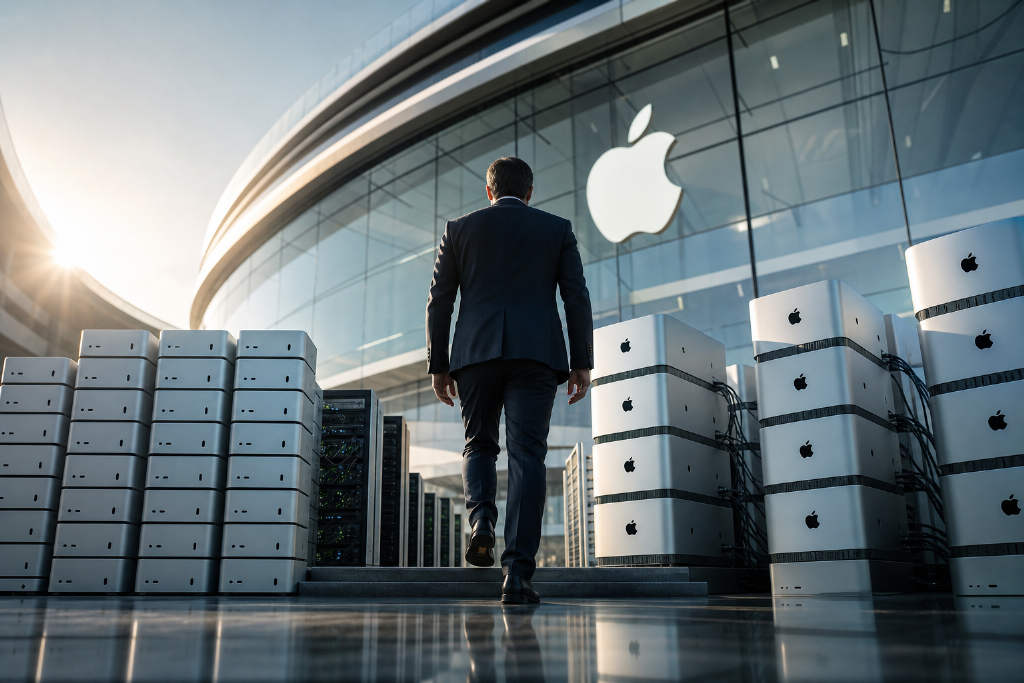
Apple changed CEOs on Sept. 1, ending Tim Cook’s 15-year tenure and handing the role to John Ternus, the executive who has led the company’s hardware business. The leadership change comes as Apple faces a central question: how can a consumer electronics company built on hardware establish a stronger competitive position in the AI era?
OpenAI’s Mac purchases put Apple back in the AI conversation
Apple has not been viewed as a clear loser in the current AI boom, but it has also remained far from the center of the discussion. Its performance has appeared steady rather than dominant.
That assessment may be changing after reports that OpenAI has purchased tens of thousands of Mac mini and Mac Studio machines without screens or keyboards. The systems are being used for reinforcement learning and for developing AI agents designed to operate computers. Anthropic is also renting Mac computing capacity at scale through AWS.
The attraction lies in Apple’s chip architecture. Apple silicon uses unified memory, allowing a chip to load quantized models with tens of billions, and in some cases more than 100 billion, parameters directly. That avoids the repeated movement of data between graphics memory and system memory required by Nvidia GPUs. For companies running large language models, the savings involve both processing time and computing costs.
Mac revenue is Apple’s fastest-growing hardware business
Enterprise demand has already appeared in Apple’s financial results. Mac revenue increased nearly 29% year over year in the latest quarter, reaching $10.3 billion. That made Mac the fastest-growing hardware product line in Apple’s business.
A competitor’s response offers another signal. Nvidia has internally identified Apple as its biggest rival in the local AI market. Nvidia’s DGX Spark, introduced earlier, has an appearance strikingly similar to the Mac mini. The resemblance has been described as Nvidia paying tribute to Apple, and it also reflects the position Apple has gained in local AI hardware.
A hardware specialist takes the CEO role
Ternus has spent 25 years at Apple. He started as a Mac engineer and later led work on the iPad, AirPods and iPhone before taking charge of the company’s entire hardware engineering organization. Inside Apple, he is widely regarded as a hardware expert.
His first tests are already set: the iPhone product launch scheduled for September and the full deployment of the new Siri AI.
The product pipeline under Ternus also carries a substantial hardware bet. Apple is expected to launch a foldable iPhone this fall, along with a smart display that can identify the person speaking and use that information to deliver personalized content. Whether these products deliver on the stated direction will directly affect Apple’s position in AI hardware.
The board chose a product-focused successor
The choice of successor also communicates what Apple’s board believes the company needs.
For more than a decade, Apple’s strengths have included operations, supply chains, its ecosystem and its ability to generate profits. In the AI era, the company’s missing piece is not money or users. It is the next major product innovation. The board therefore chose a product-focused executive with a mechanical engineering background and 25 years of hardware experience rather than a finance-oriented CEO.
In the short term, the CEO transition is likely to have a limited effect on Apple’s share price because Cook will remain executive chairman. The company will not face a power vacuum. Apple’s future valuation will depend on more than whether the next iPhone sells several million additional units. The larger question is whether Apple can find a new entry point in the AI era.
Over the next three to five years, Apple’s biggest bet may be a combination of AI, chips and a new hardware entry point rather than the iPhone alone.
Turning chip capabilities into products
Fifteen years ago, Cook took over Apple from Steve Jobs and used operations and supply-chain management to push the company to the top of the global market-capitalization rankings. Fifteen years later, the board has given the chief executive role to a hardware engineer. The decision indicates that the gains from the operations era are no longer enough and that Apple must return to product innovation.
OpenAI’s Mac purchases and Nvidia’s decision to treat Apple as its leading competitor in local AI point to one asset Apple already holds: chips built around unified memory. What the company has lacked is the product imagination needed to put that capability to work.
The fall product launch should offer an early indication of whether Ternus can address that gap. The next three to five years will provide the longer test.
Risk disclosure
This article was written and provided by an external contributor. The personnel changes described in the article have been verified, but the specific purchase figures, institutional assessments and strategic interpretations are compiled from public reports and market analysis and may be inaccurate. The views, analysis and judgments in this article belong to the author and do not represent the official position of BIT or BIT Research. BIT makes no guarantee regarding the accuracy, completeness or timeliness of the content.
This article does not constitute investment advice, an offer or solicitation of an offer, or a recommendation to buy or sell any security. Investing involves the risk of losing principal, and market prices may fluctuate sharply. Past performance does not represent future results. Investors should make independent judgments and seek professional advice.