

Tim Peters, an early Python core developer and the author of The Zen of Python, has died, Python creator Guido van Rossum announced. Peters wrote the 19 principles shown by Python’s import this command, including “Beautiful is better than ugly,” “Explicit is better than implicit,” and “Simple is better than complex.”
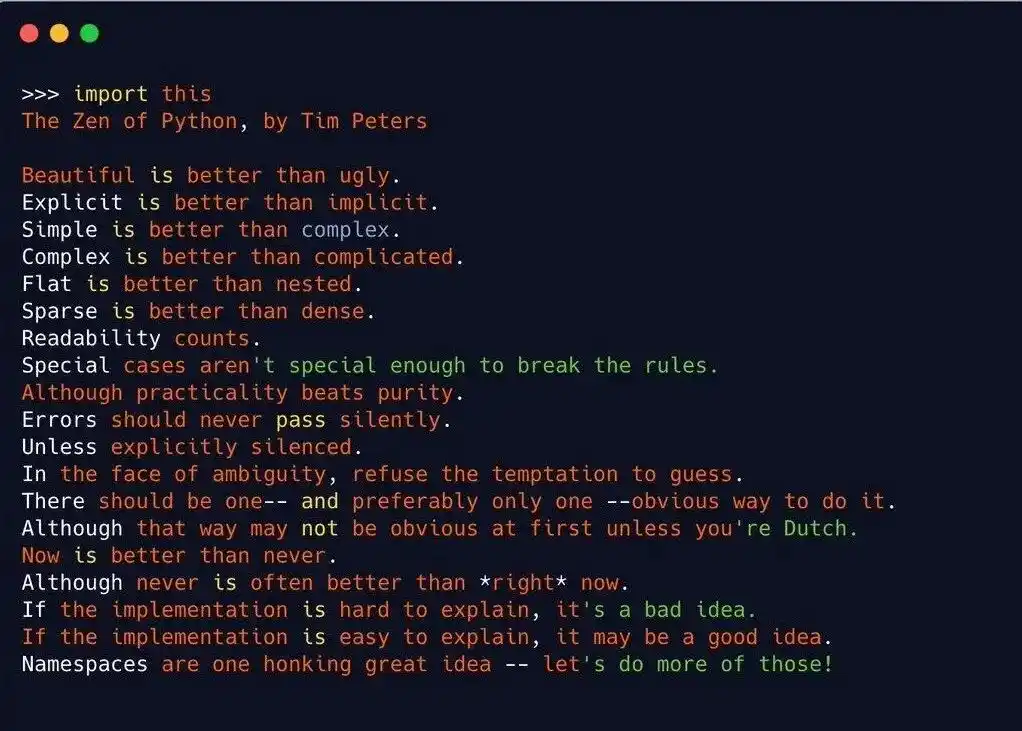
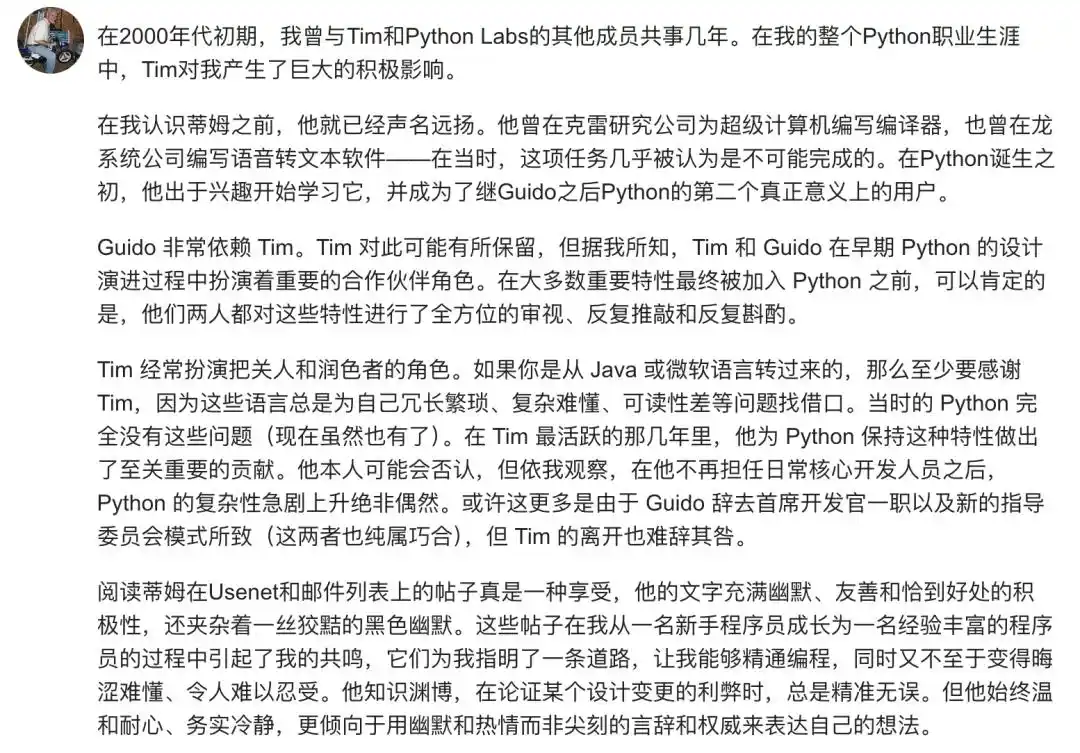
Van Rossum said Peters had been his mentor before The Zen of Python appeared and was also a co-designer of the language. Peters was described as Python’s second real user after Van Rossum, and he joined the project during its earliest period, influencing many developers, including Python’s creator.
Algorithms and systems shaped by Peters
Peters’ name is most closely associated with Timsort. He designed the algorithm for Python in 2002. Timsort takes advantage of order already present in a data set, making it effective for the partly sorted data found in real-world workloads. It later spread beyond Python and was adopted by Java and Android.
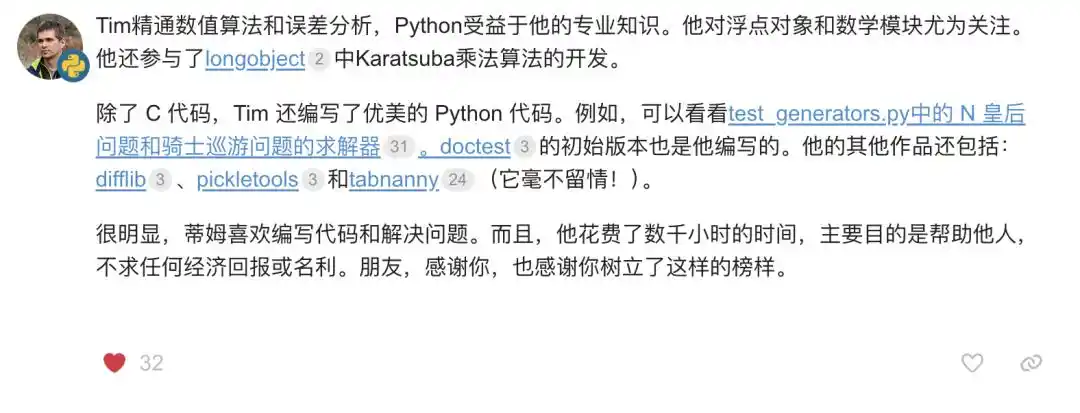
He also worked on doctest, which runs code examples embedded in documentation to check whether they are correct, and difflib, which compares two pieces of text and identifies additions, deletions and changes. Python’s memory management, garbage collection and dictionary implementation also carry traces of his work.
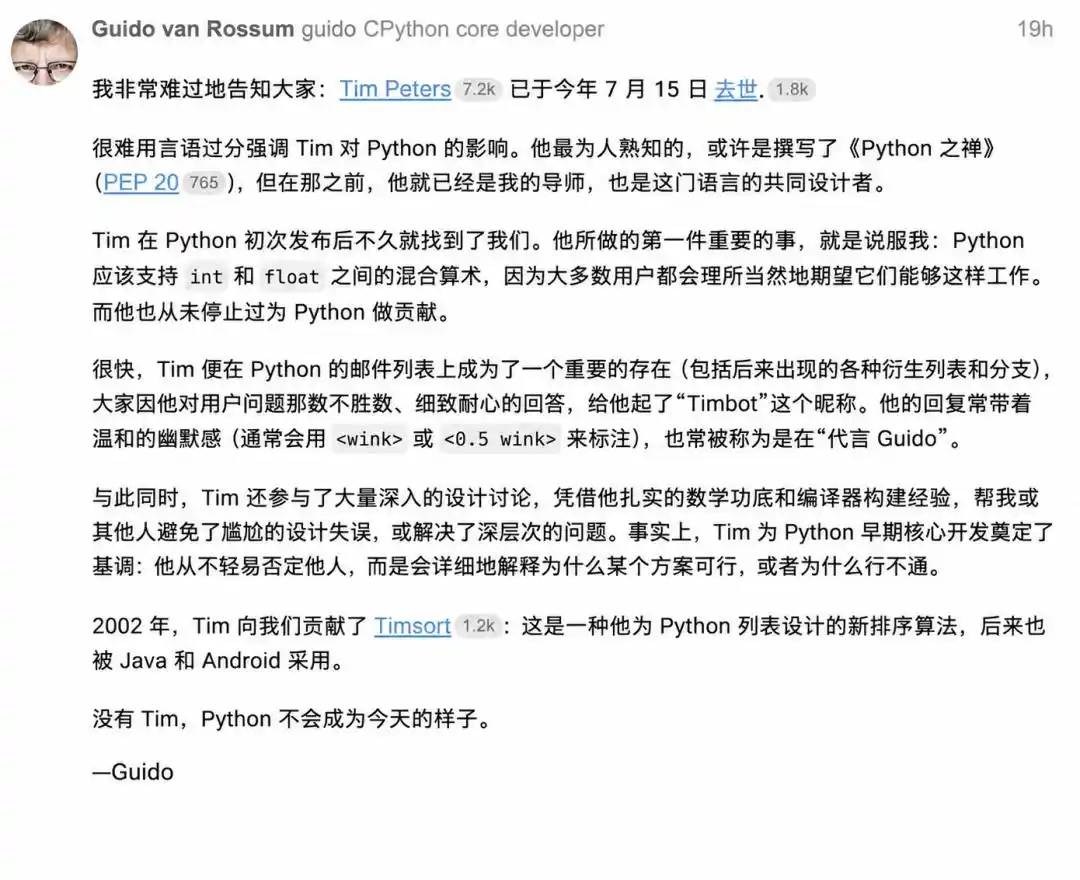
Van Rossum recalled that soon after Peters began using Python, Peters persuaded him to support mixed operations between integers and floating-point numbers. Peters continued to influence Van Rossum and the language for years.
A patient presence in the Python community
Chris McDonough, a principal author of the Python web framework Pyramid, published a long tribute. McDonough wrote that Van Rossum relied heavily on Peters, and that the sharp rise in Python’s complexity after Peters stopped serving as a day-to-day core developer was not accidental. He described Peters’ writing as humorous, kind and appropriately positive, with a touch of mischievous dark humor.
Core developer Chris Angelico recalled discussing countless technical questions with Peters. Peters never treated people as fools or dismissed their questions. He answered seriously and explained patiently.
Core developer Neil Schemenauer said Peters spent thousands of hours helping other developers without expecting financial compensation or personal recognition. Schemenauer quoted the Gospel of Matthew: “By their fruit you will recognize them.” He added that Peters’ work had spread around the world and that any Python project started between 1995 and 2010 carried his cultural imprint.
Because Peters answered so many questions so quickly and thoroughly, developers gave him the nickname “Timbot,” a Tim-shaped bot.
From supercomputers to Python
Peters was born in Wisconsin in 1952. Before becoming a legend in the Python community, he developed compilers for supercomputers and worked on speech-recognition software at Dragon Systems.
In 1991, a friend emailed him about Python, a programming language that had only recently been created. Peters quickly became interested. He began corresponding with Van Rossum, using the language while discussing how it should be designed. Python was still at version 0.9.1 at the time. Peters then committed himself to the project and became a central figure in its early developer community.
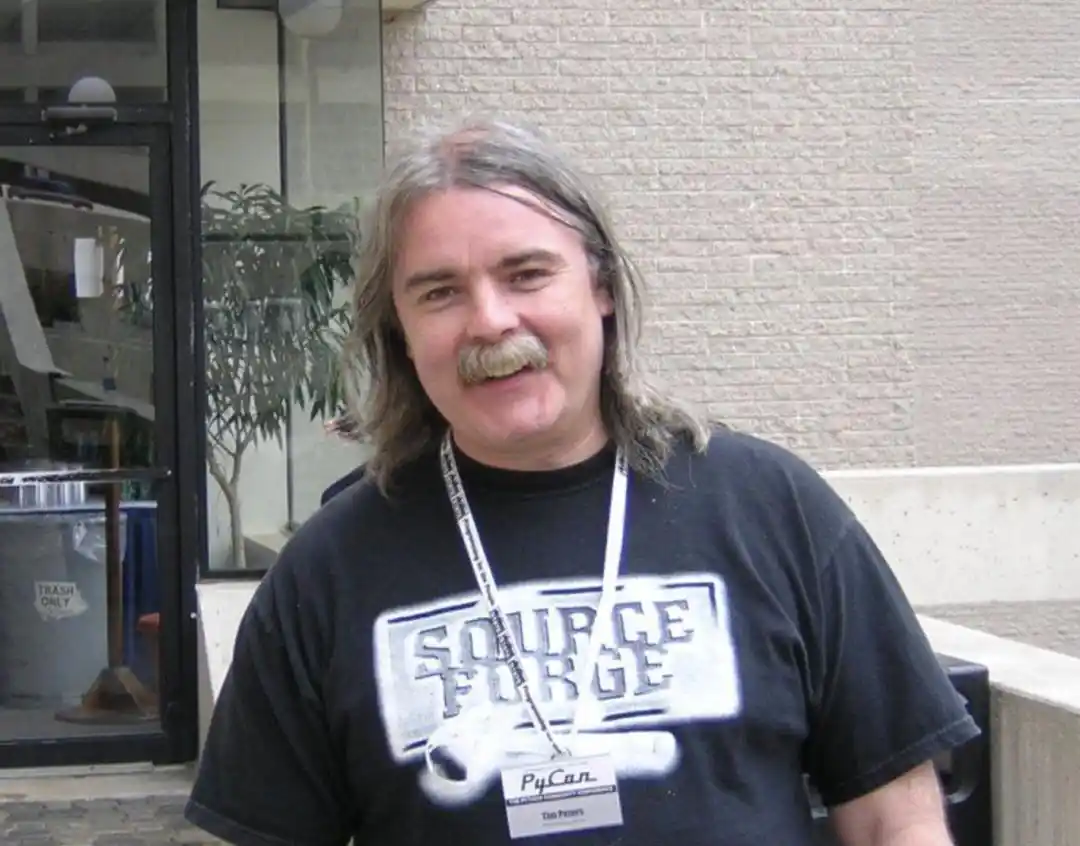
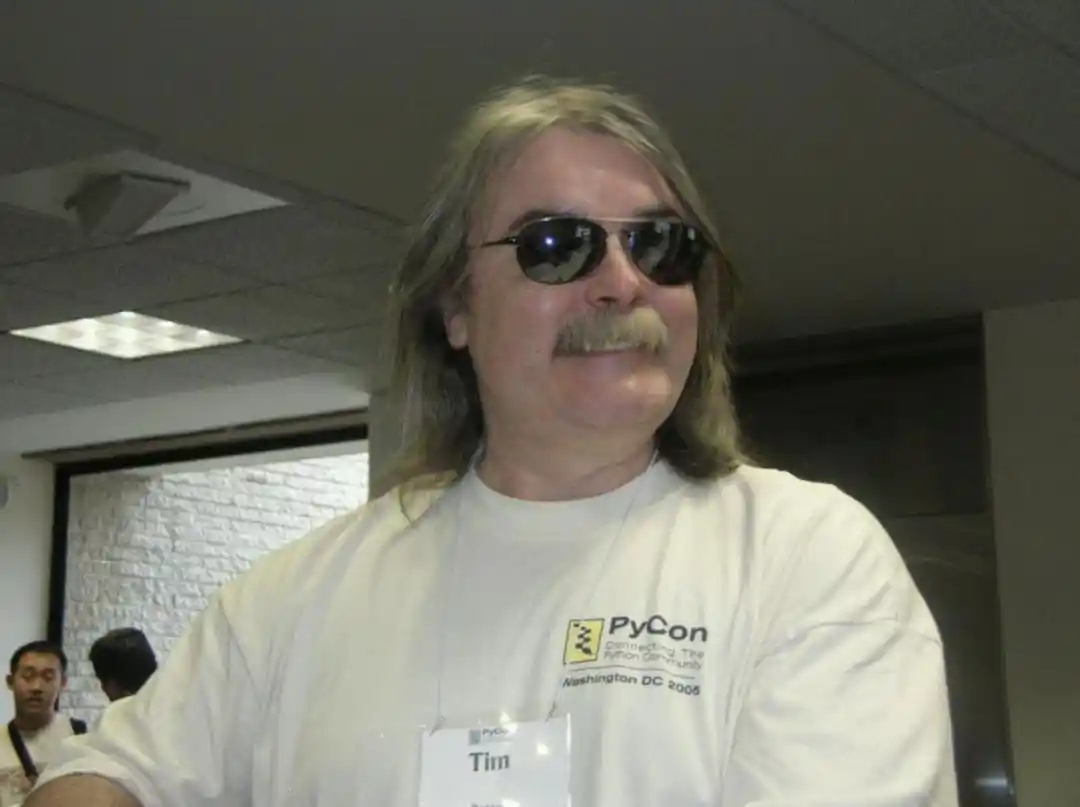
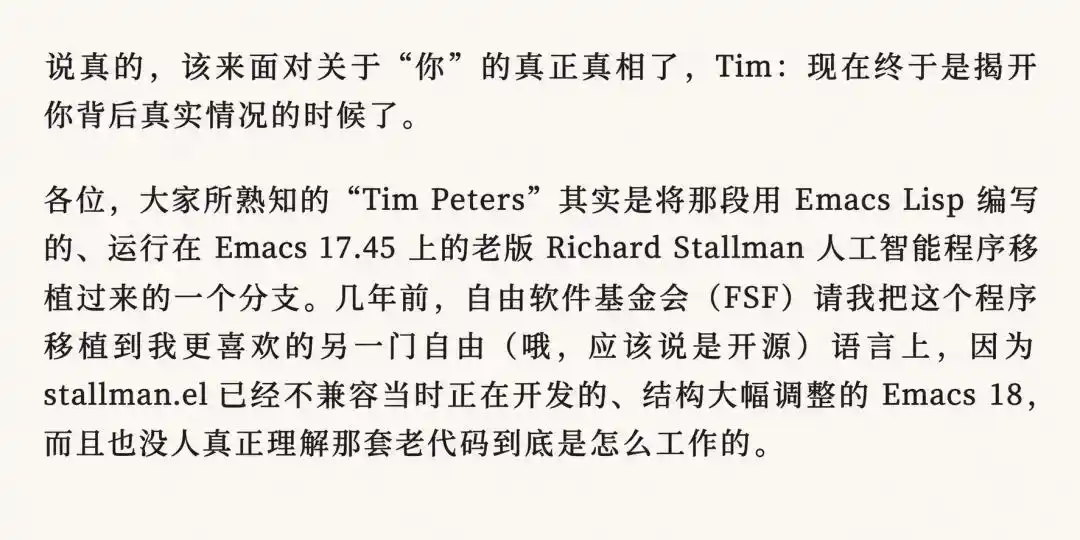
He answered questions of every level, from highly technical problems to basic questions, with long and careful replies. In 1998, Python core developer Barry Warsaw even wrote an email titled “The Truth About Tim” during a discussion about the origin of the “Tim conspiracy theory.” The joke claimed that Tim Peters did not really exist and that “Tim” was an ancient artificial-intelligence program scanning mailing lists and answering developers. It also asked whether anyone had actually seen him, while noting that Van Rossum’s claim to have done so was unsupported by evidence.
How The Zen of Python took shape
In June 1999, the Python community was again arguing about the language. One developer complained that people spent their days debating how to change Python but rarely discussed how to use it well. Another suggested that Van Rossum and Peters write a short document called The Python Way, using a small set of rules to summarize Python’s design philosophy.
Peters replied quickly, saying the task should of course go to Van Rossum. But, he added, Van Rossum would probably begin with an outline that included:
- Beautiful is better than ugly.
- Explicit is better than implicit.
- Simple is better than complex.
Peters then helped Van Rossum produce all 19 principles in one burst. He left the final principle to Van Rossum, which is why the list stopped at 19. The community still does not know what Peters originally intended as a 20th principle. Some have guessed “Significant whitespace,” while others have suggested “There is no 20th principle.”
In 2020, Warsaw asked Peters how the poem was written. Peters said he had composed it casually while eating a ham sandwich during a commercial break in a televised professional wrestling program. Warsaw later sang the poem and played guitar, bass and keyboard to turn it into a song.
Answers that became part of the culture
A few years ago, a Python beginner asked why a comma was required after a single variable when passing arguments to a thread. Peters explained the syntax of a single-element tuple. He then submitted a documentation improvement request to the Python project, asking that the issue be explained more clearly in the future.
After the questioner thanked him, Peters offered reassurance: the single-element tuple syntax was already one of Python’s strangest constructions, so the user should not worry about encountering something that odd every day.
On another occasion, a colleague asked for help with an error that appeared once every six runs. Peters jokingly asked, “Have you searched the source code for 6?”
Peters remained active in the community for more than 30 years. In 2024, he became involved in a heated dispute with then-current administrators over changes to the Python Software Foundation’s bylaws and questions of community governance. The Python Steering Council later found that he had violated the community code of conduct multiple times in related discussions. It suspended his core-developer status for three months and restricted his forum account.
Peters challenged the basis and procedure of the action and created a public blog to respond to the allegations point by point. Its footer carried the line “Question everything. Love everyone.” Three months later, he returned to the Python community and resumed technical discussions.
His final post in the Python community, dated July 8, 2026, was a detailed discussion of priority queues, data structures and path-search algorithms. At the end of the analysis, he wrote that the real world is far more complicated than the clean and elegant abstract models people expect. He died seven days later.
Programmers return to The Zen of Python
Peters’ death prompted many programmers to revisit The Zen of Python. On Hacker News, one person said they had printed it and put it on an office wall. Developers still quote it almost every week, describing it as something that began as a joke and became an important part of their culture.
Others recalled reading the poem when they first learned to program without understanding it. Re-reading it over the years brought new meaning to different lines.
The discussion also turned to the Python of that period and its community. One user argued that the principle “There should be one—and preferably only one—obvious way to do it” no longer fits Python as well as it once did. Others missed the era when developers exchanged ideas, arguments and jokes through mailing lists, with Peters willing to spend large amounts of time answering strangers’ questions.
One commenter wrote: “To a large extent, I learned how to interact with people online by watching Tim.”
This article was originally published by the WeChat account QbitAI, written by “关注前沿科技.”



