
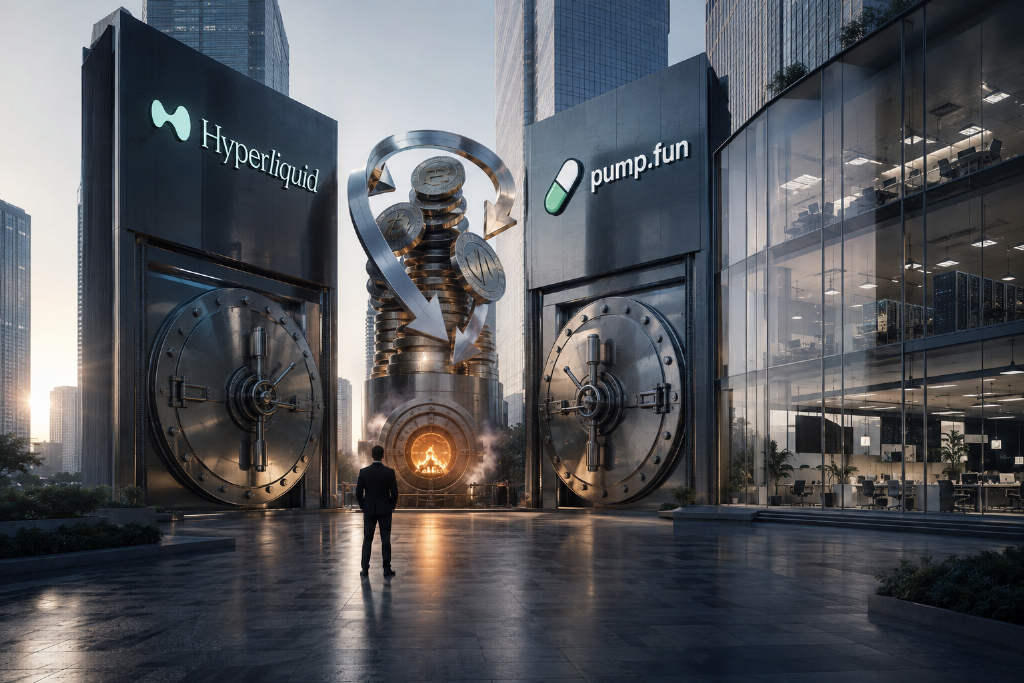
Crypto projects are pouring hundreds of millions of dollars into buying their own tokens, and the trend is raising a basic question: do buybacks create lasting value, or do they simply make tokens look more valuable than they are?
As the industry matures and borrows more from traditional finance, some crypto teams are starting to behave a bit more like public companies. One of the clearest examples is the rise of token buybacks funded by protocol revenue.
According to Cointelegraph, crypto projects have spent about $640 million on buybacks so far in 2026. That is up roughly 17% from the same period a year earlier and far above the $366,000 spent in 2024. Hyperliquid and Pump.fun account for almost 90% of the current total.
The appeal is easy to understand. Buybacks can create demand for a token, while token burns can reduce supply. In theory, that combination can put upward pressure on price.
Buybacks can also give tokenholders a more direct connection to the economics of the protocol underneath. Orest Gavryliak, chief legal officer at decentralized exchange aggregator 1inch, told Cointelegraph Magazine that telling users a project has 「bought and burned tokens」 is 「much more straightforward」 than explaining how governance rights work, how fees are set, or how the protocol is used.
Still, there is an obvious tradeoff. Every dollar spent on buying back a token is a dollar that cannot be used to hire developers, expand the business, strengthen the balance sheet or build the product.
That tradeoff sits at the center of a bigger debate as buybacks become one of crypto’s most widely discussed tokenomics tools: are they actually good for the projects using them?
Why projects are buying their own tokens
At first glance, the idea can seem contradictory. Crypto projects often sell tokens to raise funds, so buying those same tokens back may look counterproductive.
The distinction, though, is that these buybacks are funded by revenue generated by the protocol itself. When a project uses that revenue to repurchase tokens and either hold or burn them, it creates an implicit link between protocol success and token value. That is a connection many crypto projects have struggled to build for years.
Max Shannon, senior research associate at Bitwise Europe, said the shift marks a meaningful change for an industry that spent the past few years chasing narratives and speculating on the greater fool theory. Users who bought Fartcoin or Peanut the Squirrel were not doing so because of robust economic models.
Some projects have pushed the approach much harder than others. Hyperliquid, for example, has used 99% of its revenue to buy back and burn HYPE. Pump.fun directs 50% of its revenue to buying and burning its token, and $446.65 million worth of PUMP has already been removed from circulation.
Spark, a DeFi infrastructure protocol, has taken a different route. Co-founder and chief executive Sam MacPherson said the project has acquired more than 143 million SPK through open-market buybacks funded by protocol surplus.
Those tokens were not burned. Instead, they remain in the Spark treasury and are intended to reward long-term participants in the ecosystem. MacPherson said the goal is not just to reduce supply.
He said buybacks allow Spark to create that alignment while 「retaining flexibility over how and when the acquired SPK is ultimately deployed,」 making the token economically relevant rather than turning it into 「a simple dividend mechanism.」
Another argument in favor of buybacks is tax treatment. They can be a tax-efficient way to return revenue to holders because users do not face the same immediate tax bill that may come with dividends or direct rewards.
Is a buyback really the best use of capital?
Even if the logic is coherent, a harder question remains: is buying back the token actually the best use of a project’s money?
Not always. MacPherson said that if a protocol can reinvest capital at attractive returns, that may be 「far more valuable」 than distributing revenue as it comes in.
That gets to the main weakness of buybacks. They can support token economics without improving the underlying business.
There is also no guarantee that buybacks will produce higher token prices. Pump.fun has been aggressively buying and burning PUMP since July 2025, yet the token is still hovering around 50% below its September 2025 all-time high. UNI has also given back roughly half of the gains it made after Uniswap unveiled its UNIfication proposal in November 2025.
Shannon said 「many factors」 contributed to those price moves, so they do not prove buybacks failed. But he also warned that investors should distinguish between a buyback program that lifts price and a business model that is genuinely successful.
A protocol that generates real surplus may reasonably decide that buying its token is the best use of some of that capital. A weaker project, by contrast, may try to use buybacks mainly to move the price. MacPherson made that point as well.
When tokens start to resemble stocks
Buybacks may look similar to share repurchase programs on the surface, but that does not mean tokens are turning into stocks.
Shareholders own part of a company and may have voting rights, dividends or claims on residual assets. Tokenholders generally do not have those same legal rights. Gavryliak said that distinction is critical: 「This is a market mechanism, not a legally enforceable entitlement.」
MacPherson described SPK as a form of 「pseudo-equity」 for an onchain protocol. He said Spark does not have a traditional legal ownership structure, but economically it is trying to create many of the same characteristics, including governance participation, long-term alignment and a mechanism that lets the participants most committed to the protocol benefit from its success.
Regulatory questions start to appear when buybacks look like dividends
As crypto adopts mechanics that resemble buybacks in traditional finance, regulators may take a closer look at what those arrangements amount to.
Gavryliak said the proposed framework in the Digital Asset Market Clarity (CLARITY) Act of 2025, while still only a draft, highlights a central issue: where a token’s value actually comes from.
At the end of the day, crypto investors want to know what stands behind a token: revenue, users, sustainable economics, and some credible way for the token to benefit from those fundamentals.
Buybacks may offer one answer. They may also be another layer of financial engineering that makes a token appear more valuable without fixing the weakness underneath. Gavryliak put it bluntly: 「If the buybacks stopped, would there still be a reason to hold the token? If the answer is no, the problem runs deeper than tokenomics.」