
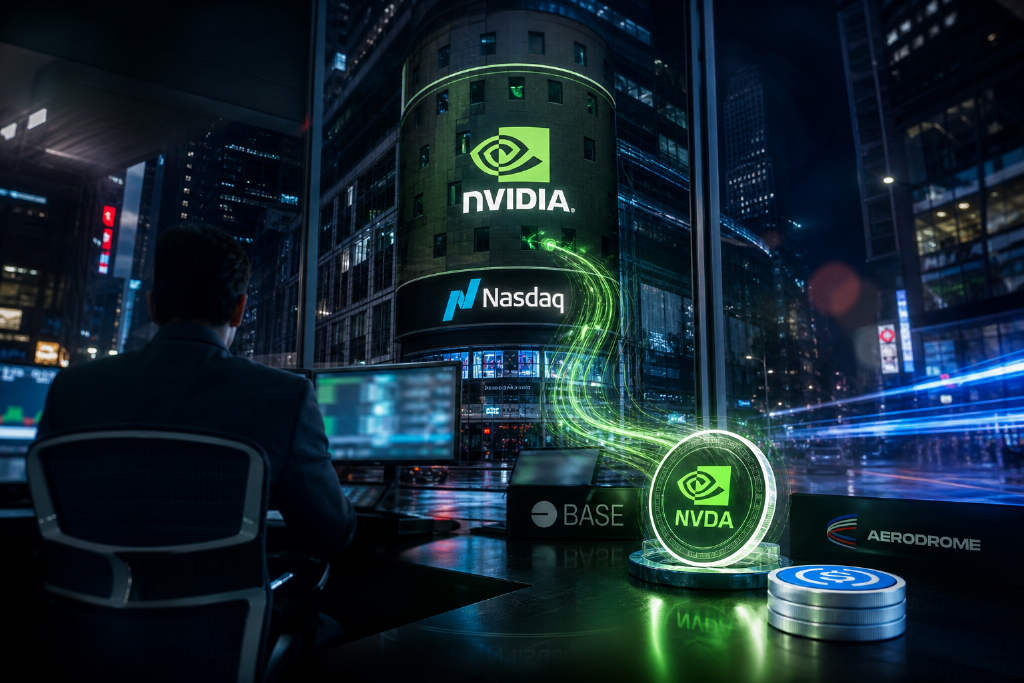
Tokenized Nvidia stock kept trading after the Nasdaq closed on Wednesday night and moved to a new price based on the company’s earnings before Wall Street had a chance to reopen.
That sequence was described by Alex Cutler, CEO of Dromos Labs, the company building the Aerodrome exchange on Coinbase’s Base network, during Unchained’s Thursday livestream. He said the stock market had closed at one price, but on-chain markets continued to run that night, drawing millions of dollars in volume and pushing the token above the official close. Public pool data cited in the report backs that account.
Nvidia’s earnings were reflected on-chain before the next regular session
Nvidia reported second-quarter results after the closing bell on Aug. 26. The company posted earnings per share of $2.22 on revenue of $96.2 billion, topping estimates, and guided to roughly $108 billion for the current quarter.
Nvidia shares had closed that day at $209.66, down 1.59%, then rose about 5% in after-hours trading.
On Base, Aerodrome’s NVDAc/USDC pool traded about $4.5 million in the four hours after the bell. The token began that period near $209.87, hit a high of $220.66 in the hour when the results landed, and finished the window at $219.80.
Roughly $2.5 million of the volume came in the single hour after the release. In effect, the on-chain market reached a price close to the after-hours quote even though the Nasdaq itself was shut.
Cutler called the dislocation a feature, not a flaw
A standard criticism of tokenized equities is that the token can drift away from the underlying share price when the stock market is closed. Cutler said that drift is the point. On the show, he described price dislocation during closed-market hours as “the feature, not the bug.”
He said Wednesday night’s move showed the market functioning, not breaking. “That was on-chain markets participating in the act of discovering what they believe the opening price would be,” he said.
According to Cutler, liquidity providers had positioned on both sides of the pool in different weights before the earnings release, and the range tightened as the event approached.
His broader case centered on composability
Cutler argued that the main advantage is not simply longer trading hours. “This is a better version of a stock, period, because of the programmability and the composability that comes with it,” he said.
He pointed to nine DeFi integrations available at launch, including Aave, Morpho and Euler.
Laura Shin pressed on the weekend pricing issue
That argument leaves an open question around price feeds when the underlying market is closed. Unchained host Laura Shin raised the issue directly on the show.
Chainlink supplies the oracle for the tokens and, as she understood it, the service is 24/5. She raised the possibility of a meaningful gap between the token and the underlying share price, thinner liquidity over the weekend, and potential problems by Monday morning for anyone using the tokens as collateral.
Cutler said he expected the oracle to move to around-the-clock operation very soon, then immediately narrowed that statement, saying he was not deeply involved in the technical details and was passing along what he had been told.
His substantive reply was that lending markets should eventually price these assets from the on-chain pools themselves rather than from an off-chain Nasdaq feed. For that to work, he said, the pools would need enough depth to support liquidations.
Coinbase’s tokenized stock rollout is new and still relatively small
Coinbase launched tokenized shares of Apple, Nvidia, Meta and Alphabet on Base on Aug. 24. The tokens are backed one-for-one by shares held with a regulated custodian and are not available to U.S. users.
Cutler said on the show that the products represent real ownership rather than the synthetic wrappers that came before. “Every token that you see today issued on Base, you know, it’s backed one by one by an actual share,” he said.
He also estimated Aerodrome’s share of this new market at about 25% of AMM volume in these tokenized assets across all exchanges, chains and issuers. He put that at roughly $25 million in the prior 24 hours, about $80 million since launch, and around 5,000 wallets holding the assets.
Unchained said the market-share figure could not be checked against a neutral source because there is no public tally covering tokenized-equity AMM volume across every chain and issuer. His volume estimate does line up with public pool data cited in the report: Nvidia pools on Base traded about $19.5 million over 24 hours, with Meta near $4.7 million and Alphabet near $3 million.
The totals are still modest relative to the traditional market these products are trying to enter, and U.S. investors remain excluded.
Regulatory path is still unsettled
Coinbase has applied for a U.S. Securities and Exchange Commission innovation exemption, according to the report. Cutler said any eventual guidance would likely fit closely with the structure Coinbase has already built: permissionless token transfers on-chain, with identity checks reserved for shareholder functions such as voting.
He based that expectation on what he described as leaks from the agency. Unchained said it could not verify that claim.
Cutler also said more assets were coming without naming them. “By this time next week, there will be a lot more, I guess, is what I can say,” he said.
The field is getting more crowded
Unchained noted that the market is not empty. Arcus, built by dYdX Labs, launched leveraged stock and crypto tokens on Robinhood Chain this week. ICE and OKX have also formed a joint venture to tokenize equities.
The report linked to a related Unchained discussion titled “Should Tokenized Stock Only Come From Issuers? Yes, Says Carlos Domingo.”