

Tokenized assets were the biggest listing category on major centralized crypto exchanges in the first half of 2026, with nearly one in every five new listings falling into that group, according to CryptoRank. In 2025, the share was still below 7%.
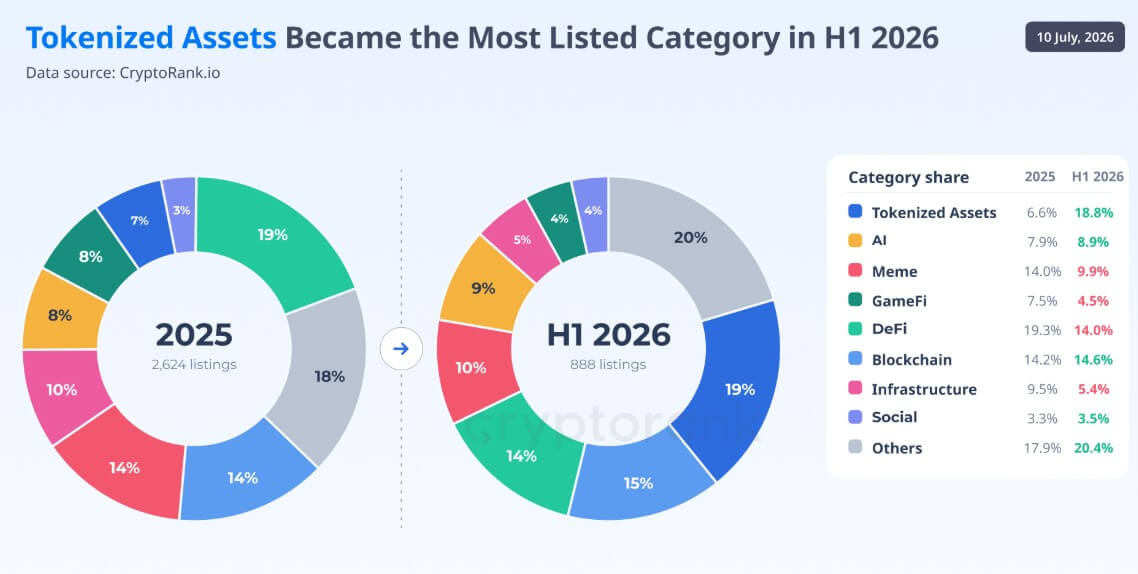
The expansion was driven mainly by tokenized stocks issued through platforms including xStocks, bStocks and Ondo’s tokenization marketplace. That marks a sharp turn in exchange strategy after several years in which meme coins, gaming tokens and other crypto-native assets dominated listing pipelines.
Retail equity buying in the U.S. weakened as tokenized stock activity rose
The shift is happening as U.S. retail participation in equities has cooled. Data from financial analytics firm VandaTrack showed net stock purchases by U.S. retail investors totaled $13 billion over the past month, the lowest level since the early stage of the 2020 pandemic.
That figure was down $18 billion from the start of 2026, a 58% drop. Buying of individual stocks fell 71% to $3.2 billion.
The report noted that the U.S. equity data and global tokenized asset data cover different markets and investor groups. Even so, crypto exchanges are clearly expanding stock-linked products for users looking for continuous trading, fractional access and exposure outside traditional brokerage infrastructure.
RWA perpetual volume hit a record $311 billion in June
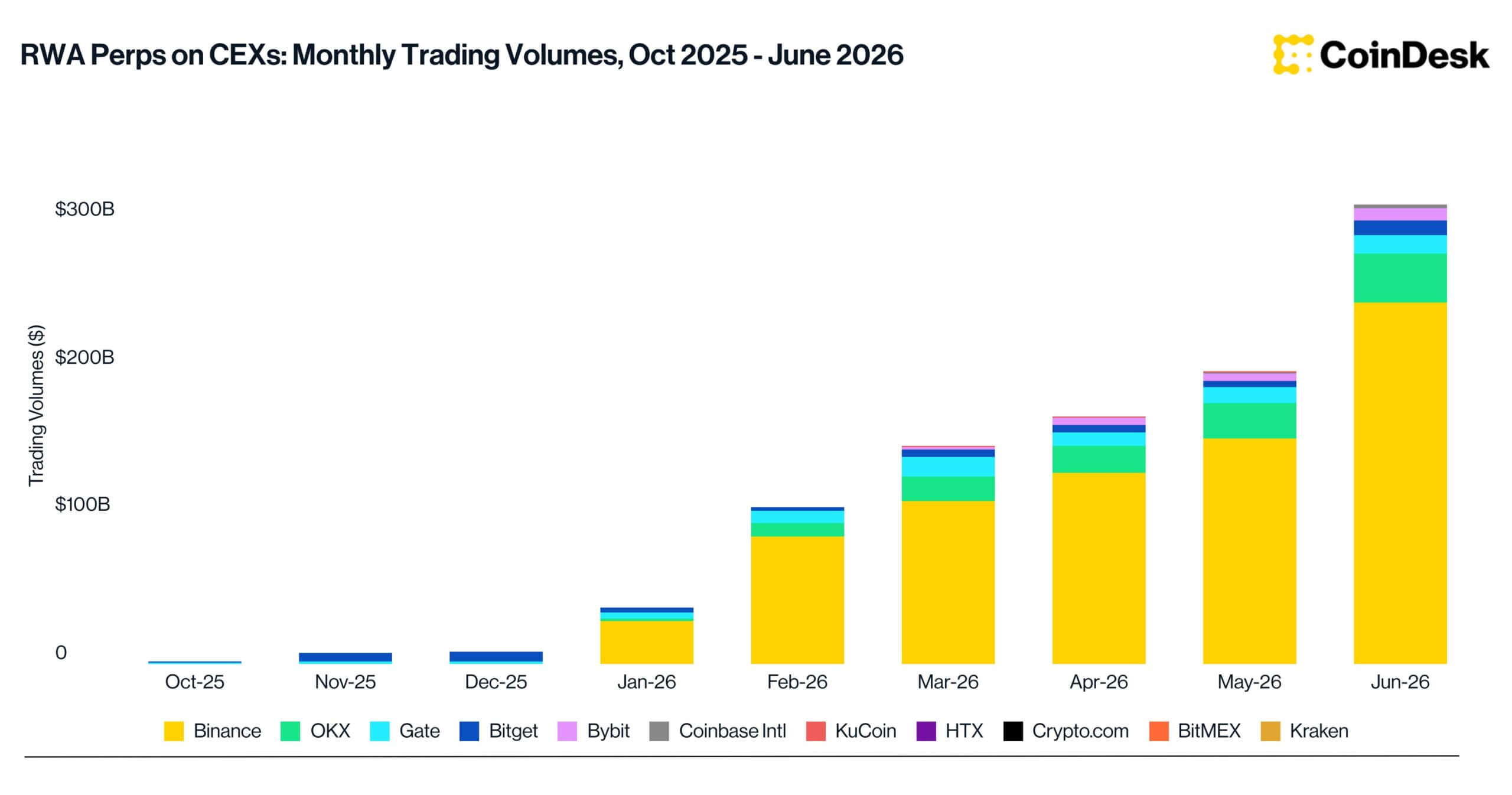
Derivatives growth has given exchanges a direct reason to add more Wall Street-linked products. CoinDesk exchange data showed real-world asset perpetual futures volume on centralized crypto exchanges rose 57% in June to a record $311 billion.
Binance accounted for $245 billion of that total, equal to a 78.6% market share. The category had little activity at the end of 2025, then expanded rapidly in the first half of 2026.
The report said SpaceX’s initial public offering helped accelerate demand for crypto-based access to traditional financial instruments, particularly among traders seeking exposure outside the limits of conventional brokerages and stock-market infrastructure.
Perpetual contracts let users trade price moves without holding the underlying security and without an expiry date. They are already one of the most active products on crypto exchanges. Leverage and round-the-clock trading can also amplify both volume and volatility.
Spot tokenized equities are growing as well
The growth is not limited to derivatives. RWA.xyz data showed the tokenized stock market increased more than 470% over the past year to about $1.87 billion. Monthly transfer volume for those assets also climbed to $8.4 billion, pointing to activity beyond exchange listings alone.
Kraken said in February that xStocks had surpassed $25 billion in total trading volume. That figure includes centralized and decentralized exchange trading as well as minting and redemption, with more than $3.5 billion in on-chain activity.
Those figures suggest that both tokenized stocks and derivatives tied to traditional assets now have measurable trading activity alongside the increase in listings.
Fewer total listings, more Wall Street-linked products
The rise of tokenized assets has come alongside a broader slowdown in exchange listings and a retreat from the sectors that defined the last crypto cycle. CryptoRank said major centralized exchanges listed 351 tokens in the second quarter of 2026, the lowest quarterly figure since the third quarter of 2023.
New listings declined for a second straight quarter. It was also the second time since early 2024 that delistings outnumbered listings.
The slowdown followed a record year in 2025, when listing activity peaked as Bitcoin hit an all-time high. Rather than replacing lost momentum with another wave of crypto-native projects, exchanges shifted toward tokenized versions of traditional financial assets.
Tokenized assets became the largest listing category in the first half of 2026. In the second quarter alone, exchanges added 42 tokenized assets, trailing only blockchain infrastructure and decentralized finance.
Meme coins and GameFi kept losing ground
Sectors that led the previous bull market continued to fade. Meme coin listings fell for a sixth consecutive quarter. Exchanges added 196 meme coins in the fourth quarter of 2024, but that number dropped to 41 by the second quarter of 2026, a 79% decline and the lowest quarterly figure since the third quarter of 2023.
GameFi contracted even more sharply. New gaming token listings were down 84% from their peak in the second quarter of 2024, leaving just 15 in the second quarter of 2026.
By contrast, CryptoRank’s broader tokenized asset category, which includes stocks, commodities and other real-world assets, showed more staying power than many of the narratives that dominated the last cycle.

As a benchmark, about 7% of tokens listed in 2025 had been delisted by mid-2026 across all categories. NFT projects posted the highest delisting rate at 19%, followed by GameFi at 14% and meme coins at 11%.
Within CryptoRank’s tokenized asset category, none of the 172 assets listed in 2025 had been delisted by mid-2026.
That lower delisting rate suggests tokenized assets have so far proved more durable on exchanges than NFTs, GameFi and meme coins. It also supports the view that exchanges are treating products linked to established financial markets as a longer-lived listing category.
Crypto platforms are moving into brokerage territory
The divergence between weak U.S. net equity buying and rising global tokenized stock activity points to a more fragmented path to market access. Crypto exchanges can combine spot trading, leveraged derivatives, tokenized assets and stablecoin settlement on one platform. That structure lets users move between crypto and traditional market exposure without shifting funds into a separate brokerage account.
Tokenized products also offer continuous trading and fractional access to assets that may be harder for some international investors to reach directly.
There are legal and structural differences. A tokenized stock may represent a claim backed by underlying shares, a synthetic instrument that tracks the price, or another contractual arrangement. Investors may not receive voting rights, custody rights or shareholder rights associated with direct ownership.
Perpetual contracts provide price exposure, not ownership, and can expose traders to leverage, funding-rate and liquidation risk. Regulation also limits availability across jurisdictions. Many tokenized stock products are not available to U.S. residents even when they track shares listed in the United States.
Still, the listing and trading data indicate that centralized exchanges are broadening their role. In the previous two market cycles, these platforms competed to distribute newly issued crypto-native tokens. Now they are increasingly competing to distribute financial products tied to stocks, commodities and other mature markets.
As framed in the CryptoSlate report, the next major exchange listing cycle may rely less on launching thousands of new tokens and more on listing products tied to existing financial assets on trading venues that never close.