
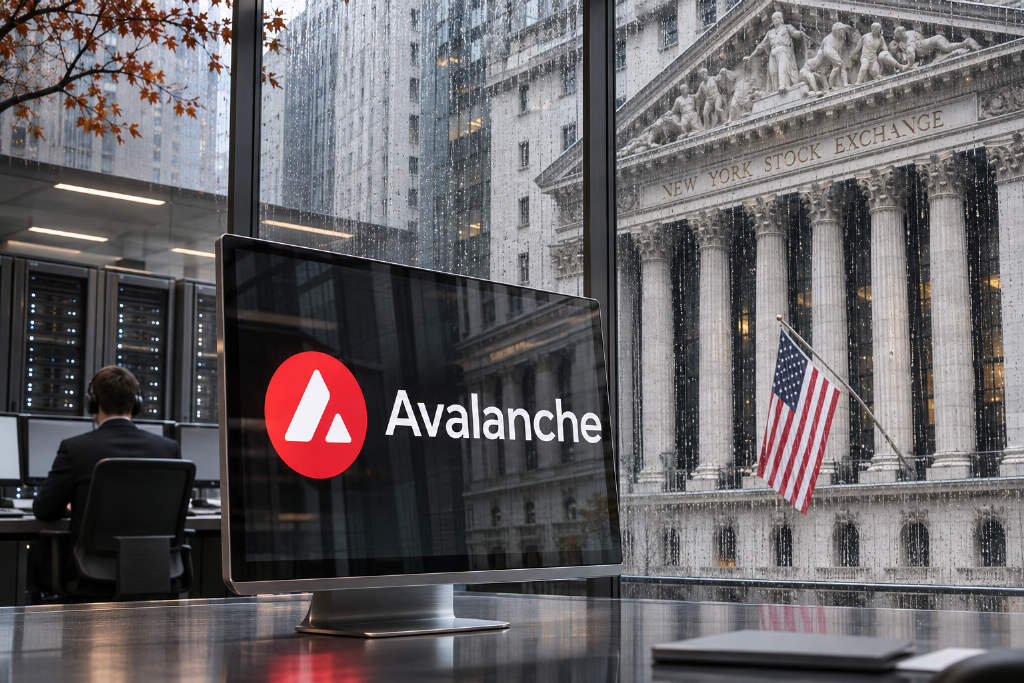
The tokenized stock market had a value of about $3.7 billion as of November 8, with approximately 4,400 tokenized assets, according to BlockTempo. The publication estimates that Avalanche has gained a roughly 5% share through its deal with the New York Stock Exchange (NYSE), equivalent to about $185 million at that market size.
Recent U.S. stock tokenization initiatives have taken three different chains. On Monday, the NYSE said it had selected Avalanche as the underlying clearing and settlement ledger technology for its tokenized securities platform. It aims to launch stock trading 24 hours a day, seven days a week, in the fourth quarter of this year.
Also on Monday, Formation filed with the U.S. Securities and Exchange Commission (SEC) to open a tokenized U.S. stock trading venue on Solana under the SEC's Innovation Exemption. It is targeting an early 2027 launch, with three stocks initially, including Galaxy.
On November 4, Five North sold its tokenized CNTN shares to trading firm DRW Cumberland. The transaction settled on TSV, a permissioned venue on Canton Network. BlockTempo said it was the first U.S. stock transaction completed under the Innovation Exemption framework.
BlockTempo characterized the three initiatives as separate routes through clearing and settlement, a trading venue, and permissioned wholesale trading. Each venue chose a single chain rather than multiple chains for its initial launch, the publication said.
Stocks and ETFs above $1 million rise to 287
The number of tokenized stocks and exchange-traded funds (ETFs) with market values above $1 million rose from three in January 2025 to 287 by November 8.
Single-chain launches and trading limits
BlockTempo said no tokenized stock venue has launched with support for multiple chains. It attributed the choice partly to regulatory complexity: issuing tokenized securities involves transfer agents, custody and registration of transfers. Each additional chain brings another ledger to reconcile and more compliance documentation. Exchange-built clearing structures such as the NYSE's also involve connections to transfer agents.
The publication also pointed to a current U.S. limit of 0.25% of average daily trading volume for an individual tokenized asset. Platforms must curb activity if volume rises too quickly, it said, restricting a strategy of placing the same stock on multiple chains to seek more volume.
Liquidity could be split as a result. Using NVDA as an example, BlockTempo said the same stock could eventually have different issuance structures and liquidity pools on Avalanche and Solana. Investors would need to compare the issuer, custodian and shareholder rights as well as the price. For issuers, choosing a chain also means choosing a distribution channel.
Exchanges and distribution
BlockTempo said trading volume is currently concentrated on three chains. On BNB Chain, it comes mainly from bStocks promoted by Binance; Coinbase drives activity on Base; and much of Solana's volume is associated with Kraken's xStocks.
HTX launched spot trading in bStocks on Monday, initially listing 20 instruments, including NVDA, TSLA, QQQ and CRCL. By number of listings, Strategy and SpaceX are currently the most frequently tokenized underlying assets, according to BlockTempo.
Comparing growth with stablecoins and tokenized Treasuries
On the 240th day after each asset class crossed $1 billion in value, stablecoins stood at about $4 billion and tokenized stocks at about $3.7 billion. Tokenized U.S. Treasuries were at approximately $2.5 billion at the same point.
BlockTempo attributed the growth in tokenized stocks to both supply and demand. The range of available assets expanded from a few large stocks to a longer tail, while overseas investors could hold U.S. stocks through an onchain wallet, reducing friction associated with account opening, transfers and time zones.
DTCC plans Solana connection
The Depository Trust & Clearing Corporation (DTCC) plans to connect its tokenization service to Solana in the second half of 2027. The NYSE, meanwhile, has chosen blockchain technology for its platform's clearing and settlement ledger.
BlockTempo argued that participation by traditional clearing infrastructure and exchanges takes tokenization beyond tokens sold by brokers and into market back-office systems. In its view, competition between chains now also concerns infrastructure.
Volume caps, launch dates and investor rights
BlockTempo said one question is whether the 0.25% average daily volume cap for an individual tokenized asset will be relaxed. It also identified the NYSE platform's planned fourth-quarter launch and subsequent trading volume as tests, arguing that the limit makes it difficult for a single platform to build depth.
Another date to watch is early 2027, when Formation hopes to launch. Whether it obtains SEC approval will bear on whether the Innovation Exemption becomes a repeatable licensing route, BlockTempo said. The publication suggested that more permissioned venues could follow outside Canton if that route takes shape.
On distribution, BlockTempo is watching whether Binance, Coinbase, Kraken and HTX can increase trading in long-tail assets. It argued that the volume generated by those channels would affect their respective chains' market shares.
For investors in Taiwan, BlockTempo said purchases of U.S. stocks currently rely mainly on sub-brokerage arrangements and overseas brokers, and that tokenized stocks have no legal local listing channel. It urged attention to how much voting power, dividend entitlement and liquidation priority a token carries, or whether it merely packages price movements.



