
a16z crypto said on July 22 that on-chain activity linked to tokenized stocks is climbing fast. Monthly transfer volume for tokenized equities reached $9.22 billion in June, up from $53 million in the same month last year, a gain of more than 170x year over year.
The metric is broader than trading volume. It includes trades, wallet-to-wallet transfers, and cases where tokenized stocks are deposited into DeFi protocols as collateral. Compared with the traditional stock market, which records trillions of dollars in monthly trading, the current scale remains small. Even so, for the still-early real-world asset sector, the growth points to tokenized equities moving from proof of concept toward actual use.
$9.22 billion in transfers shows tokenized equities are starting to circulate
The article says one of the central questions in the RWA market over the past few years has been which real-world assets can be brought onto blockchain rails. Treasury products, money market funds, real estate, and private credit have each drawn attention. Stocks, one of the world’s largest and most liquid asset classes, are now entering that process as well.
But tokenizing stocks is not just about creating a blockchain version of a traditional equity. The larger point is that blockchain infrastructure could change how stocks are issued, traded, settled, and used.
In traditional finance, a stock trade usually passes through exchanges, brokers, custodians, clearing institutions, and banks. Markets operate on different schedules, cross-border access relies on complex financial infrastructure, and settlement takes time.
On blockchain networks, assets can be transferred and settled automatically through smart contracts. In theory, that opens the door to around-the-clock trading and movement across different on-chain financial protocols. That is the core distinction highlighted in the piece. Traditional stocks sit inside a relatively closed financial system, where trading, settlement, and collateral functions are handled by separate institutions and infrastructure layers. Once tokenized stocks enter blockchain networks, they can become programmable components inside an on-chain financial system.
That means they can be bought and sold, but also transferred, pledged as collateral, and combined with other products. For that reason, the $9.22 billion figure tracked by a16z crypto should not be read as stock trading volume alone. The article argues it still matters because it shows tokenized equities are generating a growing amount of real on-chain activity.
Trades, wallet transfers, and deposits into DeFi protocols as collateral all suggest tokenized stocks are moving beyond issuance into actual use. For any financial asset, issuance is only the first step. The article says long-term viability depends on whether the asset can keep circulating and support more applications across the financial system.
Why tokenized stocks are drawing closer to DeFi
The piece points to several forces behind the growth. One is that traditional financial institutions are gradually becoming more open to blockchain as infrastructure for issuance and settlement.
In the past, many institutions treated blockchain mainly as the underlying technology for cryptocurrencies. With the rise of stablecoins, tokenized Treasurys, and the broader RWA market, more firms are starting to view blockchain as a way to change how financial assets move.
Much of the traditional financial system still depends on information passing between separate institutions and on manual operations. Blockchain, through smart contracts, can automate part of the trading, clearing, and settlement process. At the same time, the article does not argue that financial institutions will disappear. Custody, compliance, and risk control still matter. What may change is the method of issuance and circulation. Financial institutions would continue to provide the credit and regulatory functions, while blockchain could serve as the base network for asset transfer and settlement.
A second factor is rising demand for markets that operate all day. Digital asset markets have already shown that investors across regions can adapt to 24-hour trading. Traditional equity markets, by contrast, have fixed trading hours, and different jurisdictions still operate in separate time zones and market structures. If stocks can enter blockchain networks in a compliant tokenized form, they could connect with financial markets that run continuously.
The article says the most compelling part of tokenized stocks may still be their link to DeFi. Until now, DeFi has largely been built around BTC, ETH, and other crypto-native tokens. Those assets can be liquid, but they also carry heavy price volatility. As tokenized stocks, Treasurys, and other real-world assets move on-chain, DeFi could gain a broader base of underlying assets.
A tokenized stock can be used in collateralized lending, paired with stablecoins in new financial products, or included in on-chain indexes and structured products. Investors could even use smart contracts to execute investment strategies automatically. The article describes this composability as one of the most important shifts that happens when traditional assets move onto blockchain networks.
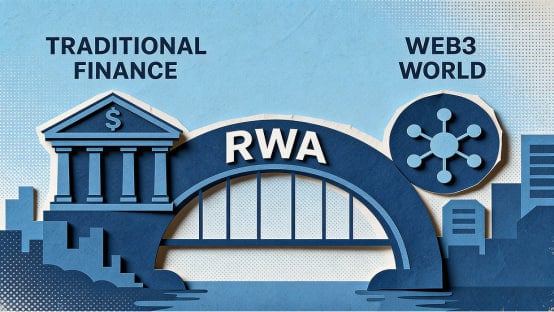
In that framing, the long-term value of RWA lies in connecting large pools of real-world financial assets to a more open and programmable financial network. Tokenized stocks, as one of the largest global asset classes, could become a major gateway in that process.
The next test is whether the market can move from issuance to ecosystem
The article also stresses that rapid growth does not mean the market is already mature. Compared with the traditional stock market, tokenized equities remain small, and the sector still faces questions around regulation, ownership, liquidity, and infrastructure.
Regulation comes first. Stocks are securities by nature, and tokenization does not change that. Whether a tokenized stock can be offered to global investors, whether buyers are eligible to purchase it, and whether the issuer needs regulatory approval are all questions that blockchain technology cannot solve on its own. Since rules for securities issuance and trading differ across jurisdictions, tokenized stocks will need to balance global trading demand with local regulatory requirements.
Ownership is another issue. The article asks whether a tokenized stock represents direct ownership of the underlying equity or simply tracks its price as a financial product. It also raises questions about who holds custody of the underlying shares, whether investors have voting and dividend rights, and whether users can actually redeem the underlying asset if the issuing platform runs into trouble. Those points go directly to market trust.
Liquidity remains just as important. The fact that tokenized stocks can trade on-chain does not mean they automatically have enough market depth. Traditional equity markets already have established exchanges, market makers, and investor bases. If tokenized stocks cannot show clear advantages in trading costs, settlement efficiency, trading hours, and financial utility, the article says it will be difficult to pull investors away from traditional venues.
That is why the next stage of competition will not be decided simply by who issues more assets. It will depend on who can build a more complete financial ecosystem, including compliant issuance platforms, custodians, trading venues, stablecoin settlement systems, DeFi protocols, and cross-chain infrastructure.
Only when those pieces are connected can tokenized stocks move from an issuance concept to a functioning on-chain financial market. Over a longer time horizon, the article says the relationship between traditional finance and crypto finance is unlikely to be a simple replacement story. A more plausible path is that traditional financial assets gradually move onto blockchain networks, while blockchain tools and financial mechanisms are increasingly accepted by traditional financial institutions.
Stocks, bonds, funds, and real estate are not disappearing. Their methods of issuance, trading, settlement, and use may change. The article closes by saying that June’s $9.22 billion in monthly transfer volume is still tiny compared with the traditional stock market, but a year-over-year increase of more than 170x shows the segment is entering a period of rapid expansion. As more issuers and platforms join, tokenized stocks could become one of the most promising asset classes in the RWA market.