


By Zhou, ChainCatcher
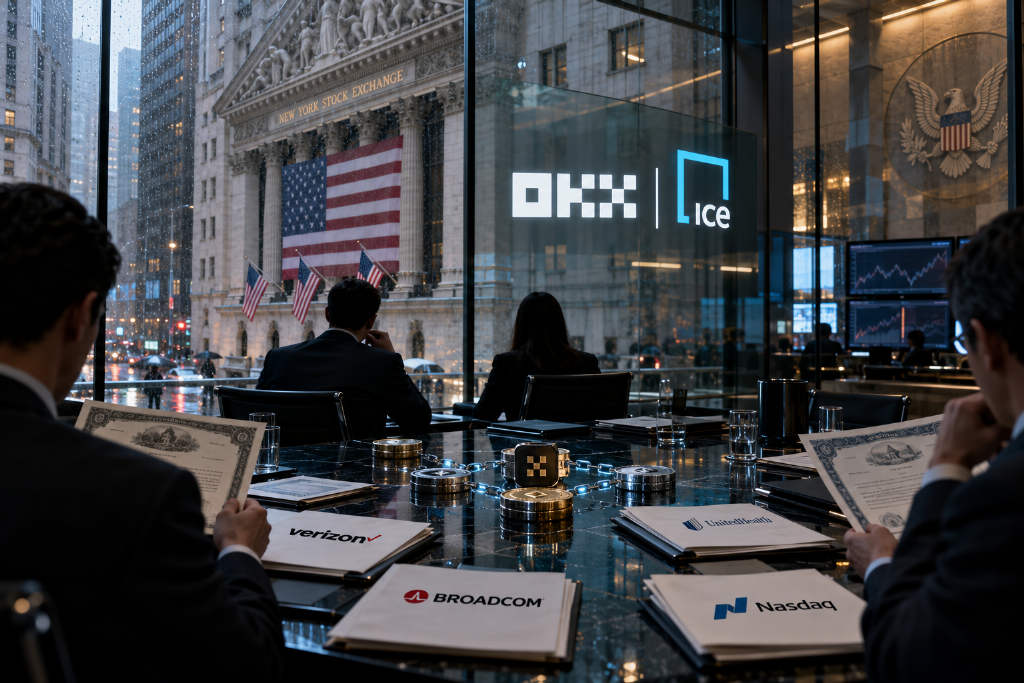
On Oct. 15, OKXICE, the tokenized stock platform formed by OKX and Intercontinental Exchange, said that nine listed companies, including Verizon, Broadcom and UnitedHealth, had objected under new U.S. Securities and Exchange Commission rules to the trading of their shares on the venue. Those stocks will not be available on the platform. Nasdaq also said it would not allow its own stock to be tokenized under the same framework.
The objections mark the first collective use of issuer veto rights since the SEC introduced its innovation exemption in September. The episode has sharpened a broader question: what does tokenized U.S. equity trading actually mean for both Wall Street and crypto markets?
The costs of tokenized U.S. stocks are starting to show
Under the SEC’s Sept. 17 innovation exemption, on-chain venues for tokenized securities can trade already-issued U.S. stocks without registering as exchanges. Third-party tokenization does not require prior approval from the listed company, but the issuer must receive written notice in advance. If the company objects within 30 days, the stock cannot be traded on that venue.
OKXICE was the first venue to announce a launch under that rule. According to its notice, the platform runs on X Layer and uses permissioned Uniswap v4 pools. Stocks are paired with stablecoins including USDC, USDG and USDT and can trade around the clock. Prices inside the pools are determined only by the ratio of the two assets, with no oracle, and there are no circuit breakers except in the case of a trading halt. The platform also acknowledged that token prices may diverge from the underlying shares, especially outside regular market hours.
For listed companies, that means their stock can enter a market where they have no control over price formation. Among the nine companies that objected, names such as CoreWeave, AppLovin and Applied Digital are popular AI and retail-trader stocks, and they are also among the names crypto traders most want to access.
Nasdaq’s reasoning was more direct. It does not want its stock traded in a venue that cannot display the best price in real time and does not report trades to the consolidated tape. The article notes that Nasdaq is also a competitor to ICE, the parent of the New York Stock Exchange, and that it received SEC approval in March this year to trade stocks in tokenized form.
One market view cited in the article is that the bottleneck for real-world assets lies in authorization: who has the right to turn the economic interest of a stock into an on-chain token. The objections from the nine companies are, in that sense, a fight over that right.
A weekend flash crash exposed pricing and liquidation risks
Those concerns were reinforced by a weekend flash crash. At around 5:22 a.m. Beijing time on Oct. 18, while U.S. equities were closed, AI-themed U.S. stock perpetual contracts on crypto platforms suddenly dropped.
DYJ, chief executive of execution platform Tread.fi, said the selloff began on Binance. The SNDK contract saw large aggressive sell orders first, with about $407,000 traded in that second and roughly $1.03 million in the next. Less than a second later, sweeping sell orders appeared on Hyperliquid. Around 10 addresses sold six contracts, including SNDK, MU and SOXL, within 1.8 seconds, all as newly opened short positions. About six minutes later, volume in the MU contract on Hyperliquid jumped to roughly $10 million per minute, a phase DYJ attributed to cascading liquidations.
On Binance, the MU contract briefly fell to $818.57, down about 6% from before the crash, before recovering most of the loss within an hour. Holders of the actual shares were unaffected over the weekend. The traders who were liquidated were those using leverage in these contracts. Prices came back, but their positions were gone.
Weekends are the weakest period for tokenized U.S. stocks. Decentralisedco compared data from 30 weekends since March and found that when the Monday opening gap exceeded 1%, perpetual contracts got the direction right 69% of the time. By Sunday night in New York, however, they reflected only about one quarter of the eventual gap size.
Thin trading and inaccurate pricing can become much more disruptive once leverage and liquidation mechanics are layered on top. In its October Global Financial Stability Report, the International Monetary Fund said tokenized stocks are about 1.5 times as volatile as the corresponding equities. Tobias Adrian, financial counsellor at the IMF, said the frictions tokenization tries to remove often serve as shock absorbers in traditional markets. The weekend market closure is one of those buffers.
Bitcoin’s four-year cycle remains, but the amplitude has narrowed
For more than a decade, Bitcoin has broadly followed a four-year cycle tied to halving events. In past bear markets, Bitcoin fell between 77% and 93% from its peak.
The cost of a bear market is not only lower prices. Capital leaves the sector, and the industry often has to wait for the next bull market to rebuild funding and attention.
This time, the timing has not changed much. Bitcoin peaked at about $126,000 in October 2025, roughly 540 days after the April 2024 halving, in line with historical patterns. But the drawdown has been much smaller. On June 5 this year, Bitcoin fell to about $59,100, a decline of roughly 53%, and then gradually rebounded to around $85,000 in recent trading.
To understand the shallower decline, the article first looks at who provided support. In spot Bitcoin exchange-traded funds, SosoValue data showed about $10 billion in net outflows from November 2025 to June 2026. In June alone, the month Bitcoin bottomed, outflows were about $4.5 billion. Then, during the rebound from July to September, net inflows totaled about $6.3 billion.
Among Bitcoin treasury companies, BitcoinTreasuries.net data showed that by February this year, listed treasury firms were selling more than they were buying, with Strategy almost the only company still accumulating. Based on filings submitted to the SEC, Strategy’s Bitcoin holdings rose from about 650,000 BTC at the end of November 2025 to 843,775 BTC in late June 2026, an increase of about 194,000 BTC. In January this year alone, Strategy accounted for 97.5% of net additions by listed companies. After the week of June 22, however, Strategy paused purchases and shifted to building U.S. dollar reserves.
In other words, price support in this bear market has depended to a large extent on the financing capacity of a single company.
Stablecoins and tokenized Treasuries changed where capital stayed
Another shift has been taking place on-chain: stablecoins did not leave the market in the same way they did in the previous cycle. CoinGlass data showed that after Bitcoin peaked in October 2025 and began to fall, USDT market capitalization kept rising and did not top out until April and May this year. It has since been broadly flat at about $183 billion. USDC has only edged lower.
By one estimate cited in the article, stablecoins have contracted by about 3% from their peak this year, far below the 26% decline seen in 2022. The article notes that part of the 2022 contraction was tied to the Terra collapse and the Silicon Valley Bank episode.
On-chain capital also found a new place to stay. RWA.xyz data showed tokenized U.S. Treasuries growing from about $9 billion in October 2025 to a peak of about $16 billion in the middle of this year. After Bitcoin rebounded, that figure started to ease and now stands at about $14.5 billion.
There are about 85,500 holders of tokenized Treasuries, mainly institutions and DeFi protocols. The scale is still much smaller than Strategy’s buying, but in the previous bear market there was almost no comparable destination on-chain.
Exchange revenue mix is shifting too
The revenue structure of exchanges is changing as well. A Dune dashboard showed that in mid-December 2025, the HIP-3 market on Hyperliquid, focused mainly on stocks, indexes and commodities, accounted for only 4% of daily volume. By this summer, the share had reached 40% to 60% on most trading days, and on July 30 it briefly hit 74%.
Part of that reflects weaker trading in crypto assets. Still, when crypto markets are quiet, exchanges now have business lines that do not depend entirely on token prices.
Crypto researcher Haotian said the industry is moving from a bull market driven by asset issuance to one driven by distribution after global assets move on-chain. In that view, part of the next wave of incremental capital could flow into tokenized U.S. stocks, which may also flatten the top of the next bull market.
At the same time, the effect of halving itself is diminishing. Bitcoin’s current block reward is 3.125 BTC and will fall to 1.5625 BTC in 2028. As traders on crypto platforms watch earnings season and Federal Reserve rate decisions alongside crypto-specific signals, market cycles may track global liquidity and U.S. equities more closely.
Crypto needs U.S. stocks far more than U.S. stocks need crypto
For companies such as Broadcom and Verizon, tokenization offers little obvious benefit. They do not lack liquidity, and they do not lack funding channels. CoinFound estimated that for 49 stocks, the median ratio of offshore tokenized stock trading volume to traditional market volume was only 0.084%.
Wall Street is pursuing tokenization too, but through a different route. In December 2025, DTC received a no-action letter from the SEC allowing securities in its custody to be converted into on-chain tokens. The scope covers Russell 1000 constituents, representing about 95% of investable U.S. equity market capitalization. On Nasdaq, tokenized shares and traditional shares are matched in the same order book, with the difference appearing only in post-trade delivery.
That model does not rely on stablecoins, and the tokens can move only between wallets registered with DTC. Michael Winnike, head of strategy at DTCC, said tokenization should modernize market functions while preserving the safeguards on which existing markets depend.
From the other direction, crypto capital is not large enough to carry the tokenized U.S. equity market on its own. Decentralisedco estimated that foreign investors hold about $19.86 trillion in U.S. stocks. Even if one-tenth of all stablecoins moved into stock tokens, that would add only about $31 billion. The rest of the incremental demand would have to come from shares already held in brokerage accounts.
What crypto capital is buying also matters. RWA.xyz data showed that as of Oct. 19, the on-chain tokenized stock market was worth about $3.45 billion. Tokens linked to Strategy totaled about $368 million, while Circle-related tokens totaled about $307 million. Together they made up about 19.6% of the market, or 2.6 times the combined size of four broad-based index products.
CoinFound said the top three U.S. stocks most heavily bought by crypto capital were Circle, Strategy and Coinbase, all of which tend to rise and fall with the crypto market itself. Holdings like that do little to diversify risk.
The most stabilizing forms are also the most constrained
The structures most likely to provide stability are also the ones facing the tightest rules. Under SEC limits, trading volume in a tokenized version of a single stock cannot exceed a set share of the previous month’s average daily volume: 0.25% for large-cap stocks and 2.5% for others. By one estimate, the first 63 stocks on OKXICE would have a combined daily cap of about $710 million, with Nvidia limited to about $64 million a day. Add issuer veto rights, and the compliant route is unlikely to scale quickly.
At the same time, open interest in stock, index and ETF perpetual contracts on tradeXYZ stands at about $3.01 billion, equal to 94% of the value of all on-chain stock tokens. In early September, a memecoin liquidity pool on Robinhood Chain held 53% of all tokenized HIMS. Buying pressure of about $39,000 pushed the token price to $132.64, while the New York closing price was only $28.84.
Crypto markets want U.S. equities to smooth out their cycles, but they can access them only under Wall Street’s rules. And the compliant forms most likely to stabilize the market are the ones under the heaviest constraints. That, the article argues, may explain why tokenized U.S. stocks sound compelling but are slow to deliver visible results.
Can tokenization become crypto’s external anchor?
For a long time, the root of crypto’s boom-and-bust pattern has been that the value of most assets comes from expectations about crypto itself. Rising prices attract capital, which then pushes prices higher. The same feedback loop works in reverse on the way down. The market lacks an anchor independent of its own sentiment.
Tokenized U.S. stocks and Treasuries could provide that anchor. Their value comes from corporate earnings and interest rates, not from token prices. With those assets on-chain, capital can stay during bear markets, exchanges and protocols can keep operating through service revenue, and developers have a reason to plan across cycles.
But that depends on the crypto industry accepting the rules of traditional markets and allowing U.S. equities to come on-chain as collateral and as a place for capital to sit. If they become just another high-leverage chip, the result will be more volatility, not less.
That also means native tokens would no longer have exclusive claim over on-chain capital. Yet a crypto market that does not have to be rebuilt from scratch every four years may be the deepest implication of tokenization for the industry.