
In 2026, the opening bell on Wall Street started to matter a little less. For more than a century, trading hours at the New York Stock Exchange shaped when global capital woke up and when it went quiet. That line is now starting to blur as on-chain infrastructure gains the ability to handle real order flow tied to Nasdaq and NYSE-listed stocks, giving one of finance’s oldest asset classes a 7x24 trading format.
That shift has been helped by a series of developments in tokenized U.S. equities this year. Europe’s MiCA framework is moving deeper into implementation, while the draft CLARITY Act in the United States offers a clearer legislative reference point for digital asset classification. At the same time, major exchanges and fintech platforms have been expanding their tokenized equity product lines.
Odaily points to three prominent examples. Ondo Global Markets pushed assets to the billion-dollar level within a matter of months and is also advancing its registration process with the U.S. Securities and Exchange Commission. Bitget’s rToken connects to Nasdaq and the NYSE, while combining a unified trading account, margin applications, and high-frequency reserve audits. Binance launched bStocks in June and has been expanding quickly by leaning on the traffic of the world’s largest exchange.
On the surface, many tokenized stock products use similar language, especially around 24/7 trading and 1:1 backing. Underneath that, Odaily argues, their liquidity sources, trading mechanics, use of funds, and risk structures differ in important ways.
Four areas define the comparison
Odaily frames its review around four dimensions:
- liquidity sourcing and price anchoring,
- trading hours and product availability,
- capital efficiency and composability,
- compliance licenses and custody transparency.
Those are also the questions investors usually care about most: whether prices reflect the underlying U.S. stocks, whether the products can be traded at any time, whether capital tied to those positions can be reused efficiently, and whether the underlying shares actually exist and can be verified. The review also refers to market-size and volume rankings as a supplementary gauge.
Liquidity: three ways to stay tied to the stock price
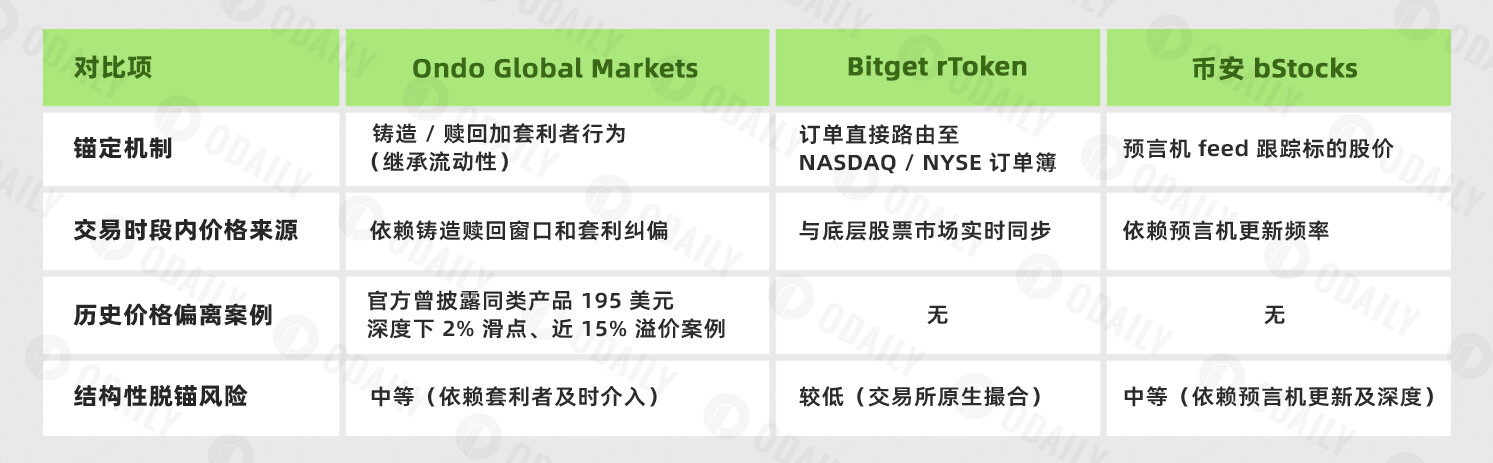
Price anchoring is one of the most important structural differences in tokenized equities. It also determines how much depeg risk a trader may face when markets become volatile.
Ondo Global Markets uses what the article calls an “inherited liquidity” model. Its token prices are kept close to the underlying shares through real-time minting and redemption, combined with arbitrage activity. The setup is designed to preserve on-chain transferability while keeping the token near the reference stock price.
Bitget’s rToken takes a different route. During U.S. stock trading hours, spot orders are routed directly to Nasdaq and NYSE order books through licensed brokers, and the execution results are written back to the exchange’s spot order records in real time. Odaily describes it as the only product among the three to achieve direct exchange-level order book connectivity, which means price and liquidity are synchronized with the underlying stock market.
Binance’s bStocks uses oracle-fed data to anchor prices to the underlying stocks. Backed by Binance’s user base and update mechanism, the model is positioned as a lower-threshold way to cover a wider range of names while still offering real-time price tracking.
In Odaily’s view, the three products represent three of the sector’s main technical paths today: direct exchange-linked matching, mint-and-redeem arbitrage, and oracle-based tracking.
Their use cases differ as well. Ondo’s approach is better suited to users comfortable with native on-chain operations and willing to accept some lag in arbitrage-based corrections, and it is also more attractive to arbitrage traders. Binance’s oracle-based design lowers the barrier to entry and suits users who want convenience and broad coverage. rToken’s direct order-book model, by contrast, comes closer in design to true market pricing, especially during regular U.S. trading hours, which makes it a better fit for traders who care about tighter pricing and lower slippage.

Odaily also ran an order-book test using tokenized shares of Circle, ticker CRCL. It says all three platforms showed narrow spreads at the same point in time, but rToken stood out on posted depth and 24-hour trading volume.
The article attributes that edge to rToken’s connection to native stock exchange order books, which gives it stronger order-handling capacity and a more active market profile.
Trading hours: all say 24/7, but the mechanics are not the same
All three products present round-the-clock trading as a key feature, though the actual operating models are different.
Ondo Global Markets offers a minting and redemption window that runs 24 hours a day, five days a week. On-chain transfers are not restricted by time, giving users flexibility in moving the asset itself, but price discovery depends on whether the mint-redeem window is open.
Bitget’s rToken covers regular U.S. stock trading, pre-market, intraday, after-hours, and overnight sessions. Some popular names go a step further and support true 24/7 trading. When the underlying U.S. market is closed, Bitget provides exchange-internal liquidity to maintain price discovery, extending the trading experience beyond standard hours.
Binance’s bStocks also emphasizes all-day liquidity, near-instant settlement, and zero conversion fees. With Binance’s native user base, more names can be traded conveniently at any hour.
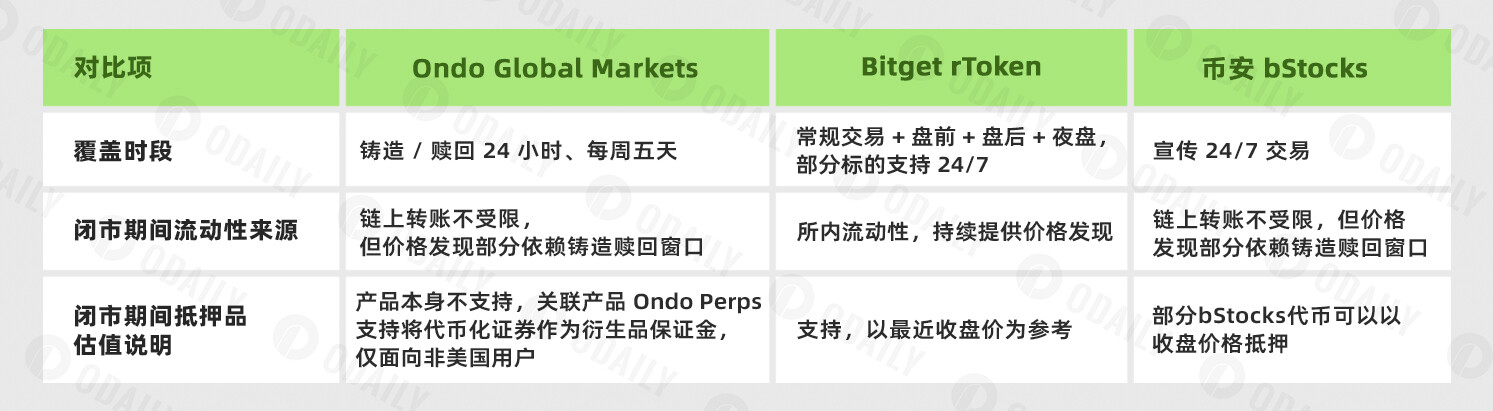
Odaily’s assessment is that all three have built mechanisms to deal with trading and price-volatility risk outside U.S. market hours, and that the overall product experience and risk-management frameworks are already fairly complete. Still, on pure 24/7 availability, Ondo trails the other two to some extent, which leads the article to say that rToken and bStocks may be more suitable for everyday users.
Capital efficiency: DeFi composability versus unified margin systems
For institutions and professional traders, capital efficiency is often the decisive factor. The question is not simply whether a tokenized stock can be bought and sold, but whether it can also be used as margin or collateral and moved easily across strategies and account structures.
Odaily notes that this part of the comparison may matter less to small retail traders, but it is central for professional desks and institutions allocating crypto-based exposure to U.S. equities.
At the design level, Ondo and bStocks lean more toward on-chain DeFi composability. They depend more heavily on third-party protocol ecosystems, which gives users a broader open-finance environment but also adds cross-protocol friction and extra smart-contract risk.
rToken follows a different path. It uses an exchange-based institutional unified margin account, allowing stock positions to be integrated directly into derivatives, lending, and other scenarios within the same account system.
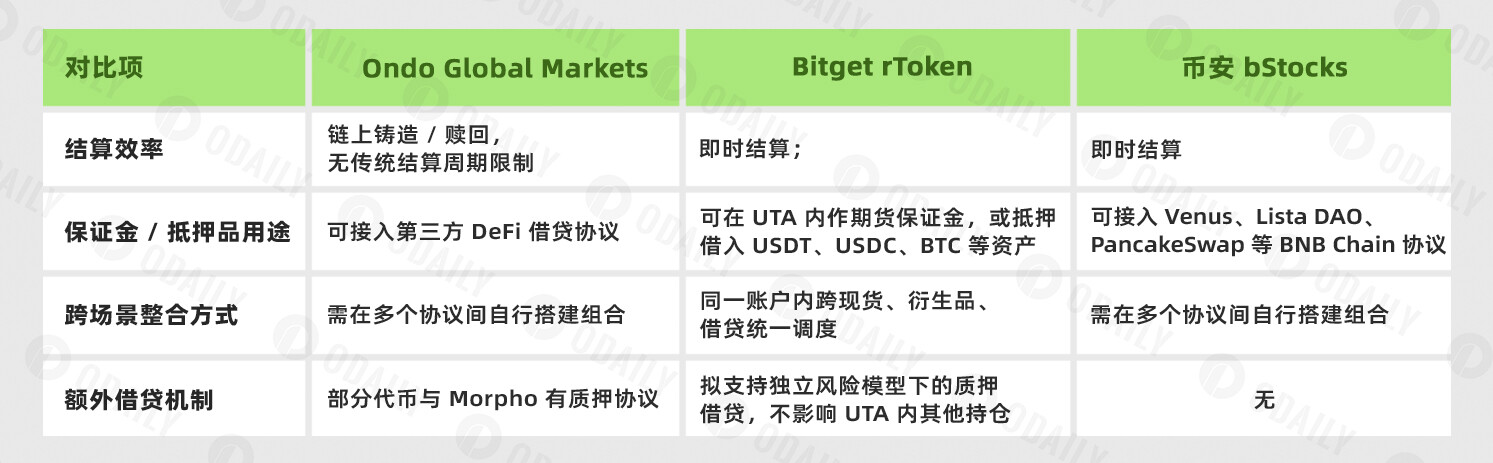
That leaves a clear divide. If a user wants deeper on-chain DeFi functionality, Ondo and bStocks are the more natural fit. If the benchmark is practical capital efficiency for professional and institutional trading, Odaily says rToken’s integration and convenience stand out more clearly and align better with institutional preferences for controllable risk management.
Compliance and custody: broad convergence, narrower differences
Trust in tokenized equities depends on more than on-chain tradability. The underlying U.S. shares need to exist, and they need to be independently verifiable.
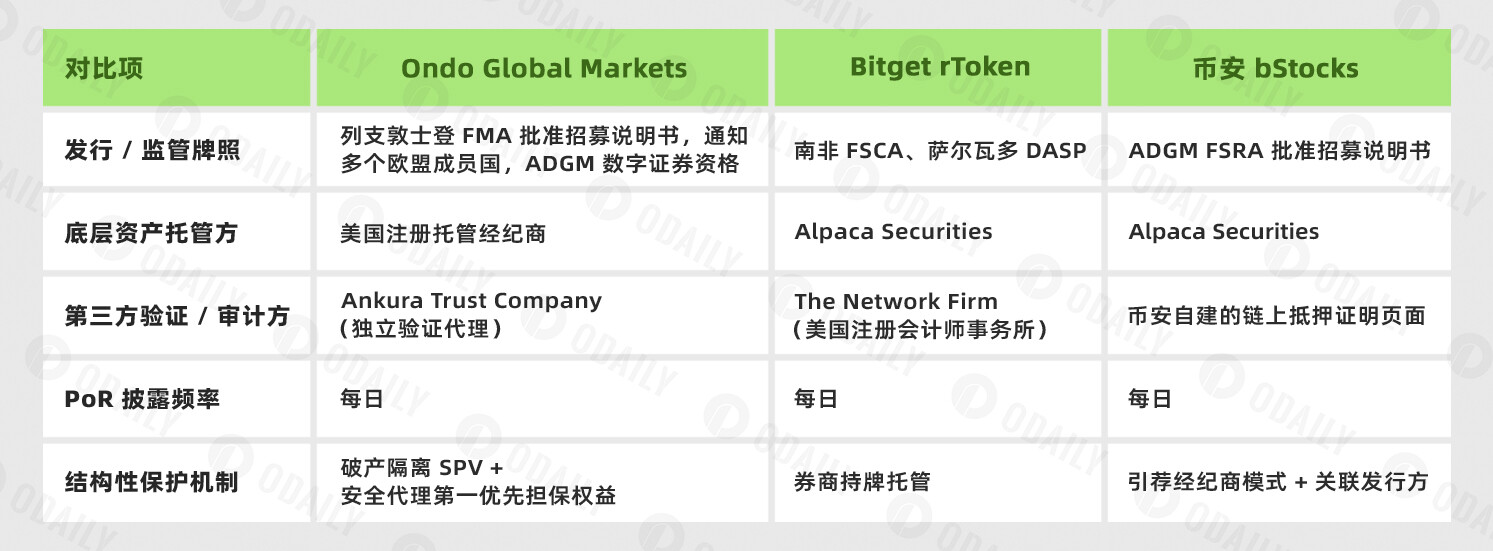
According to Odaily, Ondo, rToken, and bStocks all use a combination of regulated custody and third-party independent verification to protect underlying assets. That gives each of them a relatively complete framework for compliance, transparency, and confidence in the underlying stock holdings.
The article argues that after several rounds of market washouts in crypto, major players in tokenized equities have moved to maximize protections around the underlying assets. The differences that remain are more granular: audit frequency, the level of disclosure detail, and the identity of the third-party verifier. For end users, Odaily says, those distinctions may not translate into a large difference in day-to-day experience.
Three products, three target user groups
Taking the four dimensions together with market rankings, Odaily’s conclusion is that the three models answer different needs inside the tokenized stock market rather than forming a simple hierarchy.
Ondo Global Markets, with its inherited-liquidity structure and compliance footprint across multiple jurisdictions, appears better suited to institutions and users that care more about regulatory frameworks and open on-chain use cases in Europe and the United States.
Binance’s bStocks benefits from exchange-native traffic and integration with on-chain ecosystems, which makes the entry point, self-custody, and on-chain circulation more convenient. Odaily sees it as a better fit for investors already active in the BNB ecosystem and comfortable operating on-chain.
Bitget’s rToken, by contrast, is presented as a stronger match for high-frequency traders and institutional clients because of its broader product functions. Those users are typically more sensitive to liquidity, capital efficiency, and moving assets across multiple trading scenarios.
The bigger questions are still ahead
Odaily also argues that the sector’s shared challenges may matter more over time than the differences between individual products.
Among the unresolved issues it highlights are whether cross-border finance can remain compliant, whether real demand will keep pace with product supply, and whether pricing can stay precise when the underlying U.S. market is closed.
As regulatory boundaries become clearer and underlying liquidity deepens, the article expects the competing models to learn from one another and help move tokenized equities from an early experimental stage toward a more mature market. The line once drawn by Wall Street trading hours is now being rewritten, trade by trade, on-chain.