

On June 2, at the "Proof of Talk 2026" conference held at the Louvre in Paris, Tom Lee, Chairman of BitMine (NYSE: BMNR)—the largest public company treasury of Ethereum—delivered a keynote titled "Crypto Spring: ETH is the Future of Money." On that day, Bitcoin fell below $66,000 and Ethereum dipped as low as $1,820, putting BitMine's ETH holdings at an unrealized loss of approximately $8.86 billion. Lee argued that the prevailing bearish sentiment marks the market bottom and that Ethereum could eventually reach $250,000 driven by AI and tokenization transforming financial infrastructure.
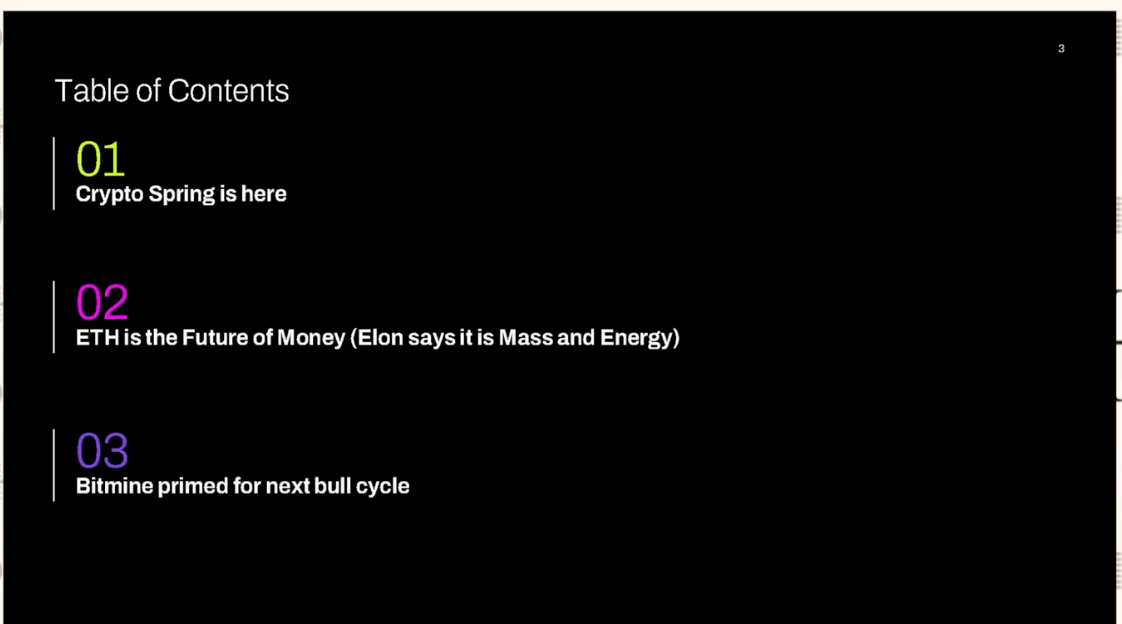
Lee structured his talk into three parts: the five macro tailwinds ushering in a Crypto Spring; why Ethereum is the best candidate for the future of money; and why investors should consider holding crypto treasury stocks, particularly BitMine, rather than the underlying tokens.
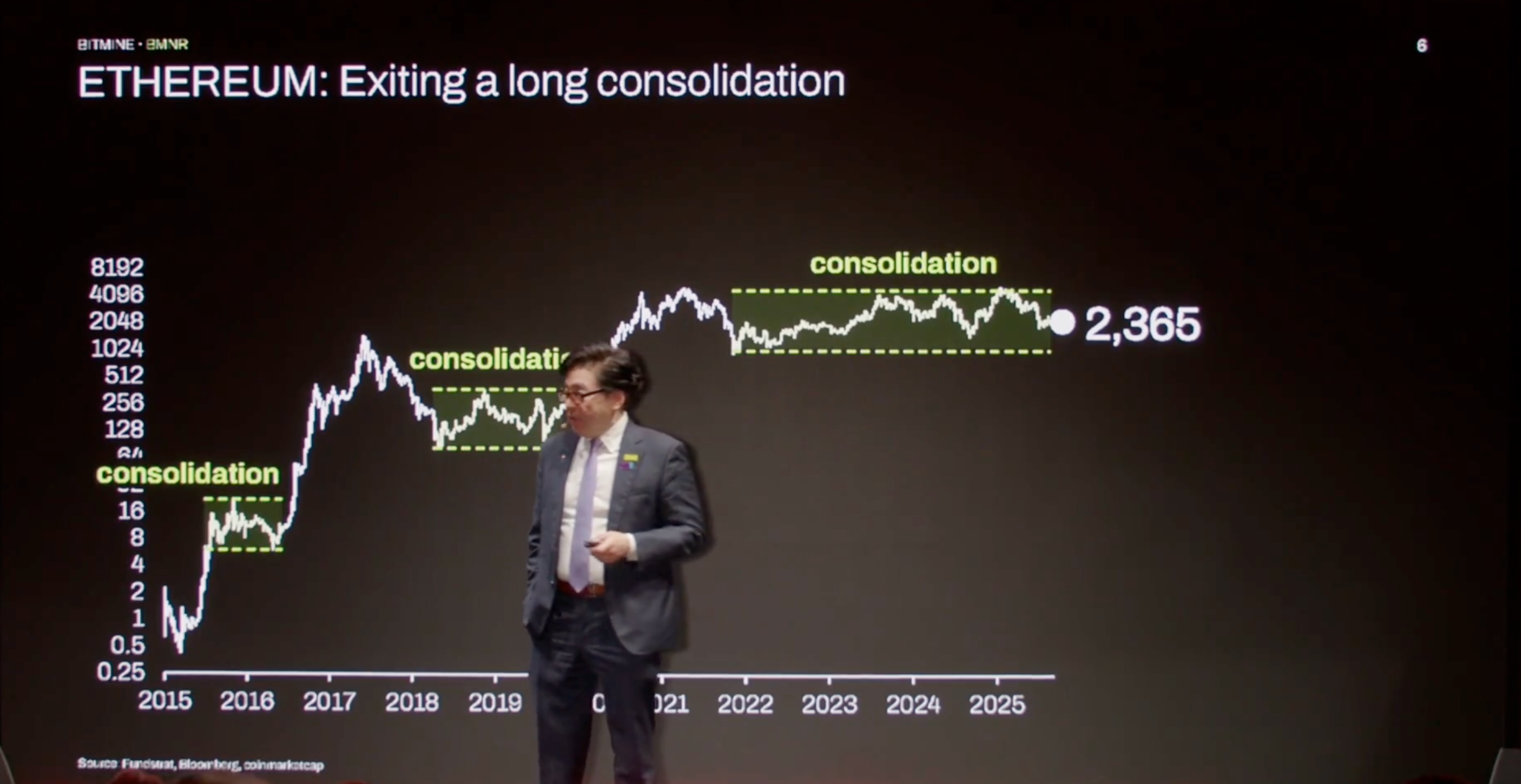
Five Catalysts for Crypto Spring
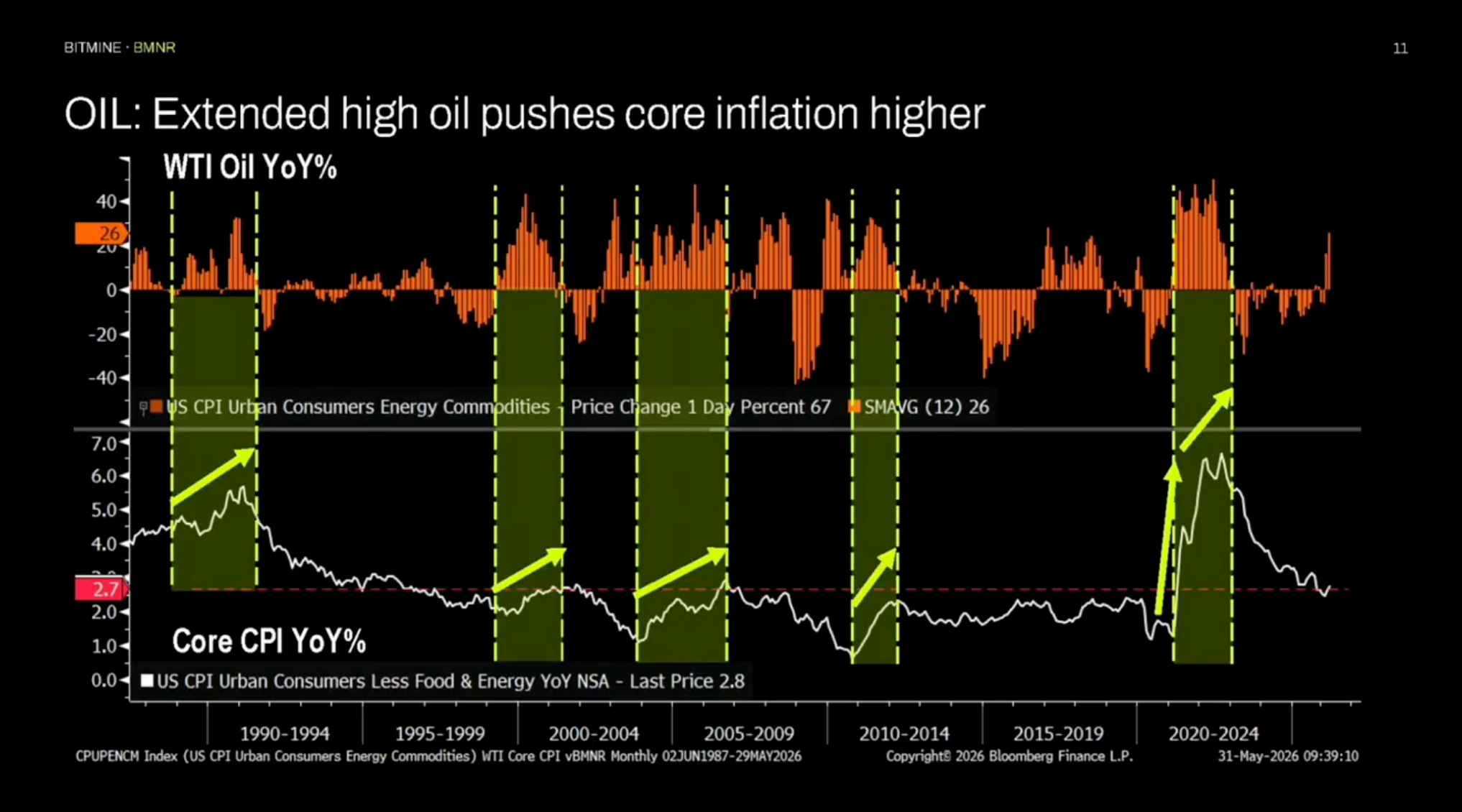
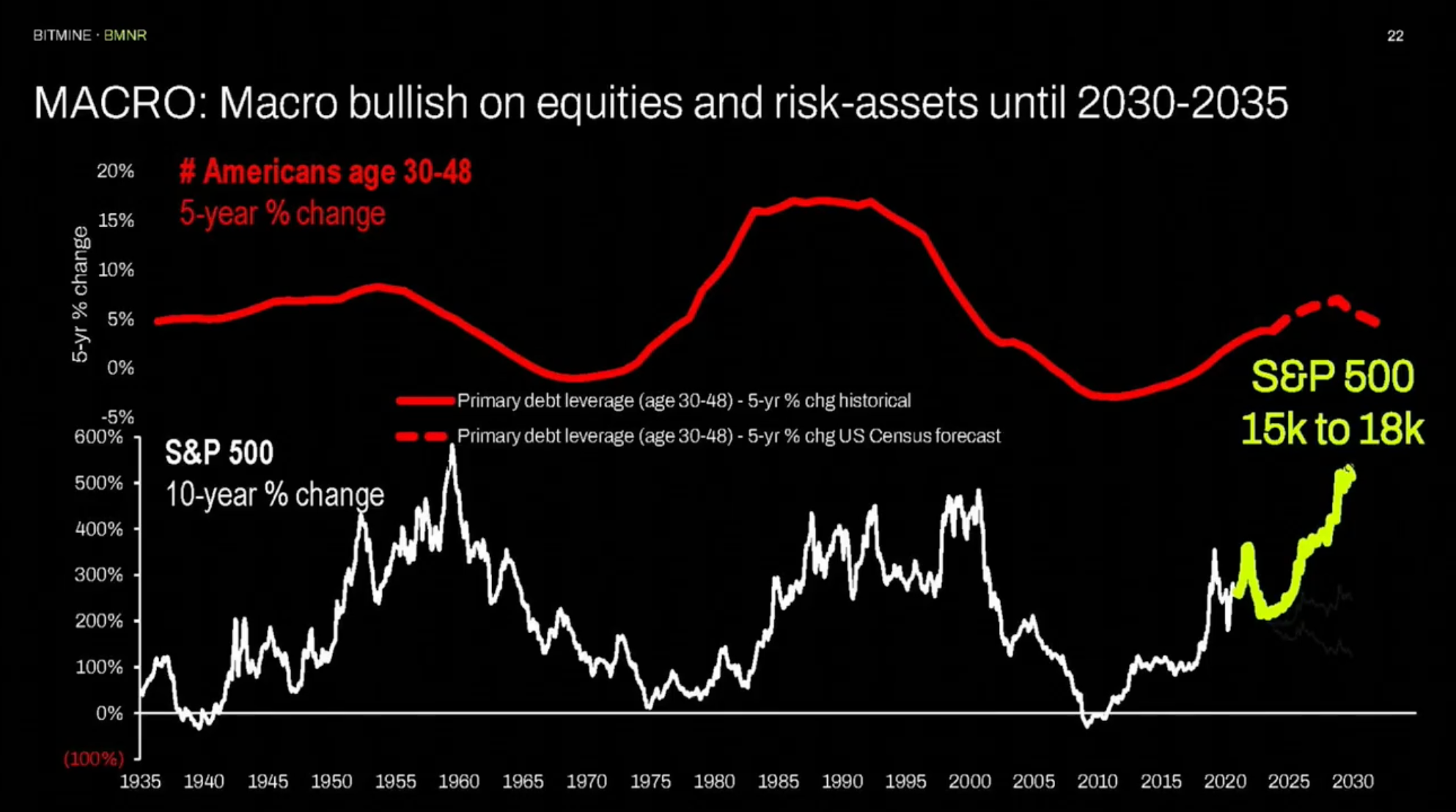
Lee identified five key drivers. First, the end of the war in Iran would remove the war premium from oil, possibly pushing prices down to $40 per barrel, and given Ethereum’s historically high negative correlation with oil, that would be a major tailwind for ETH. Second, the Clarity Act would provide a regulatory framework for crypto adoption in the U.S.; prediction markets assign only a 56% probability of passage, but Lee believes the actual odds are much higher. Third, the White House is pro-Bitcoin and supportive of stablecoin-friendly dollar policy. Fourth, new Federal Reserve Chair Kevin Warsh is known to be pro-Bitcoin. Fifth, equities are structurally bullish due to demographics: the rising 30–50 age cohort—fueled by Millennials, Gen Z, and Gen Alpha—is driving above-trend economic growth, and Lee projects the S&P 500 could reach 15,000–18,000 by the end of the decade.
Ethereum as the Future of Money
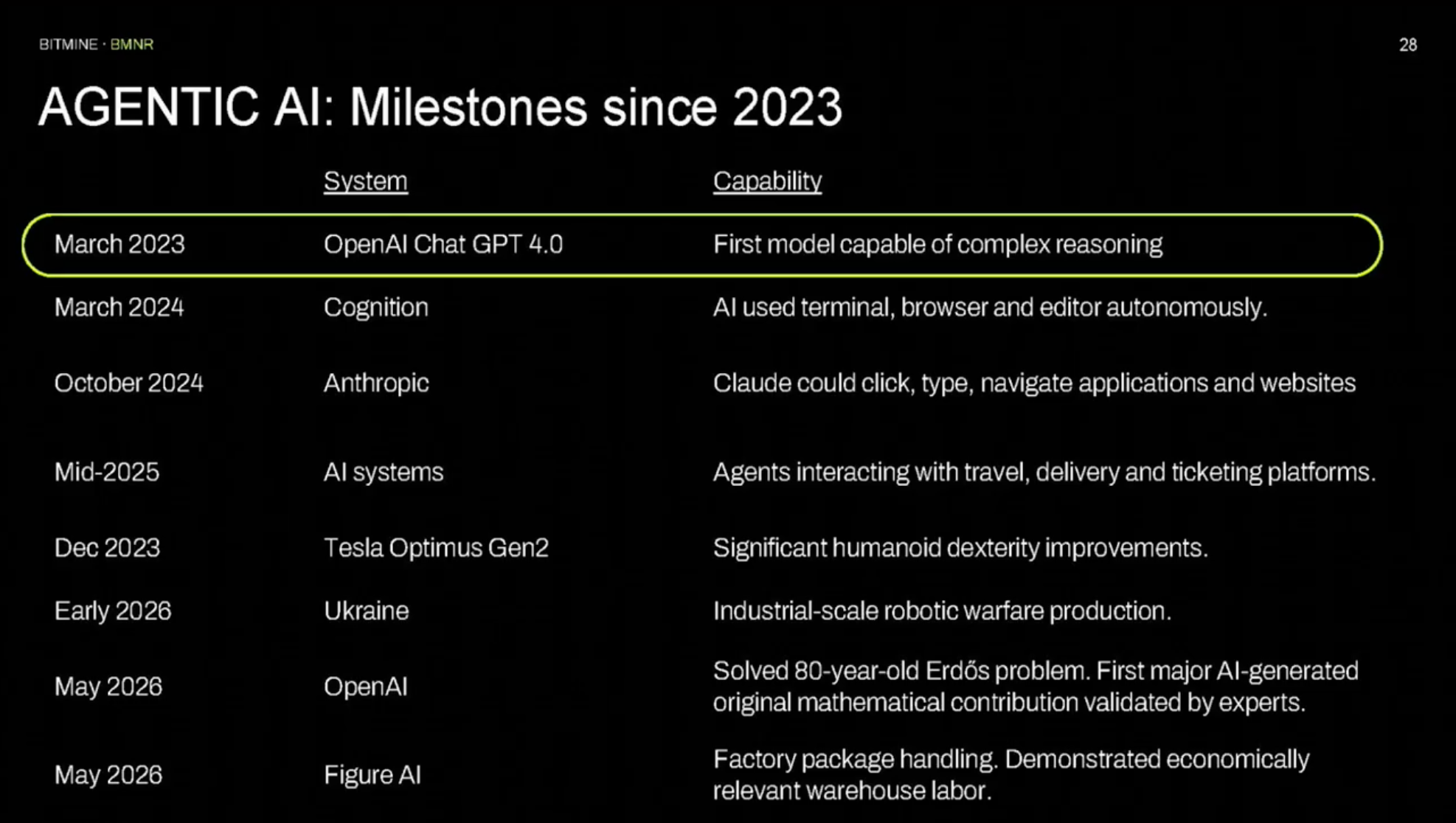
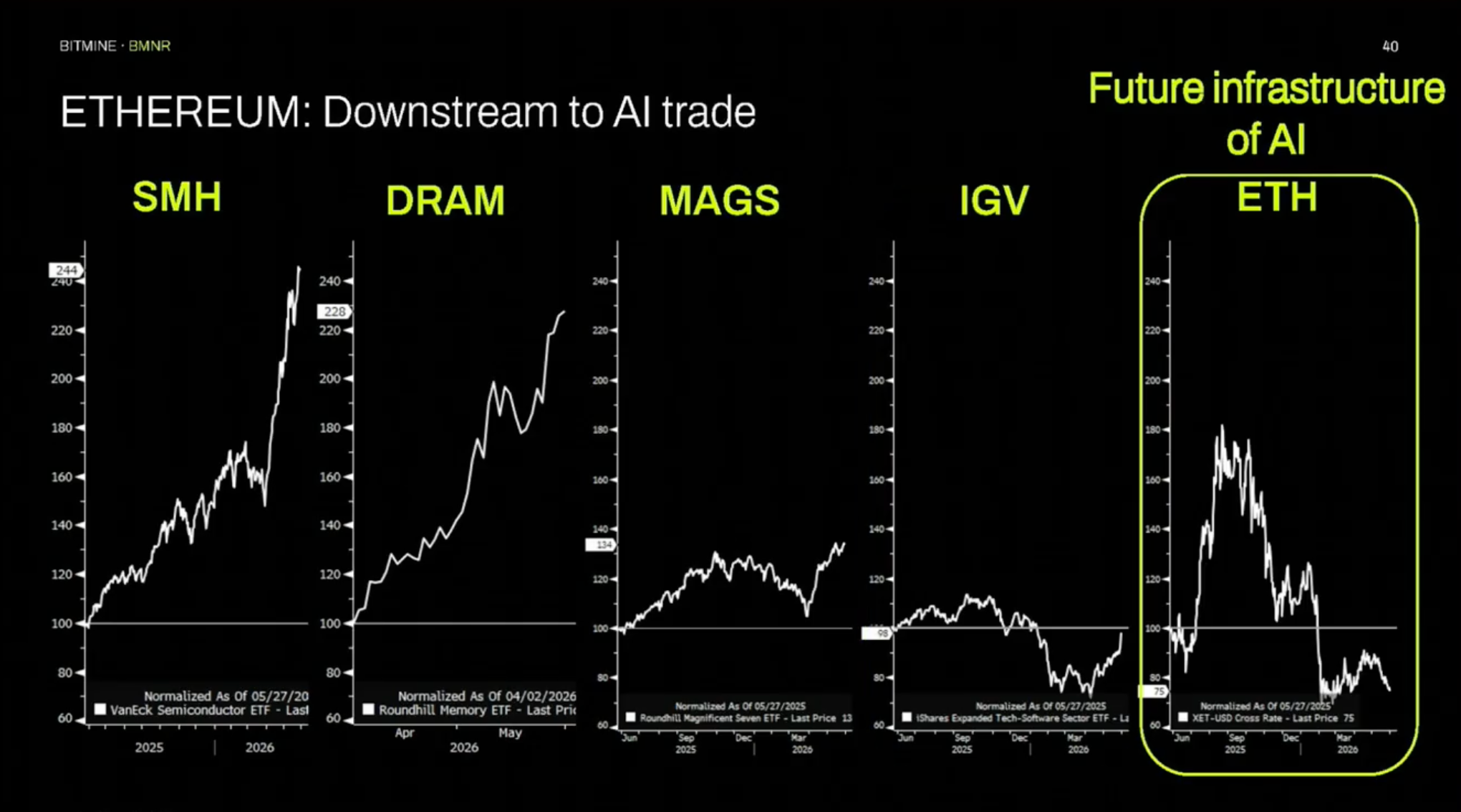
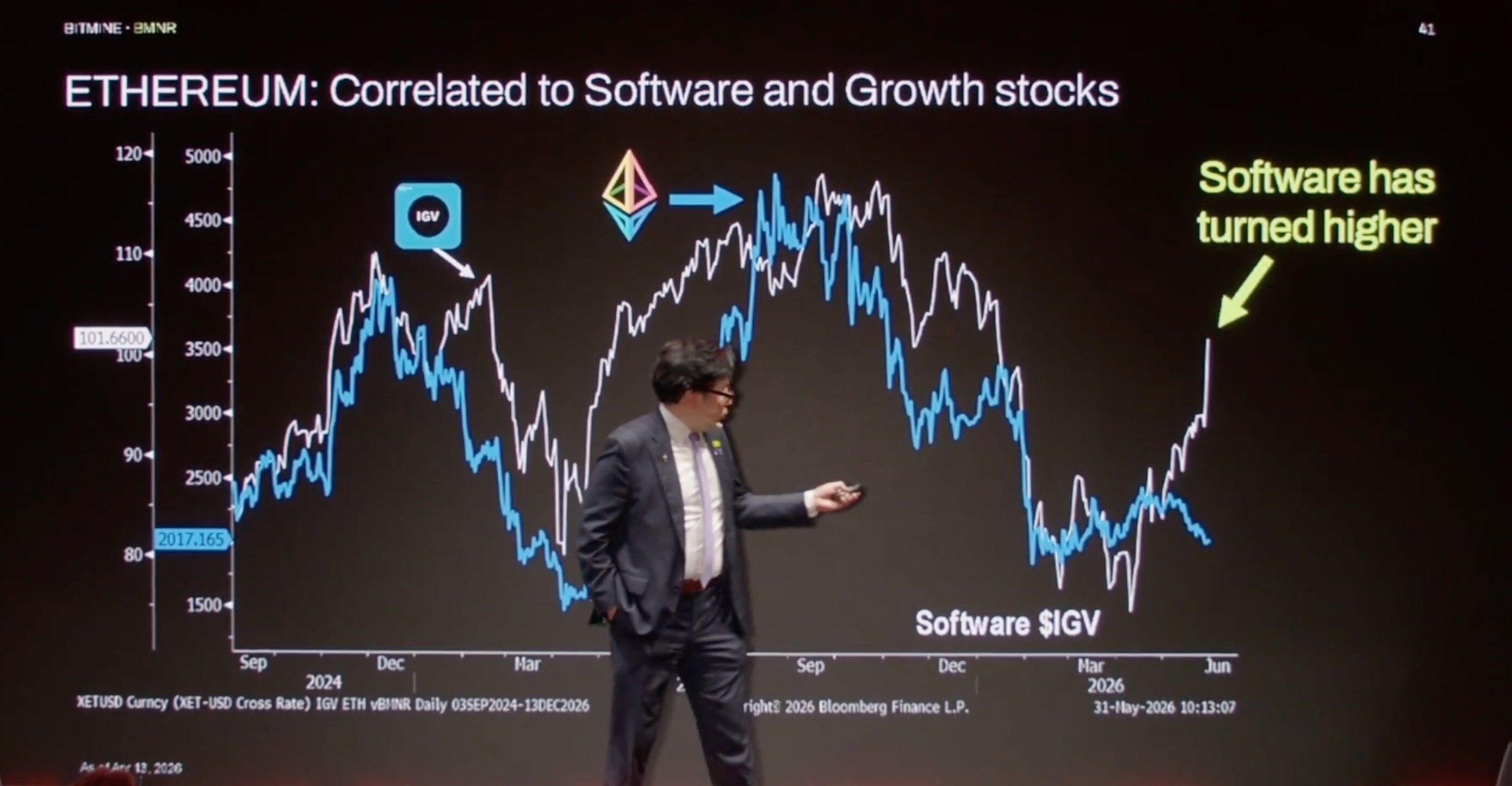
Lee traced milestones since ChatGPT’s launch in 2023: agentic AI systems gaining web interaction capabilities, breakthroughs in robotics such as Optimus Prime, industrial-scale drone manufacturing in Ukraine, OpenAI solving an 80-year-old problem, and Figure AI’s warehouse robot. He stressed that robots will dominate internet traffic, and blockchain is far more efficient than traditional systems for identity verification, authentication, and payment speed. While crypto prices have not yet reflected these advances, software stocks have surged, and ETH—long correlated with software equities—should catch up within a few weeks.
Tokenization is another major force. Stablecoin volumes have surpassed Visa’s payment network, and a tokenized securities market could reach $300 trillion, encompassing real estate, fixed income, equities, derivatives, land, and gold. Lee noted that only a handful of blockchains can operate at scale, and crypto technology will displace today’s most profitable banks. He pointed out that JP Morgan generates $60 billion in annual revenue, but Jane Street, with just 3,000 employees, will earn $40 billion this year, while Tether, with only 300 employees, may pull in $15 billion. "In the next 10 years, five of the world's top ten financial institutions will be crypto-native," he said.
The Changing Role of the Ethereum Foundation and Corporate Treasuries
Lee criticized the Ethereum Foundation for its shrinking stake—now just 100,000 ETH, or 0.1% of supply, down from 17%—while corporate treasuries such as BitMine collectively hold 7% of supply (BitMine alone holds 4.5% and accounts for 65% of all treasury holdings). These treasuries can generate roughly $500 million annually in staking rewards to fund ecosystem development. Lee argued that a $240 billion network with 1,500 nodes across 89 countries and 15,000 developers is too large to be coordinated by a single foundation. Instead, he sees a model akin to the mobile industry’s CTIA, where private companies lead, and the foundation focuses on long-term research such as quantum resistance. Vitalik Buterin has also signaled a reduced role for the foundation.
BitMine’s Strategic Moves
Lee detailed BitMine’s key initiatives. The company invested in Eightco (ticker ORBS), the largest public holder of Worldcoin. ORBS' balance sheet includes 28% stakes in OpenAI, 8% in MrBeast, 8% in ETH, and 34% cash. Compared to a similar entity, VCX, which trades at 13x net asset value, ORBS at $1 should be around $15, making it deeply undervalued. BitMine also launched MAVAN, now the world’s largest single staking operator for Ethereum, managing roughly $2 billion in third-party assets and generating about $1 million per day in rewards from its own staked ETH. Another investment is MrBeast, whose revenue has surpassed $1 billion with 50% growth, and who is now entering banking through the acquisition of Step Financial, targeting the 120-million-strong Gen Z and Gen Alpha demographic.
Additionally, BitMine successfully uplisted to the New York Stock Exchange and met the criteria for inclusion in the Russell 1000 index, effective June 26. With only 25 institutional holders today and approximately 1,600 active Russell 1000-tracked fund managers forced to consider the stock, Lee sees a huge catalyst for the stock later this year.
Lee presented a chart showing a 90% correlation between BitMine’s stock price and ETH price. If ETH reaches $22,000, BitMine stock would be worth about $500; at $250,000 ETH, the stock could hit $5,000. BitMine currently holds around 4.5% of the total ETH supply and may slow accumulation while deciding whether to cross the 5% threshold. “If you are bearish today, you are selling at the bottom,” he concluded.