
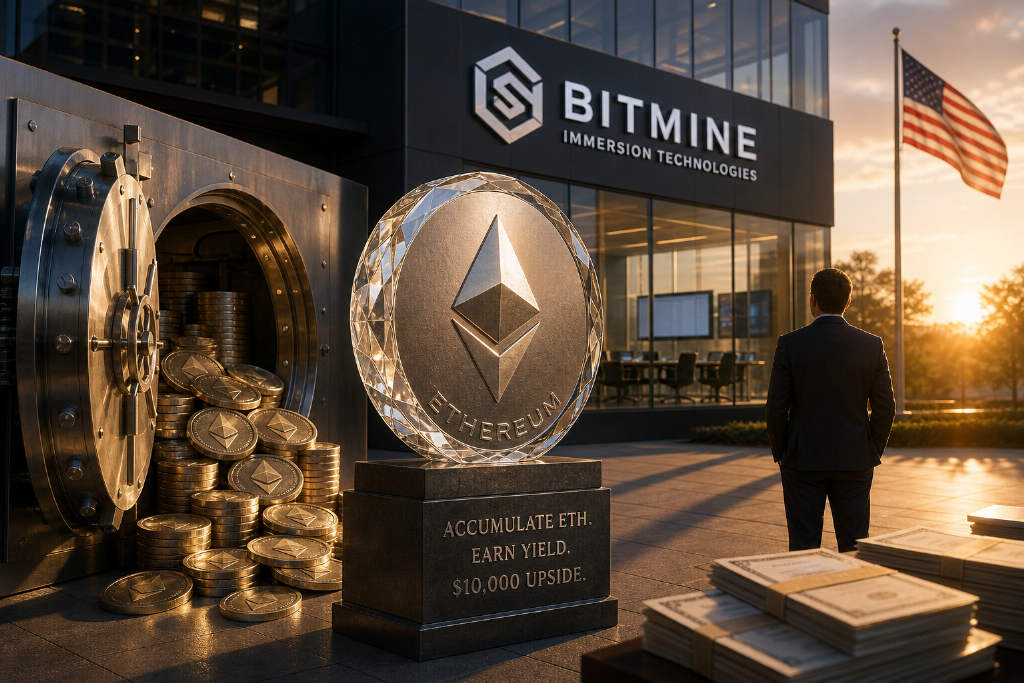
Tom Lee said BitMine Immersion Technologies is nearing its target of owning 5% of Ethereum’s total supply, but he suggested that threshold may not be the finish line. The company, where Lee serves as chairman, held about 5.8476 million ETH as of Aug. 23, equal to roughly 4.8% of total supply, according to the figures cited in the discussion.
The source also included a clear conflict-of-interest disclosure. BitMine Immersion Technologies (NYSE: BMNR) was described as the world’s largest corporate holder of ETH. Lee is also a personal investor in BitMine, while his Fundstrat Capital manages the GRNY ETF and runs a paid research subscription business. The article said Lee’s personal wealth is closely tied to ETH prices, BMNR shares, and GRNY performance, and noted that his views on Ethereum and the broader crypto market align with those financial interests.
From zero to nearly 5% in 14 months
BitMine announced its shift to an Ethereum treasury model on June 30, 2025, setting a goal of buying 5% of ETH supply. At the time, the two Bankless hosts privately thought 5% was out of reach. Fourteen months later, the company’s holdings had climbed to about 5.82 million ETH. Using a total supply figure of 120.7 million ETH, that put BitMine close to 4.9%.
Bankless host David Hoffman said at the start of the episode that BitMine was one of the few digital asset treasury, or DAT, cases that had not only avoided collapse but had outperformed expectations.
Lee attributed that progress to three factors. First, the message to investors stayed simple and consistent: keep the capital structure clean by relying on equity financing only, with no debt and no convertible notes. Second, the company presented ETH purchases as support for the Ethereum ecosystem, with a 5% target large enough to matter but not so large that it would become an overly centralizing force. Third, BitMine did not try to tell a week-by-week stock story. Lee said the plan should be judged over years, not short trading windows, and cited Michael Saylor’s view that companies like this should be assessed on a four-year horizon.
He also said BitMine had raised capital at prices above net asset value, or NAV, in nearly every financing round. The amount of ETH represented per share had increased by more than 10x from the roughly $450 starting level tied to the company’s initial trading period. In Lee’s telling, that materially expanded ETH exposure for early shareholders and helped explain why the stock was able to hold above $450.
More than 60 straight weeks of buying
Lee said BitMine has bought ETH every week since the strategic pivot, extending the streak to more than 60 consecutive weeks. The article contrasted that with Strategy (MSTR), which it said had paused Bitcoin purchases multiple times during the same period and had at one point sold Bitcoin.
His explanation was simple: each week, the company allocates capital to whichever action offers the highest return. Over the last five weeks, that has meant a combination of ETH purchases and share buybacks. Lee said that if ETH looks set for a strong move before year-end, BitMine becomes more tactical, continuing to accumulate ETH while repurchasing stock to increase ETH exposure on a per-share basis.
Three main funding sources
- Issuing common stock above NAV. Lee described that as the main source of cash, though not one the company uses indiscriminately.
- Buying ETH at a discount. He said most of the ETH acquired over the past 14 months was not bought at spot through direct market purchases, but obtained through structured arrangements at discounted prices.
- Issuing the perpetual preferred stock BMNP. Launched in June with a 9.5% dividend, the deal was more than five times oversubscribed, priced at $80, and was trading around $91 at the time of the program.
Lee likened BMNP to a three-year at-the-money call option on ETH. In his framing, the company pays a 9.5% annual dividend in exchange for the right to lock in more ETH at current prices. He said a comparable option in the market could carry a premium close to 100%.
Staking income adds to the pile
BitMine has staked more than 5 million ETH through its in-house platform Maven and with partners, according to Lee. At an annualized staking yield of about 2.6% to 2.7%, that translates to roughly 120,000 ETH added each year.
He ran the math this way: the company is about 200,000 ETH short of the 5% target, but staking alone can "auto-produce" around 120,000 ETH annually. That means only about 80,000 additional ETH would need to be purchased to get there.
What happens after 5%
The obvious market question is whether BitMine’s ETH buying engine shuts down once it reaches the 5% mark.
Lee outlined two possible paths. One, 5% is not necessarily a hard ceiling. If corporations begin treating ETH as a long-term treasury asset, then going beyond 5% could be "entirely reasonable," though he said the right time to revisit that question is 2027. Two, even if the company stops at 5%, staking rewards would still increase holdings over time. In that case, BitMine could sell rewards to manage its percentage ownership, but not because it needs cash.
He made that point directly: "ETH is a yield-bearing asset. BitMine has no need to sell any ETH because of financial pressure."
Lee said annualized staking income is about $300 million, while the yearly dividend burden tied to the 9.5% preferred stock is around $30 million to $35 million. On that basis, coverage is high. The article also said BitMine does not convert those staking rewards into dollars or stablecoins. Rather than sell ETH, Lee said he would prefer to find ways to monetize ETH holdings, including putting about 800,000 currently unstaked ETH into uses that are beneficial to the ecosystem.
From treasury vehicle to Ethereum ecosystem company
That led to what the discussion described as BitMine’s second transition: from a company that mainly buys ETH into an Ethereum ecosystem company.
Lee said Maven manages not only BitMine’s own ETH but also more than $2 billion in outside client assets. He called it a "real cash flow business" incubated inside BitMine.
Backing EF spinouts
The article said the Ethereum Foundation, or EF, has spent the past year narrowing its scope and shifting some work to three new entities: the nonprofit EthLabs, the for-profit EthSystems, and EthInstitutional. BitMine was described as the lead seed investor in all three.
Lee’s explanation was that Ethereum has grown too large for a single organization to handle every task, much as the semiconductor industry does not rely on one trade association alone. Because BitMine is permanent capital, with no maturing debt and no redemption pressure, he said it can provide three years or more of runway to these spinouts so they can focus on execution rather than fundraising month by month.
In the article’s framing, that support serves both as public-goods funding and as a commercial bet. BitMine wants Ethereum to capture as much of the future upside from tokenization and AI as possible.
How Lee frames ETH as an asset
David Hoffman asked Lee whether ETH should be viewed as a cash-flow asset or a store of value. Lee chose the second category, but used a different lens to explain why.
He argued that treating equities as pure cash-flow assets is misleading. Since 2009, he said, the S&P 500 has returned roughly 10x in total, with dividends contributing only 30% and the remaining 9.7x coming from capital appreciation. Investors buy stocks because they believe companies can allocate capital better than they can themselves, he said, while bonds are the cleaner example of a true cash-flow asset. By that logic, ETH looks more like the stock market, and more like land. Land can be rented out, but its long-term value through cycles still rests on appreciation.
Lee put it this way: "If you think of the stock market as a cash flow machine, then over the past 15 years the S&P 500 has gone up about 10x, and dividends only contributed 30% of that. The other 9.7x had nothing to do with cash flow. At its core, the stock market is a store of value."
He also pushed back on the claim that institutions may use Ethereum for tokenization without needing to hold large amounts of ETH. Lee said that line of thinking is common in bear markets and tends to disappear quickly once ETH enters a new uptrend. He compared ETH ownership debates to the U.S. dollar, saying the dollar cannot be redeemed for gold from the government either, yet it remains the world’s transaction unit. In his view, trying to force every asset into a single economic model leads to absurd conclusions.
A different path from Strategy and the BMNP logic
BitMine is often compared with Michael Saylor’s Strategy, and Lee addressed that directly. He said Strategy has already been highly successful as a common-equity story, but its later financing strategy became more complex, incorporating structures such as digital credit and volatility monetization. Lee said those innovations will need a longer time horizon to judge fairly, adding that the full picture may not be clear until 2032.
BitMine chose a different capitalization route. It uses 9.5% perpetual preferred stock to lock in dollar costs while preserving upside for common equity holders. Lee said that if ETH reaches $5,000 or $10,000, staking income would far exceed the preferred dividend burden, creating significant leverage for common shareholders.
He also suggested that BMNP would likely be expanded only if BitMine decided to buy far more than 5% of ETH supply. Otherwise, he said, the current size of the preferred issuance is enough.
Lee described the instrument this way: the company pays a 9.5% dividend each year in exchange for the right to lock in more ETH at today’s price, and buying a similar call option in the market could cost close to 100%.
Cycle calls, AI, and price targets
On the market cycle, Lee said he believes crypto has already bottomed. In time terms, he said the process is about 95% complete. In price terms, about 90%. "Unless you’re a genius, buying here is probably cheaper than waiting for a confirmed bottom," he said.
He agreed with Hoffman’s observation that AI has absorbed a large share of investor attention and capital that might otherwise have gone to crypto, but added what he sees as the more important point: crypto is downstream from AI. As AI becomes more capable, machine-to-machine payments, on-chain settlement, and tokenized assets should become more relevant, not less. Lee summarized it in one line: "The more AI develops, the more important crypto becomes. Crypto is the downstream story of AI."
He then laid out explicit price targets:
- ETH should trade above $5,000 simply by entering a new crypto bull cycle.
- If Wall Street tokenization and AI-driven demand are layered on top, ETH could "easily" move above $10,000 within one to two years.
Lee also offered a rough shareholder-return scenario. If ETH were to flip Bitcoin, implying an ETH price of around $15,000, BitMine shares could rise another 10x from current levels to about $180, according to his estimate.
Disclosure remains central
The discussion was ultimately about more than BitMine’s ability to scale an ETH treasury strategy without debt. It also laid out Lee’s framework for judging Ethereum: whether it functions as a store of value, whether staking income can cover capital costs, and whether institutional balance-sheet demand for ETH becomes durable by 2027.
But the source repeatedly stressed that Lee is one of the clearest financial beneficiaries of this thesis. BitMine owns close to 5% of ETH supply, and Lee himself is tightly tied to the company’s outcome. The article ended by saying that the path to a $10,000 ETH will still depend on the macro cycle, the pace of regulation, and whether Ethereum can turn the tokenization and AI narratives into actual on-chain demand.