

On June 2 Beijing time, Tom Lee, Chairman of BitMine (NYSE: BMNR), took the stage at the Proof of Talk 2026 conference in the Louvre, Paris, to deliver a speech titled “Crypto Spring: ETH is the Future of Money.” With Bitcoin slipping below $66,000 and ETH touching $1,820 that very day, Lee dismissed the pervasive bearish sentiment as a classic signal of a market bottom and boldly forecast that Ethereum could eventually soar to $250,000 as artificial intelligence and tokenization reshape financial infrastructure. At the time, Bitmine was sitting on an unrealized loss of approximately $8.86 billion on its ETH position.
Lee disclosed that Bitmine had recently purchased an additional 111,942 ETH, lifting its total stash to close to 5.4 million ETH, or 4.47% of the circulating supply. That stands in stark contrast to the Ethereum Foundation, which now holds only 100,000 ETH—a mere 0.1% of the supply. He argued that corporate validators will increasingly replace the shrinking foundation as the true stewards of the Ethereum network.
Five Tailwinds Fueling Crypto Spring
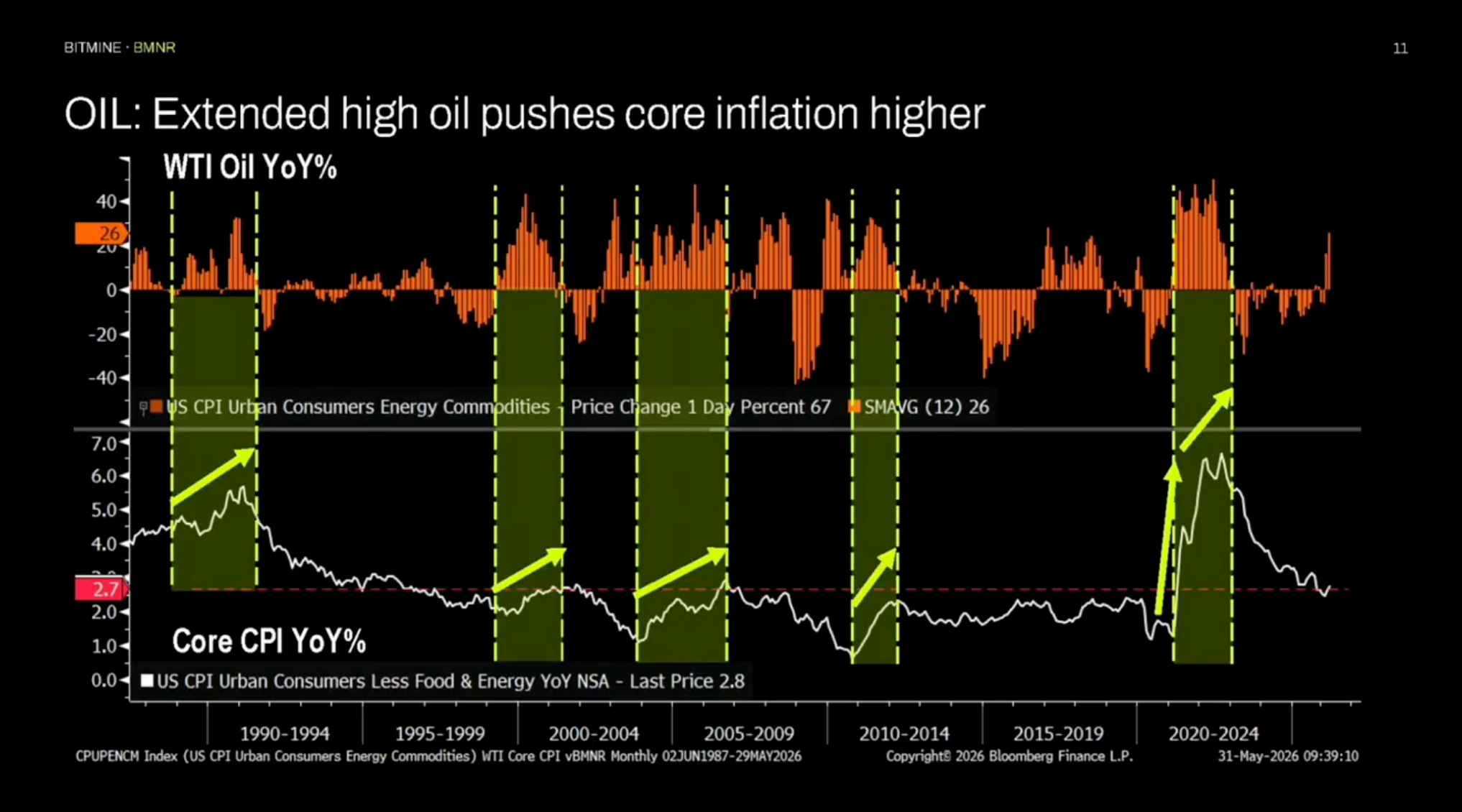
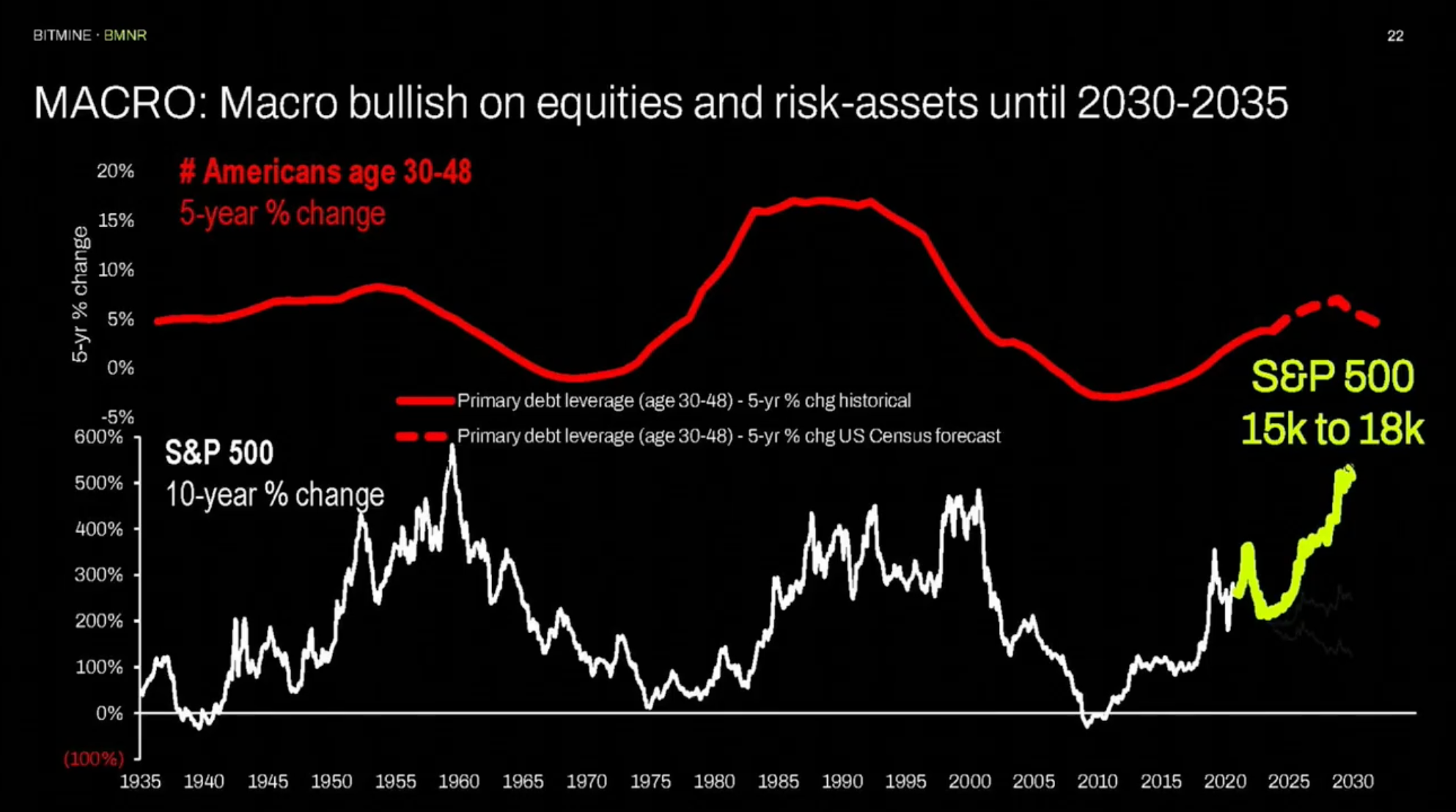
Lee laid out five macro, policy, and technology drivers that underpin his bullish outlook. First, an end to the US-led Middle East conflict would remove the oil risk premium, potentially pushing crude to $40 per barrel; with ETH now exhibiting its strongest-ever negative correlation to oil, lower energy prices would ease inflation pressure and force the Fed to reverse its hawkish stance. Second, the Clarity Act has a far higher chance of passage in Washington than the 56% priced into prediction markets, and its ratification would offer a clear legal framework for institutional crypto participation. Third, the White House remains supportive of Bitcoin and crypto, particularly in the stablecoin arena, which would benefit the dollar. Fourth, the new Federal Reserve Chair Kevin Warsh is openly pro-Bitcoin, further removing policy uncertainty. Fifth, demographic trends show the US population aged 30–50—prime spending years—will continue to grow, fueling above-trend economic expansion; Fundstrat models suggest the S&P 500 could reach 15,000–18,000 by the end of this decade, providing a powerful equity tailwind for crypto.
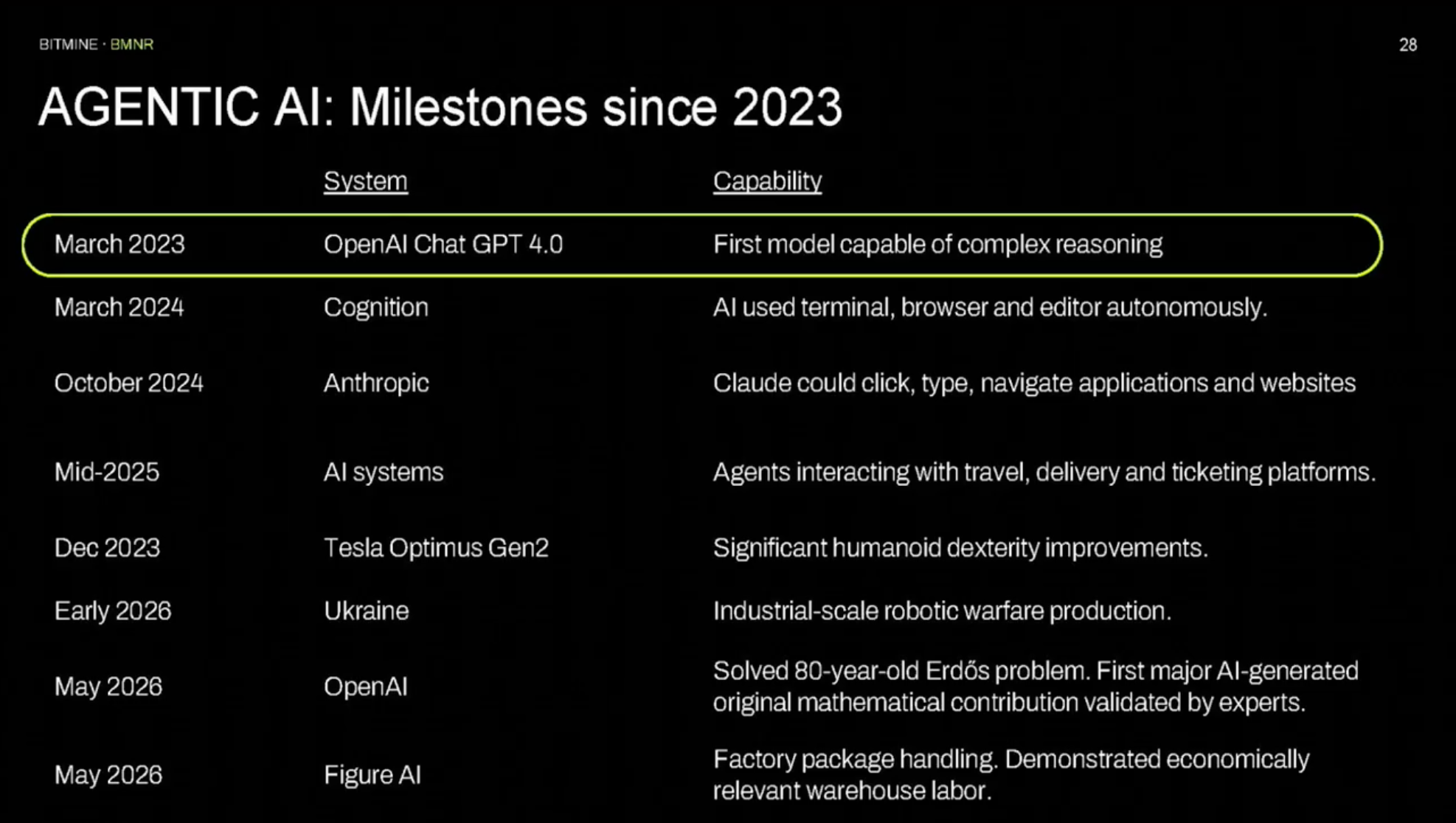
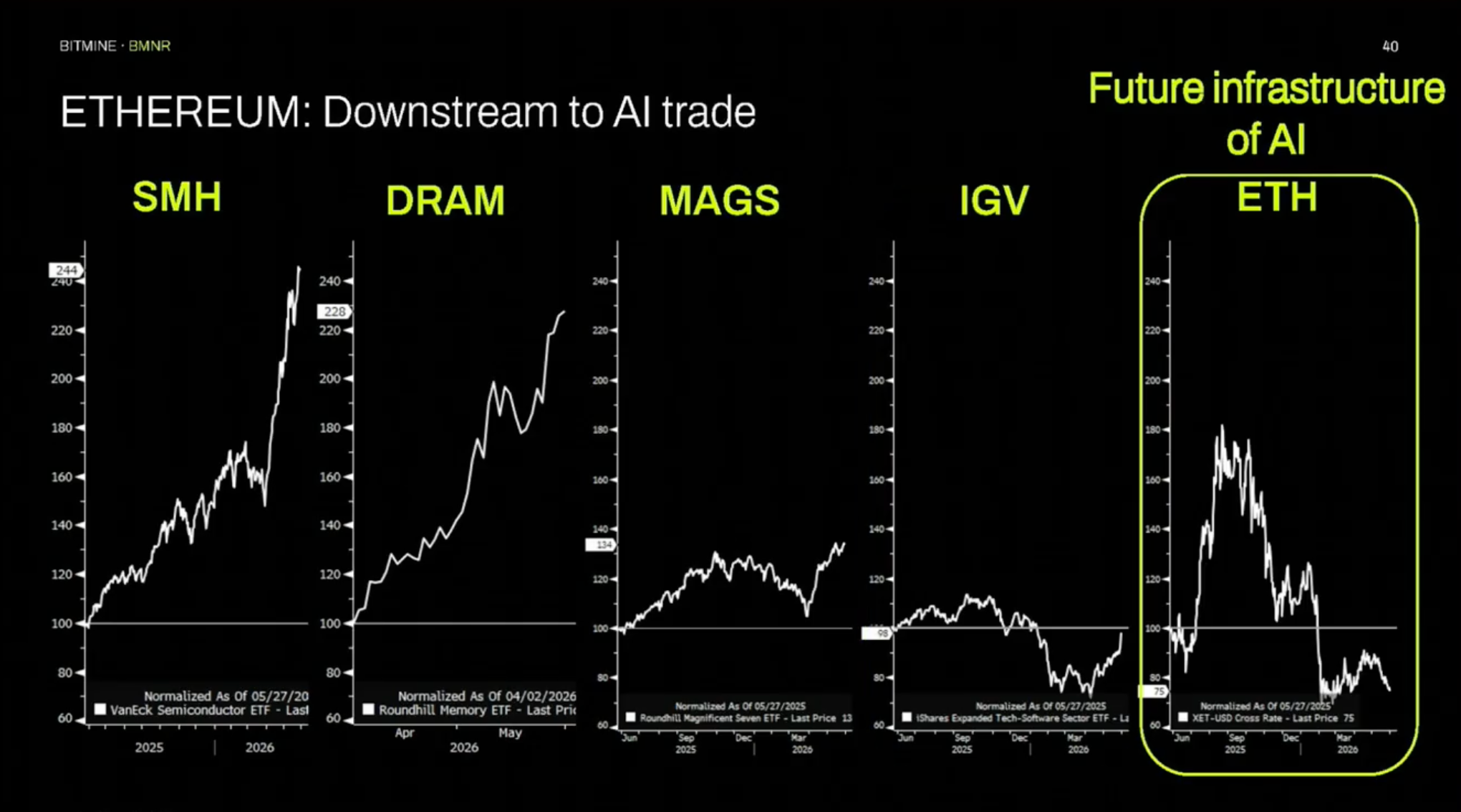
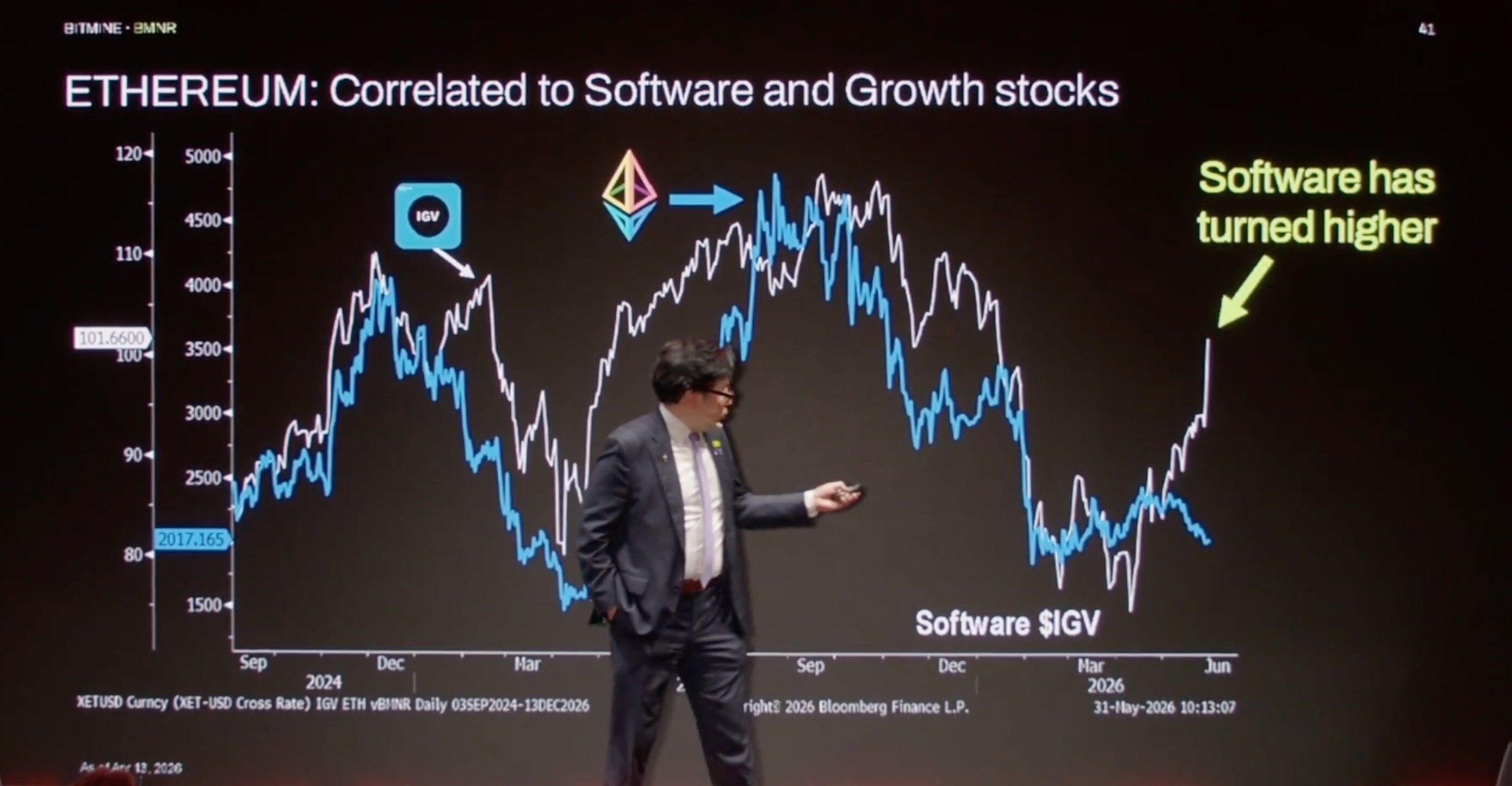
Lee stressed that the explosive progress in agentic AI and robotics is crypto’s most underappreciated narrative. Since ChatGPT’s launch, agent systems can now interact with websites, the Optimus robot has achieved dexterous manipulation, and Figure AI has deployed robots capable of large-scale warehouse operations—what Marc Andreessen calls the “unification” trend. Non-human traffic already dominates Polymarket, web browsing, and securities trading, and blockchain systems far outperform traditional infrastructure in identity verification, payment speed, and control over robotic behavior. While the AI windfall has so far been confined to semiconductor and software stocks, Lee pointed out that Ethereum and software equities have historically moved in lockstep, and with software stocks recently turning parabolic, ETH should catch up within weeks.
Ethereum: The Future Carrier of Money
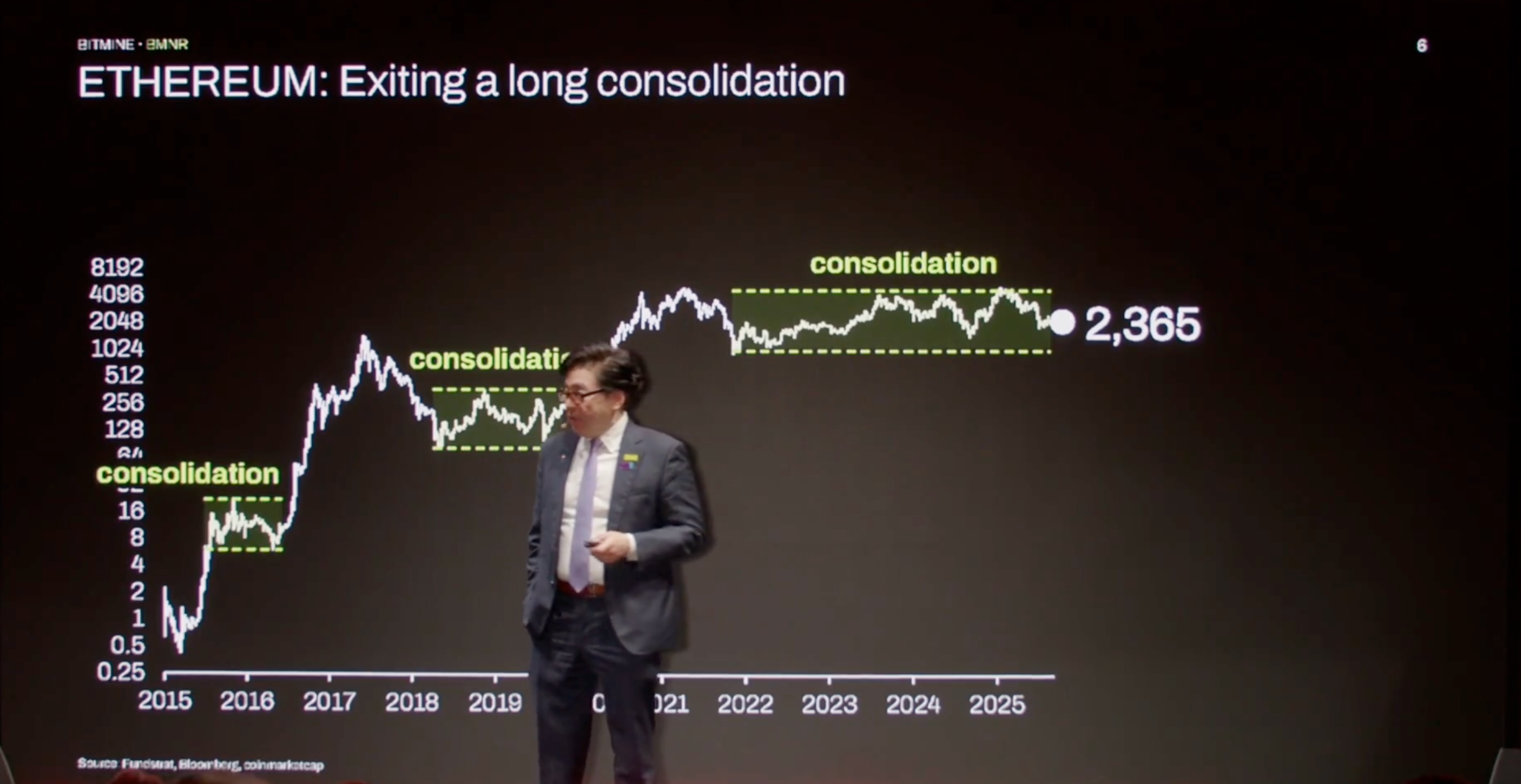
Tokenization supplies a second massive catalyst. Stablecoin volumes have already eclipsed Visa, and Lee cited market estimates that tokenized securities—spanning real estate, fixed income, equities, derivatives, and commodities—could expand into a $300 trillion market. Because crypto asset prices are tightly correlated with the volume of on-chain tokenized assets, if that market materializes, total value locked on Ethereum will not stay in the hundreds of billions. Lee frames ETH as “computational energy” and referenced a recent Standard Chartered report that likens Ethereum to Amazon in its early days: the stock was stuck around $6 for years before delivering a thousand-fold return, and ETH could undergo a similar 50x re-rating.
Lee continued that the world’s most profitable bank earns $60 billion a year, yet market-maker Jane Street, with just 3,000 employees, is on track to generate $40 billion, while Tether, with 300 employees, could rake in $15 billion. Money transfer has become far more profitable than traditional banking—and crypto excels at moving money. He predicts that five of the top ten global financial institutions will be crypto-native within a decade, with smart-contract platforms like Ethereum serving as the archetypal units of value storage and exchange.
Corporate Treasuries Replace the Foundation
The Ethereum Foundation’s role is rapidly shrinking. From once holding 17% of the supply, it now holds just 0.1%, generating barely $10 million a year in grants under a typical 5% return model. By contrast, treasury entities like Bitmine and Sharplink collectively hold 7% of the ETH supply and produce roughly $500 million in annual staking rewards. Lee argued that a funding system backed by corporate treasuries is far more sustainable and more aligned with decentralization.
Drawing parallels to industry bodies such as the CTIA in mobile communications, the SIA in semiconductors, and the National Association of Broadcasters, Lee said a mature ecosystem must be governed by multiple private entities. Ethereum already hosts profitable Layer 2 solutions and enterprise products, and at least five new organizations are set to spin out from the foundation. Bitmine intends to finance and support those spin-offs.
Bitmine’s Three Strategic Plays
After laying out the macro and ecosystem thesis, Lee highlighted Bitmine’s own wintertime maneuvers. First, the firm invested in AI identity project Eightco (ticker ORBS), the largest public holder of Worldcoin, which also carries 28% exposure to OpenAI and 8% to MrBeast. With ORBS trading at $1, it would be fairly valued at $15 if it commanded the same 13x NAV multiple as peer VCX. Second, MAVAN, the world’s largest single Ethereum staking operator, is now live, managing roughly $2 billion in multi-chain assets and generating around $1 million in daily staking rewards. Third, Bitmine backed MrBeast, the top global content creator, whose revenue has surpassed $1 billion and is growing at over 50%; MrBeast is acquiring Step Financial to enter banking and could become a Web3 version of Robinhood or SoFi for Gen Z and Gen Alpha, who stand to inherit $50–60 trillion over the next two decades.
Beyond these bets, Bitmine has successfully uplisted to the NYSE and was last week approved for inclusion in the Russell 1000 index on June 26. With over $4 trillion benchmarked against the index and only 25 institutional holders of Bitmine stock today, Lee sees the remaining 1,575 active managers evaluated for membership as the biggest near-term catalyst for the share price.
Treasury Stocks Outperform the Underlying
Lee supports the treasury stock thesis with two data points. From June 30 to December 31 last year, ETH rose 22% while Bitmine shares surged 500%; even with ETH down this year, Bitmine has held up better. Given the 90% correlation between the stock and ETH, Lee set valuation anchors: at $22,000 ETH the stock would be worth $500; at $250,000 ETH it would hit $5,000. Against a current price of around $18, the upside appears enormous.
On ETH accumulation, Lee revealed that Bitmine held 1% of the supply last August, reached 4% on April 10, and sat at 4.5% at the time of his speech, with a possible move to 5% by late June. He stressed the firm would slow purchases until a formal internal decision is reached and would not cross the 5% threshold precipitously. His bottom line: for investors bullish on crypto’s long-term trend, transparent, yield-generating treasury stocks represent a superior vehicle to direct token ownership.