

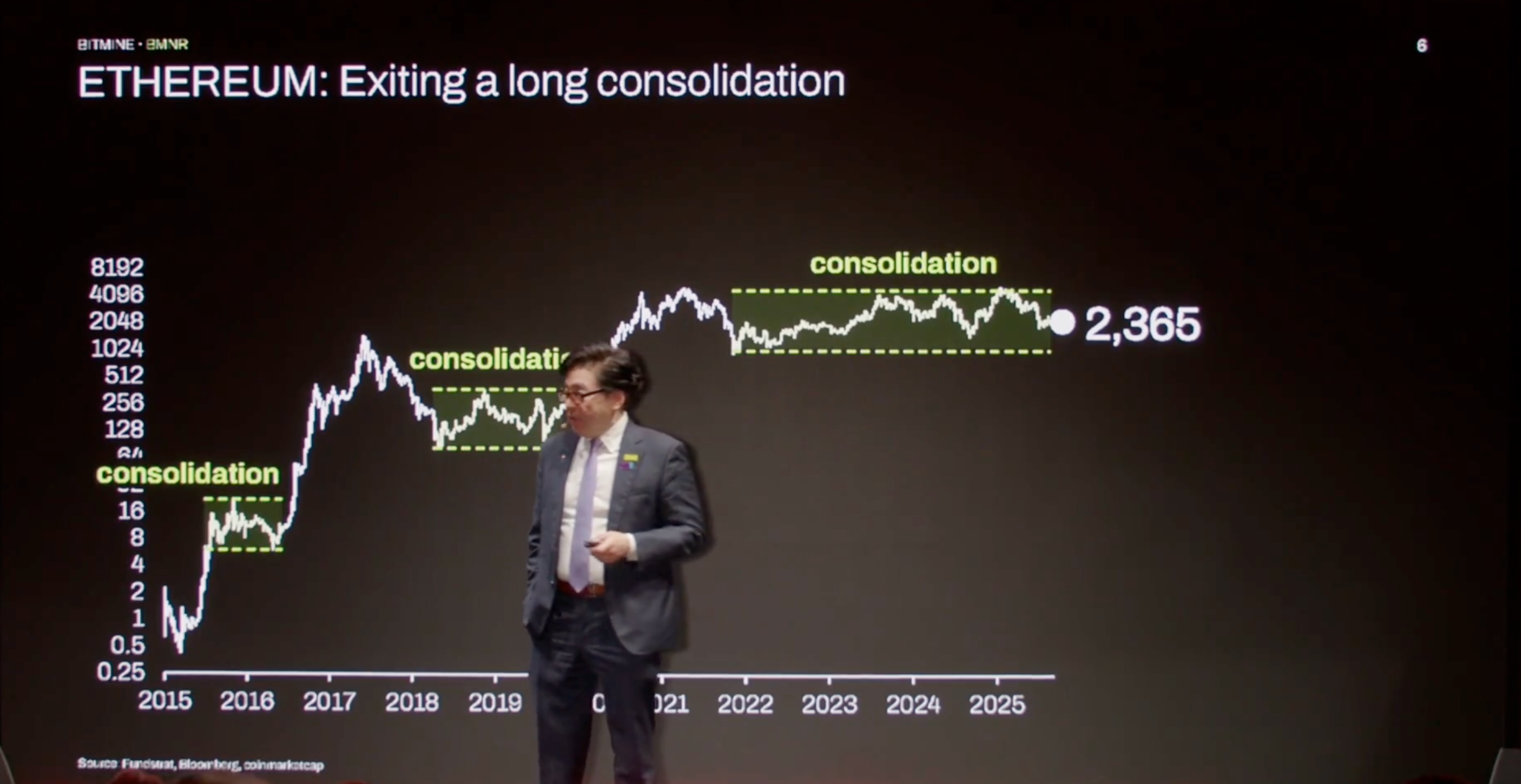
On June 2, at the Proof of Talk 2026 conference held at the Louvre in Paris, Tom Lee, Chairman of BitMine (NYSE: BMNR) — the largest public corporate treasury of Ethereum — delivered a keynote titled “Crypto Spring: ETH is the Future of Money.” He stated that the prevailing bearish sentiment and price weakness actually mark a market bottom for Bitcoin and Ethereum. Going further, Lee claimed that as AI and tokenization drive profound changes in financial infrastructure, ETH could ultimately reach $250,000. Notably, on the day of his speech, BTC fell below $66,000 and ETH dipped to $1,820, with Bitmine’s ETH position showing an unrealized loss of approximately $8.86 billion.
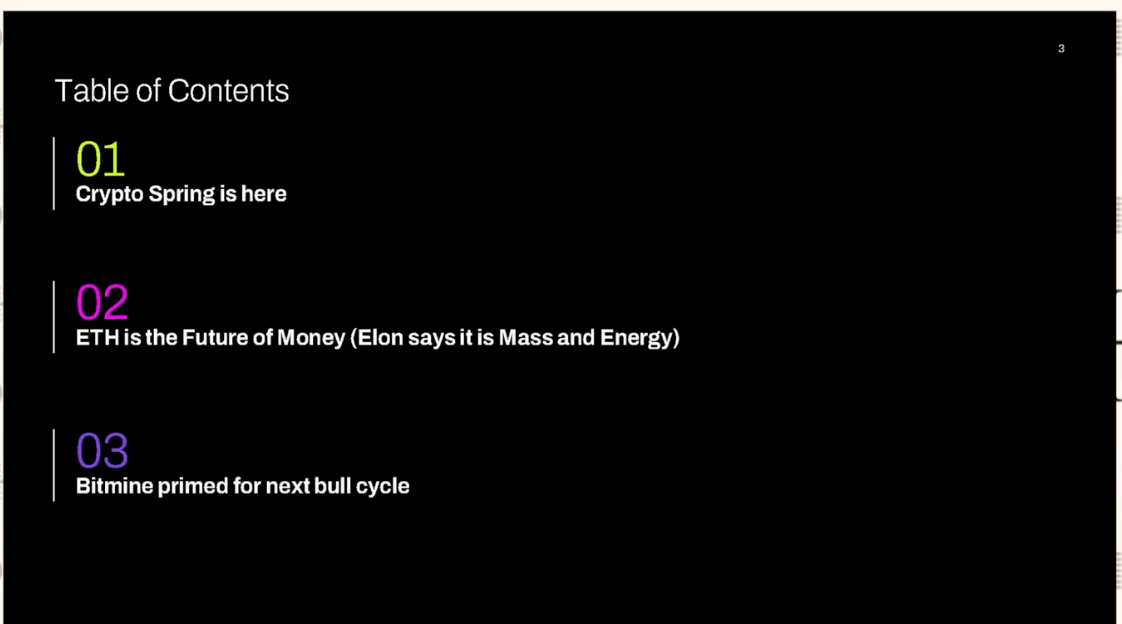
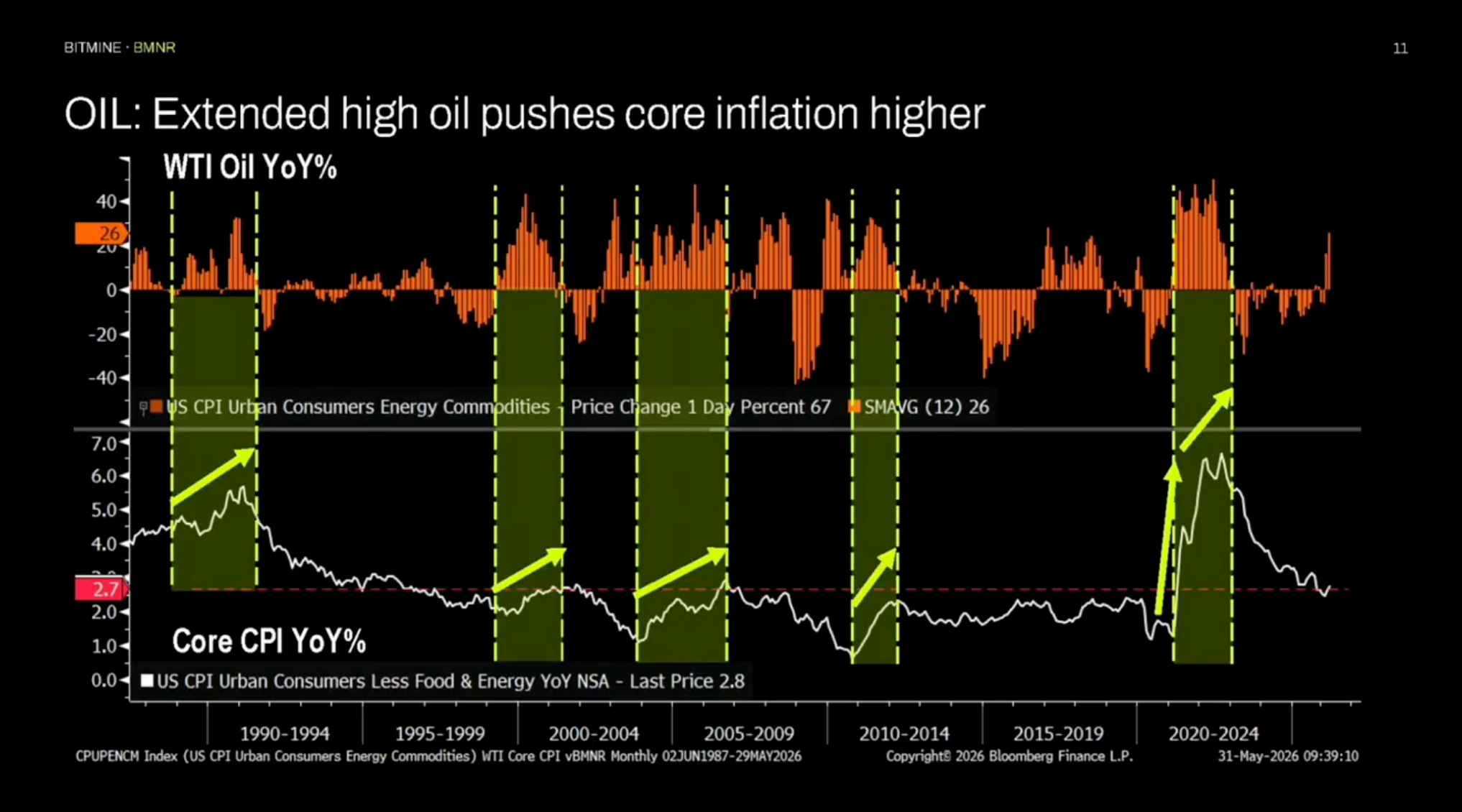
Lee presented five macro-based arguments for why “crypto spring” has arrived. First, once the Iran war ends, the panic premium on oil will vanish, potentially pushing oil down to $40 per barrel. Ethereum currently exhibits its highest-ever negative correlation with oil prices, so falling oil acts as a powerful tailwind for ETH. He backed this with historical data showing that sustained oil spikes consistently push core CPI higher, forcing central banks to tighten, and the reverse is equally true.
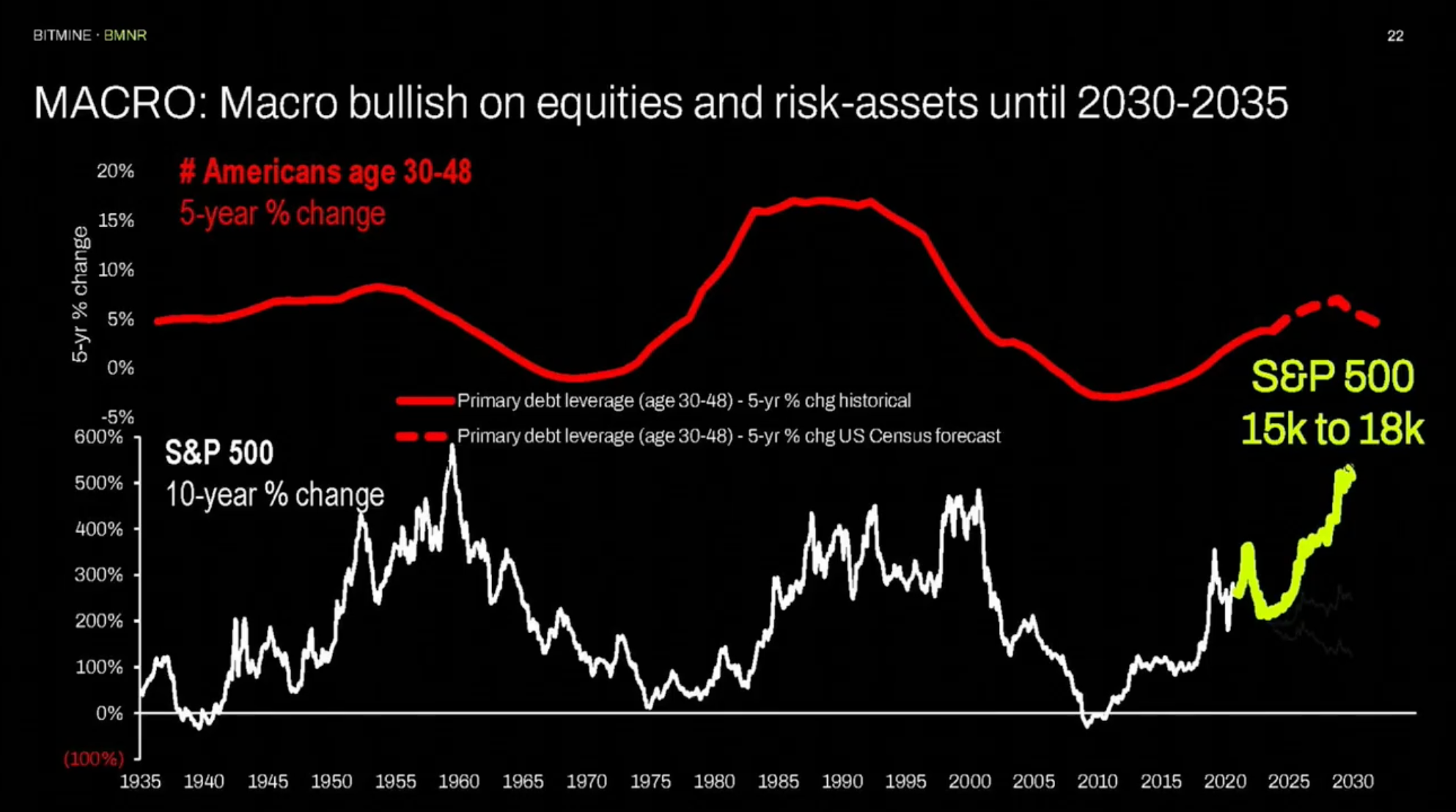
Second, the Clarity Act — designed to provide a legal framework for crypto adoption and institutional participation in the U.S. — has a 56% probability of passing according to prediction markets, but Lee and his team see a much higher chance. The third catalyst is government support: the White House is pro-Bitcoin and pro-crypto, which is positive for dollar policy, especially regarding stablecoins. Fourth, the newly appointed Fed Chair Kevin Warsh is also a Bitcoin supporter. Finally, demographic tailwinds underpin risk assets: the 30-50 year-old population in the U.S. is rising, a cohort historically correlated with stock market returns. Lee forecasts the S&P 500 could reach 15,000-18,000 by the end of this decade, providing a solid macro backdrop for crypto.
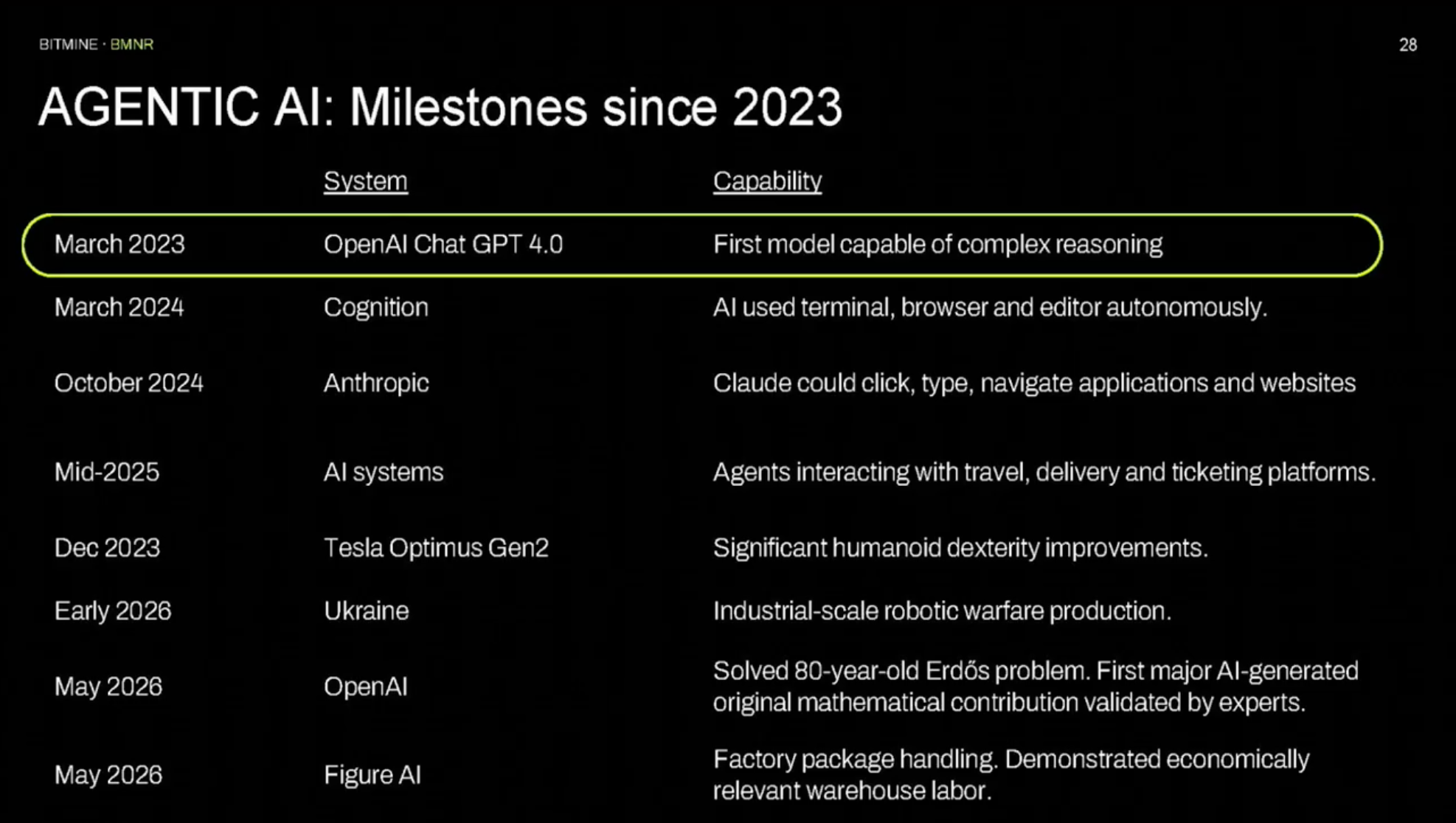
Lee argued that the market has yet to respond to these positives because people have forgotten that “crypto is the future of money.” He mapped milestones since ChatGPT’s launch: 2023’s generative AI breakthrough; 2024’s agent systems capable of interacting with websites; rapid advances in robotics, including Ukraine’s industrial-scale drone manufacturing and Figure AI’s warehouse robots. In his view, robots will soon dominate most internet traffic, and blockchain is far superior to traditional systems for controlling robotic behavior — whether for identity verification, authentication, or payment speed.
Parallel to AI is the tokenization wave. Stablecoin transaction volumes have already surpassed Visa, and the tokenized securities market could reach $300 trillion, encompassing real estate, fixed income, equities, derivatives, land, and gold. Crypto asset prices are highly correlated with the amount of tokenized assets, so such a massive expansion would directly boost Ethereum’s network value. Lee illustrated the shift in financial power with examples: JPMorgan earns $60 billion annually, but Jane Street, with just 3,000 employees, will make $40 billion this year — proving that moving money can be more profitable than custodying it. Tether, a crypto-native firm with 300 employees, is on track to earn $15 billion. He predicts that within a decade, half of the world’s top ten financial institutions will be crypto-native.
On governance, Lee criticized the Ethereum Foundation as anachronistic. Its ETH holdings have plummeted from 17% of supply to just 0.1% (around 100,000 ETH), enabling an annual grant budget of roughly $10 million — inadequate for a $240 billion network. In contrast, corporate treasuries like Bitmine and Sharplink have accumulated about 7% of ETH supply and generate $500 million annually in staking rewards, positioning themselves as the new funding backbone. With 1,500 validators across 89 countries and 15,000 developers, the network is too large to be coordinated by a single entity. Lee drew parallels with the CTIA in mobile communications, the Semiconductor Industry Association, and the National Association of Broadcasters — sector bodies that emerged to coordinate but not monopolize governance — suggesting Ethereum has already reached a similar stage.
As Ethereum’s largest single staking operator and corporate treasury, Bitmine has built a “crypto treasury equity” narrative through several strategic moves. First, it invested in Eightco (ticker ORBS), the largest public holder of Worldcoin. ORBS’s balance sheet includes 28% exposure to OpenAI, 8% to MrBeast, and 8% in ETH, yet trades at just $1 per share. If valued like peer VCX at 13x net asset value, ORBS would be around $15 — a deeply undervalued asset. Second, Bitmine launched MAVAN, the world’s largest staking operation, managing roughly $14 billion in assets, with its own ETH staking alone generating approximately $1 million per day in rewards.
Third, Bitmine invested in MrBeast, the world’s largest content creator, whose revenue recently surpassed $1 billion with a 50% growth rate. MrBeast is moving into banking through the acquisition of Step Financial, targeting Gen Z and Alpha consumers. Lee highlighted that this demographic — over 120 million people — will inherit $50-60 trillion over the next 20 years, echoing how Gen X once fueled the rise of BlackRock and Blackstone. Additionally, Bitmine recently uplisted to the NYSE and will be included in the Russell 1000 index on June 26. This means every fund manager benchmarking against the Russell 1000 — representing over $4 trillion in assets — will have to evaluate allocating to Bitmine. Currently only 25 institutional investors hold BMNR; over 1,575 others could soon join, creating a massive catalyst for the stock.
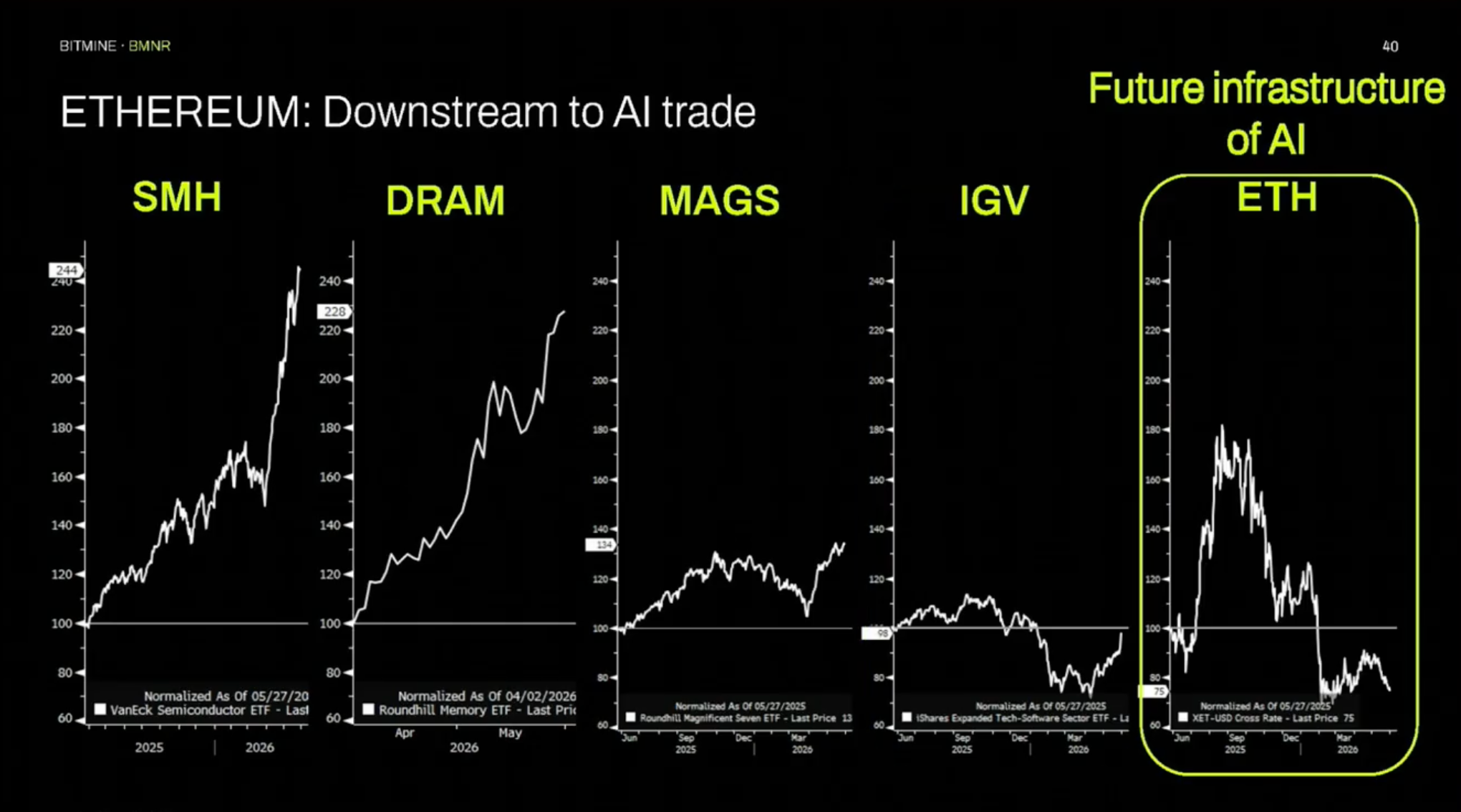
On ETH accumulation, Bitmine’s holdings have reached 4.5% of circulating supply (nearly 5.4 million ETH) and could hit 5% as early as late June. Lee indicated the company may slow purchases before crossing the 5% threshold and is discussing whether to push beyond. From a performance standpoint, between June 30 and year-end 2024, ETH rose 22% while Bitmine surged 500%, demonstrating treasury stocks’ ability to outperform the underlying asset. Even during ETH’s decline this year, Bitmine has held up better. With a 90% correlation between ETH price and Bitmine’s stock, Lee’s model projects BMNR reaching $500 per share if ETH hits $22,000, and a staggering $5,000 per share if ETH reaches $250,000.
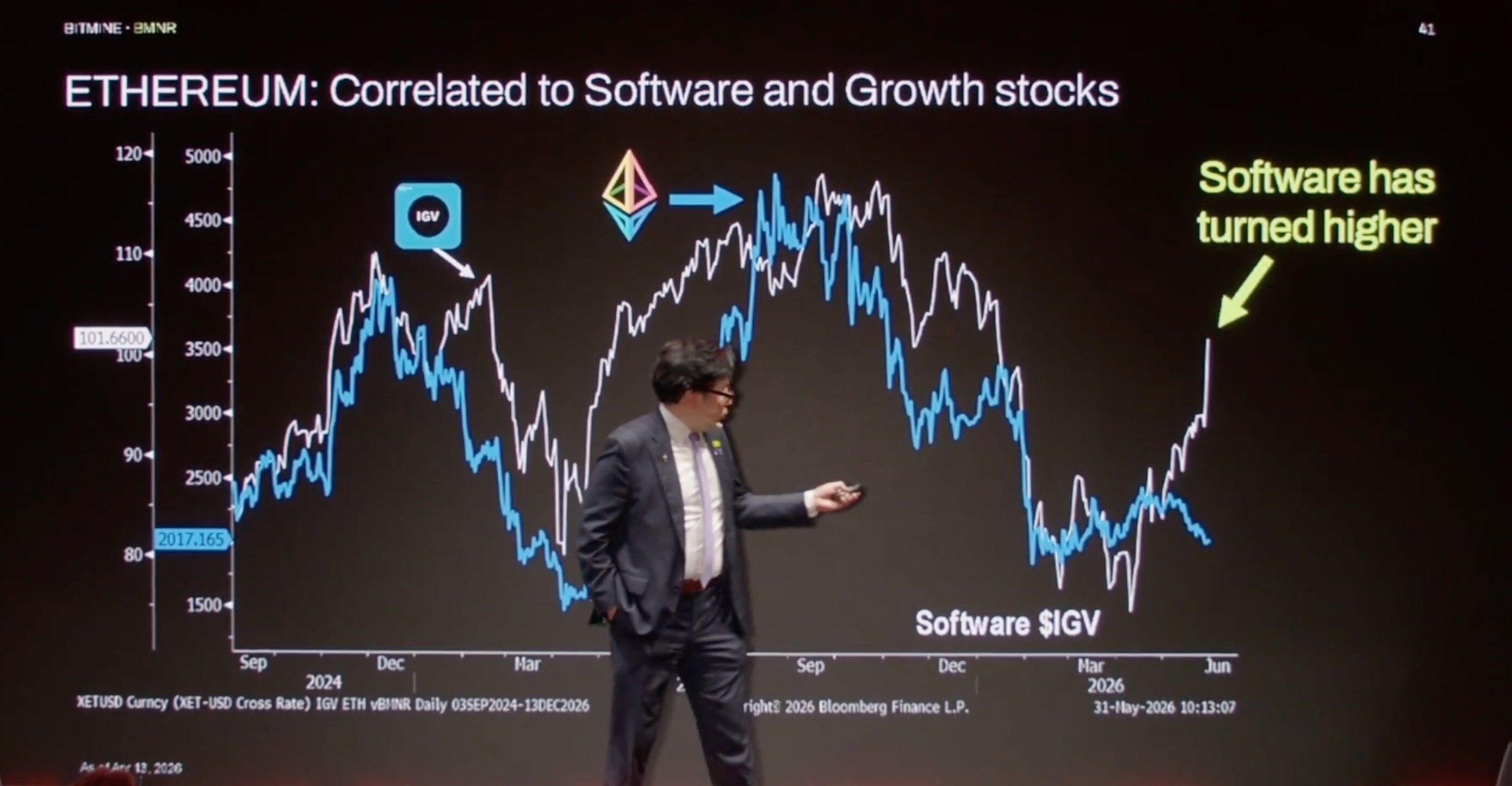
In summary, Tom Lee’s address provided a shot of conviction during a deep market lull. His roadmap hinges not only on fading macro headwinds and regulatory clarity, but on the structural transformation brought by AI and tokenization. For investors, rather than directly holding volatile ETH, gaining exposure through a deeply integrated public treasury like Bitmine — which combines yield generation with valuation upside — may offer a more efficient way to ride the crypto spring.