
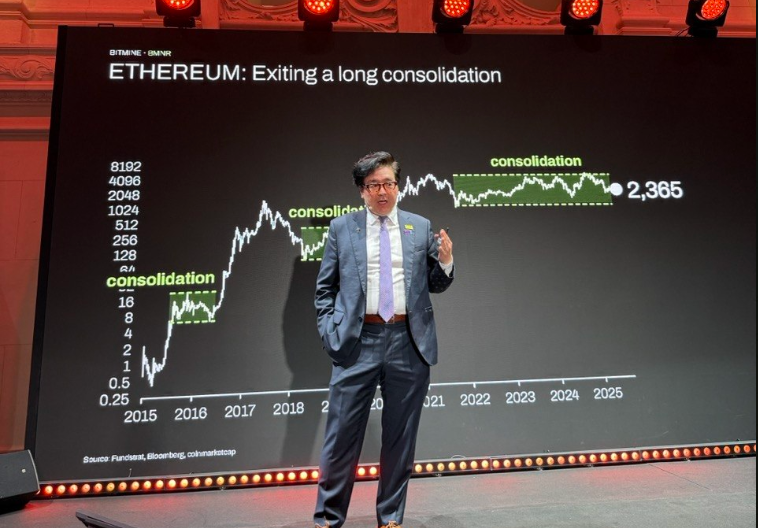
Tom Lee, Fundstrat’s head of Research and chairman of Bitmine Immersion Technologies, said at the Proof of Talk conference in Paris that ether could eventually reach $250,000. He did not attach a timeline to the call, but he laid out a structural case centered on tokenization, AI, and a shift in who holds influence over Ethereum’s base layer.
As of Tuesday, ETH was trading at $1,906, down 6% over the previous 24 hours. Lee’s argument focused less on short-term price action and more on what he described as a quiet change in how financial networks are being built and operated.
Bitmine’s ETH position rose to about 4.47% of circulating supply
Lee’s Bitmine is already one of the largest corporate holders of Ethereum. The firm stepped up purchases last week with its biggest accumulation since December, acquiring 111,942 ETH worth about $237 million at current prices. That pushed Bitmine’s total holdings to nearly 5.4 million ETH, equal to roughly 4.47% of ether’s circulating supply.
Lee said that if Ethereum breaks out of its current consolidation on the back of tokenization and AI, the upside could be around 50x. He tied that view to Bitmine as well, saying that if ETH reaches $250,000, Bitmine stock would be worth $5,000, versus its current price of $18, which he called a bargain.
AI and machine-to-machine payments sit at the center of the thesis
Lee’s core claim is that advanced software and automated computing systems will need instant ways to pay each other, instead of relying on traditional bank wires. In his view, robots are set to account for most internet traffic, and blockchain systems handle authentication, identity, control, and payment speed more effectively than legacy rails.
From that perspective, Ethereum would move beyond a speculative crypto asset and become a primary global currency for automated computing payments. The demand case, in his framing, comes not only from traders but from machines settling value directly on-chain.
Ethereum Foundation’s holdings have fallen to about 0.1% of supply
Lee also pointed to a governance shift inside the network. He said the non-profit Ethereum Foundation has spent years reducing its own footprint and now holds 100,000 ETH, or about 0.1% of total supply. That change, he argued, shows influence moving away from the foundation model and toward large corporate validators and institutional participants.
That transition is part of his broader valuation case for Ethereum. As corporate balance sheets, validator power, and AI-linked on-chain settlement demand converge, Lee believes Ethereum may be priced less as a trading vehicle and more as core digital infrastructure.