
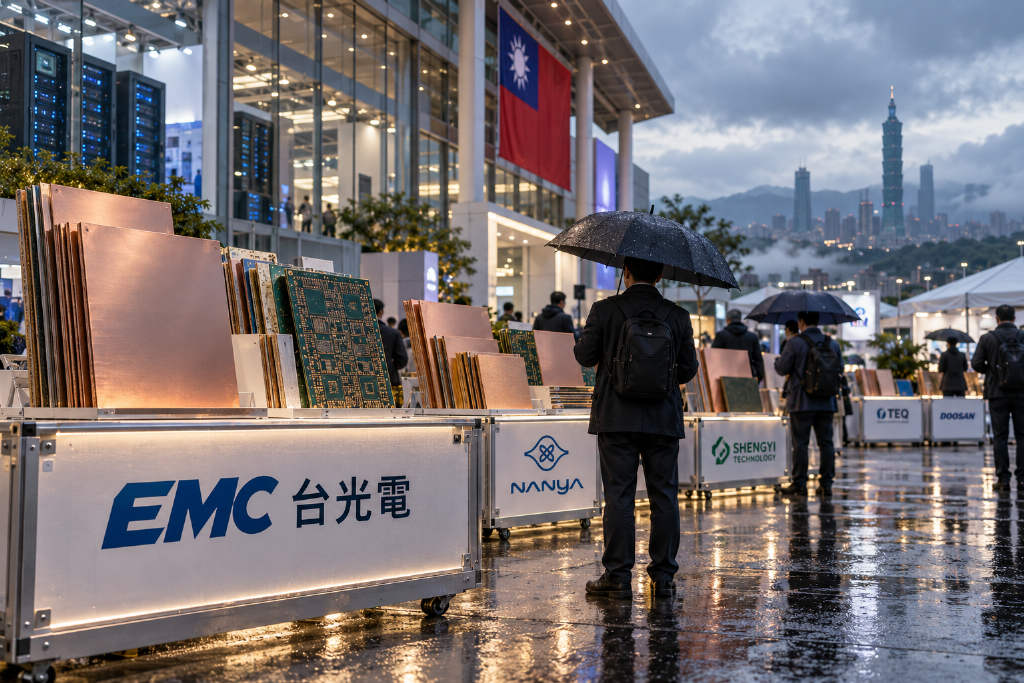
After TPCA Show 2026, PCB industry analyst kokycpcb said in a post on X that the old "Taiwan Big Three" framework for copper clad laminate, built around Elite Material Co. (EMC, 2383), ITEQ Corp. (6213) and TUC (6274), no longer reflects the changes taking place across the high-speed CCL supply chain. His latest view is that EMC remains firmly in the lead, while Nan Ya Plastics (1303) and China’s Shengyi Technology (600183.SS) are being undervalued by the market. He also argued that TUC’s exhibition presence and its actual order outlook are not the same thing.
Why the old CCL "Big Three" framework no longer works
Referring back to his earlier comments on X, kokycpcb said winning Nvidia orders in the AI era depends on five factors: technology, lead time, sales execution, feedback from PCB makers and customer satisfaction. In that framework, being the current market leader or having a technical edge does not guarantee a company will stay ahead.
He did not identify the biggest winner among Taiwanese suppliers in that earlier discussion, though outside observers had speculated that his description of a company with a high degree of vertical integration pointed to Nan Ya. In his post after the show, he made the point more directly: technology on display at an exhibition does not equal order volume. Commercial success still depends on process compatibility at PCB makers and trust from end customers. If one of those pieces is missing, market consensus can break down.
EMC keeps the lead, while Shengyi emerges as the closest challenger
In kokycpcb’s assessment, EMC’s position in top-tier AI compute trays and cloud operators’ in-house ASIC programs has not been challenged. He also said EMC’s push into orbital compute, together with recent findings from SemiAnalysis, could help build a long-term geopolitical barrier against Chinese competitors.
On the supply side, EMC’s lead time has stretched to 2 to 4 months, which he said reflects tight availability in high-speed materials.
He added that the only company truly capable of being discussed alongside EMC is China’s Shengyi Technology. According to him, Taiwanese brokerage research has paid limited attention to Shengyi, but checks with first-tier PCB makers in China show that the company is moving quickly in PTFE processing. Based on that view, he expects Shengyi to have a chance to secure the largest share in major U.S. GPU projects, making it the only rival with scale comparable to EMC.
Nan Ya is singled out as a potential 2027 shipment leader in M6 to M7 applications
Kokycpcb also named Nan Ya more explicitly this time. He described the company as the one with the biggest gap between sell-side sentiment and commercial results. His reasons were threefold:
- Qualification feedback from major cloud operators and PCB makers continues to improve.
- The company is actively developing M10.5 to M11 grade high-speed materials.
- It has a high level of upstream self-sufficiency, covering advanced copper foil and multiple glass fiber cloth products, along with a strategic partnership with Nittobo.
From those conditions, he concluded that Nan Ya will become the shipment leader in M6 to M7 applications in 2027. In his view, the company’s vertical integration gives it an edge in lead times and material supply, and that advantage can convert into orders when supply is tight.
ITEQ, TUC and Doosan show a more divided second tier
He placed ITEQ in a disciplined second tier. Its in-house material coverage is not as strong as Nan Ya’s, but the broader market still faces a supply gap, and spillover demand for high-speed materials could support the business. He also pointed to low-earth-orbit satellite network design wins and a stable M6 to M7 business.
TUC, by contrast, shifted its promotional focus at the show toward low-earth-orbit satellites. After cross-checking with upstream fabric suppliers and downstream PCB makers, kokycpcb said the market still has concerns about consistency in TUC’s M9-and-above materials and about customer qualification. Whether its displayed M10 to M11 boards can scale up, he said, depends on securing concrete customer commitments.
South Korea’s Doosan was also included on his watch list. He said Doosan is a key designated supplier in optical transceiver modules, with supply expected to remain under a strict quota system through 2027. After running into obstacles in M9 development, the company has now introduced M10-grade boards, though downstream qualification progress still needs to be watched.
What comes next: qualification, compatibility and control of key inputs
Overall, kokycpcb said the high-speed CCL market is moving away from a structure in which three Taiwanese suppliers split the field. In its place is a market where the leader remains entrenched, challengers are catching up quickly and the second tier is starting to diverge. The next points to watch, he said, are the real pace of customer qualification, process compatibility at PCB makers and each supplier’s control over critical upstream raw materials.



