
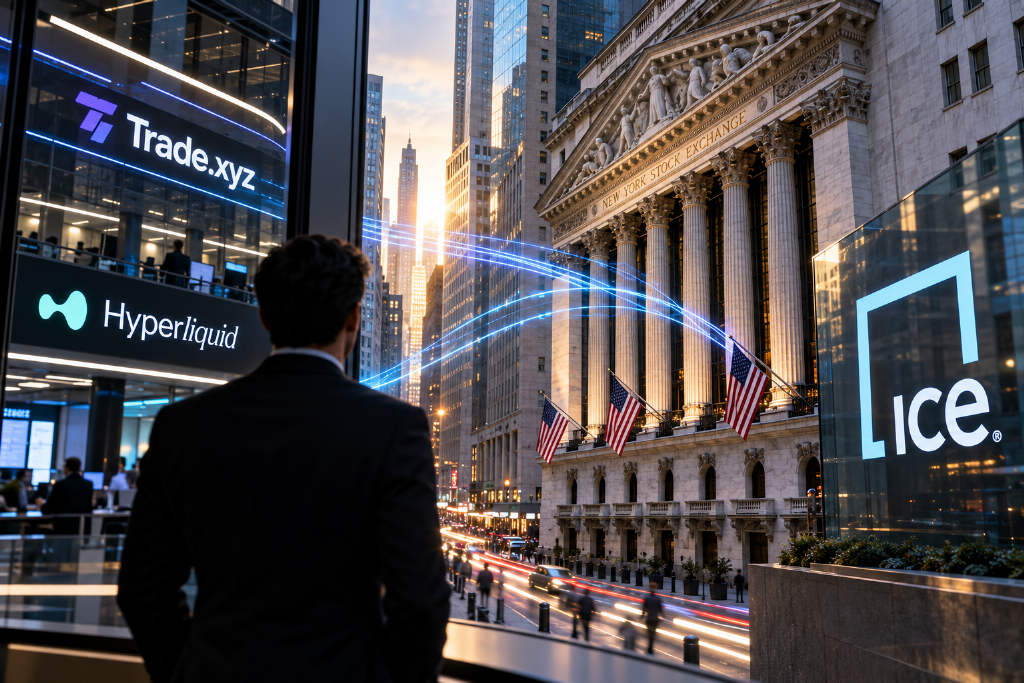
Trade.xyz founder shoku said in an open letter that the company is working with Intercontinental Exchange (ICE), the parent company of the New York Stock Exchange, to bring perpetual contracts from Hyperliquid into regulated U.S. markets.
The letter looks back on the project’s first 381 days. Shoku wrote that trade[XYZ] launched its first market on Hyperliquid 381 days ago, and said the company is now partnering with ICE on a plan to introduce around-the-clock perpetuals to the United States.
He said builders across the industry have spent years trying to prove that open onchain markets can handle price discovery, risk management, and market stress at a standard comparable to traditional market infrastructure, while remaining open at times and in places where traditional markets are not. He said trade[XYZ]’s progress rests on that broader effort by developers, traders, market makers, and users.
Shoku described markets as products shaped by their participants. A new generation of investors trades on mobile phones, moves across asset classes, and wants access seven days a week at any hour, he wrote. Before Hyperliquid, he said, the infrastructure suited to that kind of market did not exist.
Annualized volume reached about $1 trillion, founder says
Building those markets was not easy, according to the letter. Shoku said the team had to develop new approaches to pricing, funding rates, and risk management, then test and refine them with real capital in markets that never close. He also said the company had to earn traders’ trust.
That trust, he wrote, helped trade[XYZ] lift trading volume to an annualized rate of about $1 trillion in a little over a year. He added that the platform helped open up new products including perpetual contracts tied to pre-IPO companies, and said it had also earned the trust of long-established institutions such as S&P Dow Jones Indices. In the letter, he said this is also why ICE chose trade[XYZ] as its exclusive partner to bring 24/7 perpetuals into the U.S.
Shoku pointed to ICE’s history of market digitization
The letter argues that technological change has repeatedly made markets more transparent, improved price discovery, and widened access. Shoku traced that progression from coffeehouses to curbside exchanges, from ticker tapes to telephones, and from trading floors to digital exchanges.
He also revisited ICE’s own history. In 1997, Jeff Sprecher bought a small power trading technology company for $1, according to the letter. In 2000, ICE was formed as an electronic energy marketplace, later pushed major commodity markets toward digitization, and acquired the New York Stock Exchange in 2013. Shoku said that drive toward innovation is what made ICE grow quickly, and called that the kind of partner trade[XYZ] wants.
An all-hours integrated exchange for the U.S.
Americans should be able to access the world’s most innovative markets while still receiving the protections offered by U.S. regulation, shoku wrote. Subject to regulatory approval, he said, trade[XYZ] and ICE could offer both.
He argued that the change is not just about adding another route into markets. Perpetual contracts do not expire, which means traders do not need to roll positions on a schedule, and liquidity in the same asset can gather in one deep market. Cross margin, he wrote, allows the same collateral to support multiple positions across stocks, commodities, and crypto assets, improving capital efficiency. Underneath that structure are atomic clearing and settlement, real-time risk management that keeps markets running continuously, and rules that are verifiable and applied uniformly to everyone.
Shoku said his responsibility now, and the company’s responsibility, is to build a market worthy of the trust placed in it by partners and users. He said the commitment remains the same: maintain fair and transparent markets, offer a broad range of trading venues, reduce execution costs, and protect market integrity.
He then stated the goal in one line: an integrated exchange for the United States that stays open around the clock.
The letter said trade[XYZ] has already launched more than 100 markets. Shoku wrote that, compared with the opportunity ahead, the company is only getting started. Many assets are still not covered, and many things people want to trade still do not have mature markets. Wherever there is demand for trading in an asset, he said, trade[XYZ] wants to be the place where its price is discovered. He listed global equities, commodities, bonds, pre-IPO companies, hashpower, new indices, digital assets, interest rates, stock baskets, volatility products, and alternative assets.
He also described a possible use case. If major news breaks on a Saturday night, he wrote, a trader should be able to post tokenized stock as collateral, hedge a portfolio with index perpetuals, add oil exposure, and express a view on a private company that has not yet gone public. All of that, he said, should happen in one account, under one risk management system, before traditional markets open. Trade[XYZ] and Hyperliquid were built for that, he wrote.
Looking further out, shoku said he hopes that years from now, when someone opens a first investment account, these capabilities will feel ordinary. He said they may even wonder why earlier generations had to deal with so many separate financial institutions. Reaching that point will take liquidity, reliability, trust, and prices people believe in, and he said he is prepared to spend years working toward it.
Thanks to the team, partners, and users
At the end of the letter, shoku thanked the XYZ team, Jeff Sprecher and ICE, and specifically Michael Blaugrund and Trabue Bland for their support. He also thanked Stan Druckenmiller, Hyperliquid Labs, and the accounts @chameleon_jeff, @iliensinc, and @xulian_hl.
He reserved his final thanks for users, writing: 「When no one thought these markets mattered, you traded them.」
The letter closed with another line directed at users: 「You know what? These trades do matter.」



