

Debate around the relationship between trade.xyz and Hyperliquid has picked up sharply over the past week. The trigger was straightforward: RWA perpetuals posted more volume on Hyperliquid than crypto-native contracts for the first time, and trade.xyz all but controls the HIP-3 segment. That pushed a sharper question into the open: what happens if trade.xyz ever decides to go its own way?
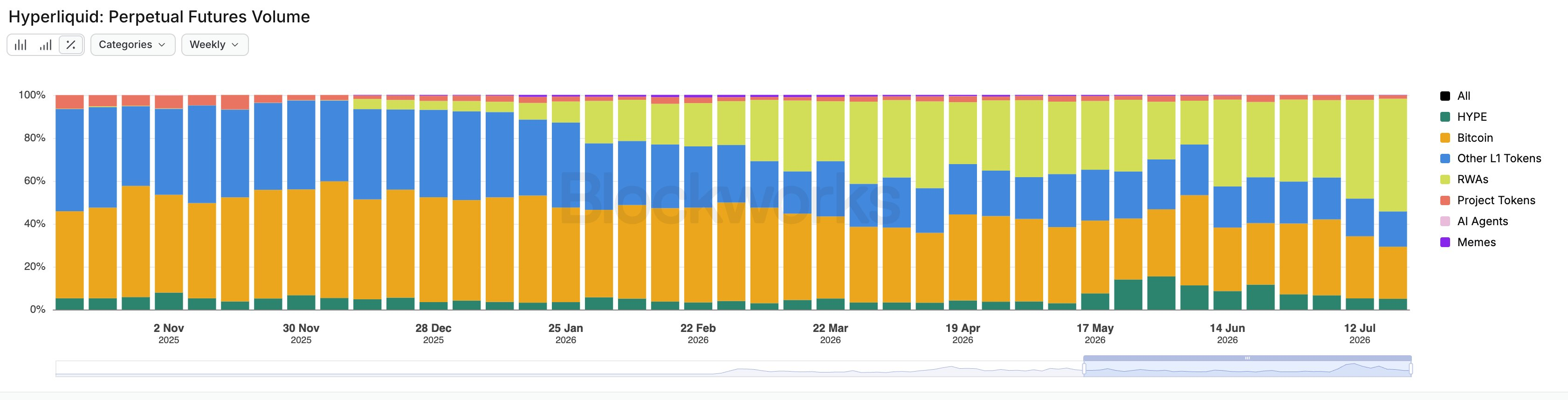
RWA volume overtook crypto-native contracts
On July 24, ARK Invest crypto research head Lorenzo Valente said in a post that RWA trading made up 54% of Hyperliquid volume in a given week, the first time it had moved ahead of crypto assets. Hyperliquid’s total weekly volume was about $50 billion, and HIP-3 RWA trading contributed $26 billion of that amount, more than the combined crypto perpetual volume of all other DEXs over the same period.
The composition inside that RWA flow has also shifted. Since June, single-stock perpetuals have moved ahead of index and commodity products and now account for 61% of RWA volume. Valente said he is no longer convinced that RWA trading will naturally consolidate in the same venue as crypto assets, adding that the category may develop its own standalone leader.
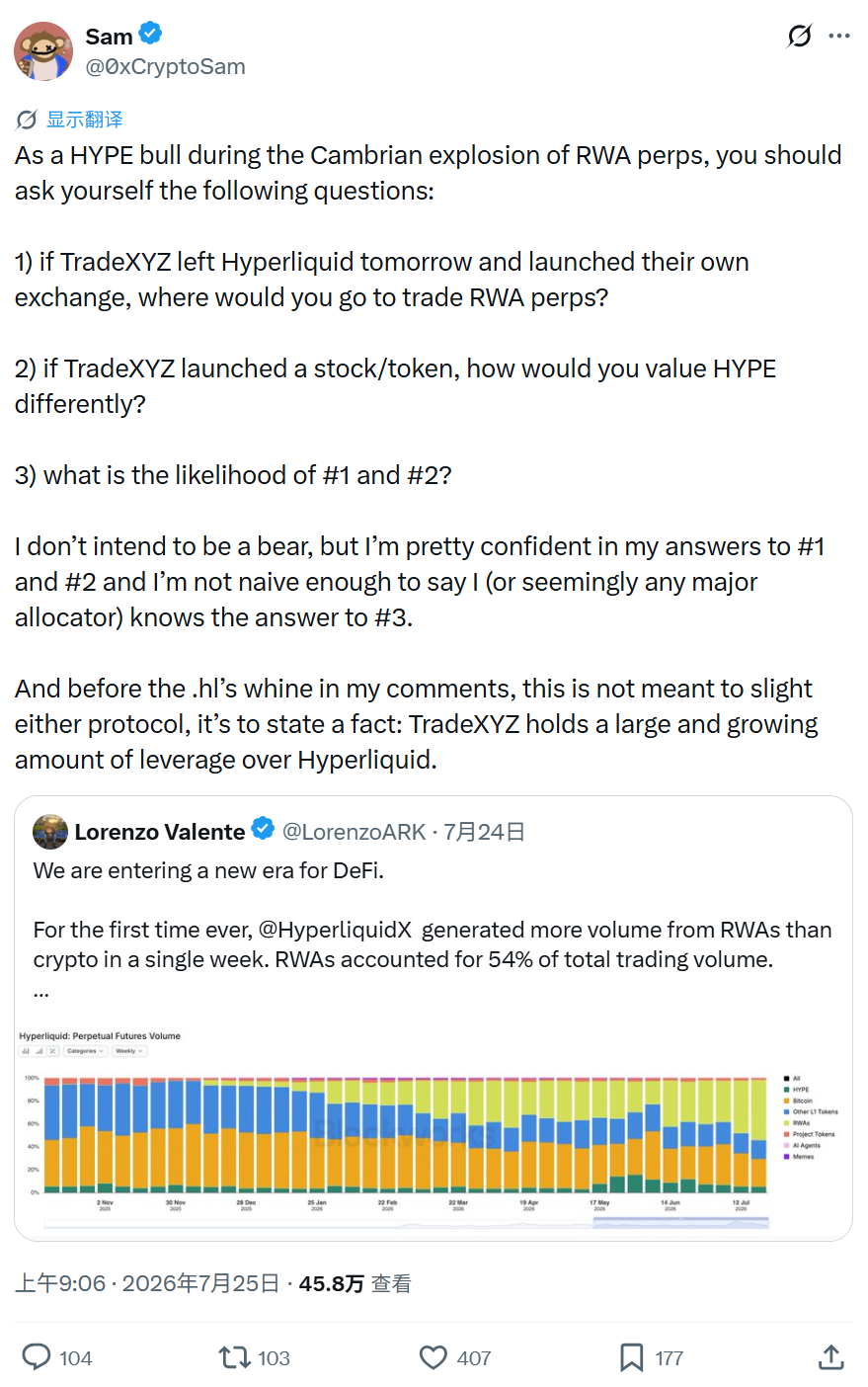
Two days later, investor @0xCryptoSam pushed the discussion a step further. If trade.xyz left Hyperliquid tomorrow and launched its own exchange, where would traders go to trade RWA perpetuals? And if trade.xyz issued stock or a token, how would that change the valuation logic for HYPE? He said he felt confident about the answers to those questions, but not about the probability of that scenario, and stressed that he was not trying to diminish either side. In his framing, trade.xyz has gained increasing leverage over Hyperliquid.
Cobie gave a more direct reply in the same discussion: why leave at all? In theory, the team could issue markets across multiple venues at the same time.
From first HIP-3 deployer to $408.4 billion in cumulative volume
That backdrop helps explain why trade.xyz has drawn so much attention in less than a year.
trade.xyz is not a standalone chain, and it does not run its own matching engine. It is the first deployer under Hyperliquid’s HIP-3 framework and, at this point, the dominant one.
HIP-3, introduced around October 2025, lets independent teams launch perpetual markets on top of Hyperliquid infrastructure. trade.xyz decides which assets to list, which oracle to use, and how leverage caps and risk parameters are set, while Hyperliquid’s HyperCore handles order matching, liquidation, margin calculations and onchain settlement.
That setup lets users post USDC as collateral and trade perpetual contracts tied to equities, indexes, commodities, FX and Pre-IPO assets around the clock. Hyperliquid’s own documentation says clearly that every market accessed through trade.xyz runs on Hyperliquid. trade.xyz is one interface, not an exclusive gateway.
Since becoming the first deployer when HIP-3 went live in October 2025, trade.xyz has expanded its market count to nearly 100. The lineup now spans several categories:
- Single-stock perpetuals, including Tesla, NVIDIA, Google, Micron and SK Hynix
- Index products such as XYZ100, the S&P 500 and STAR 50 ETF
- Commodities including crude oil, gold and silver
- FX markets
- Pre-IPO contracts including SpaceX and CXMT
Earlier this week, the price in the CXMT Pre-IPO market tracked the spot opening price almost perfectly, with price discovery accuracy that the team itself said exceeded expectations.
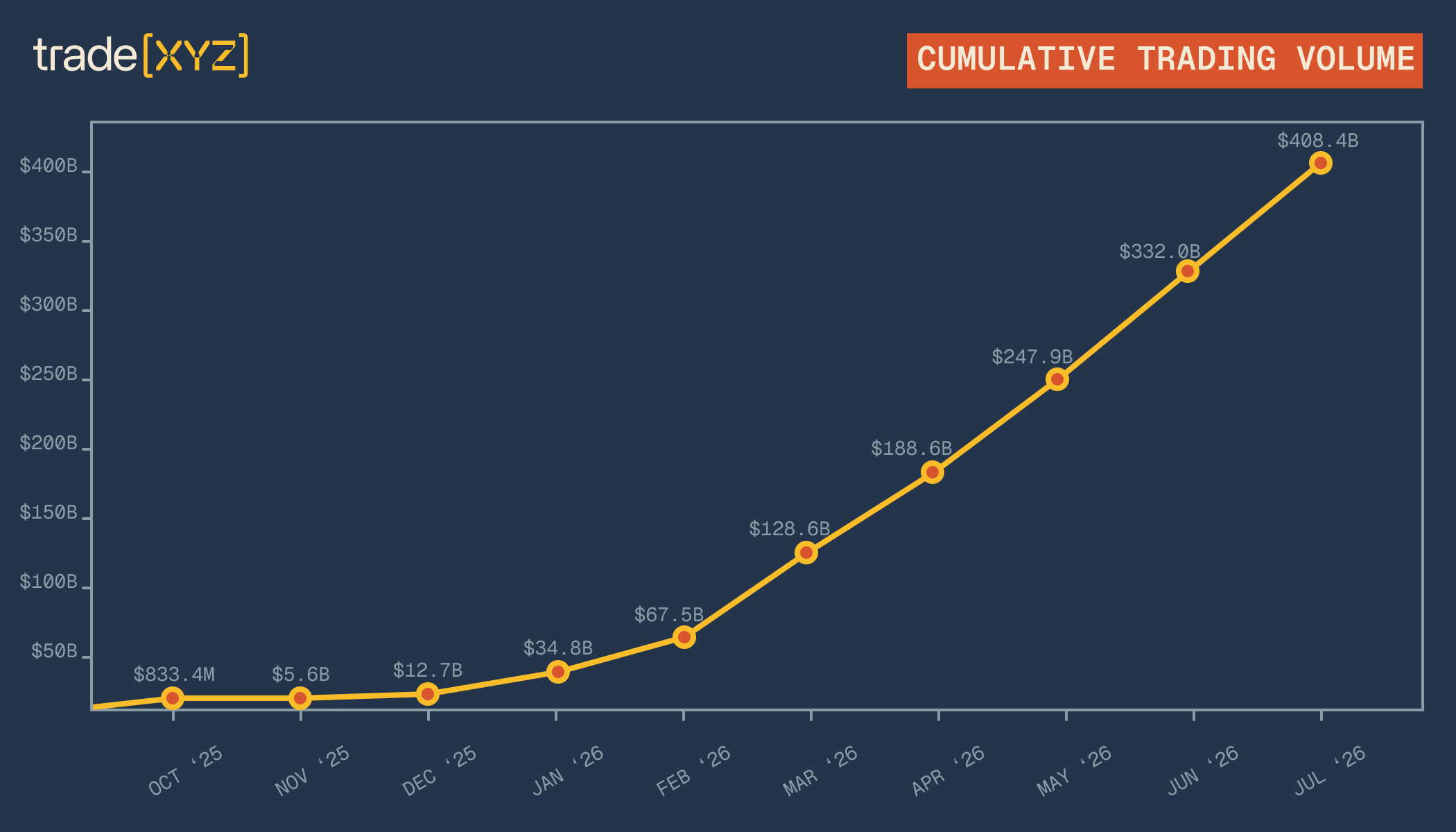
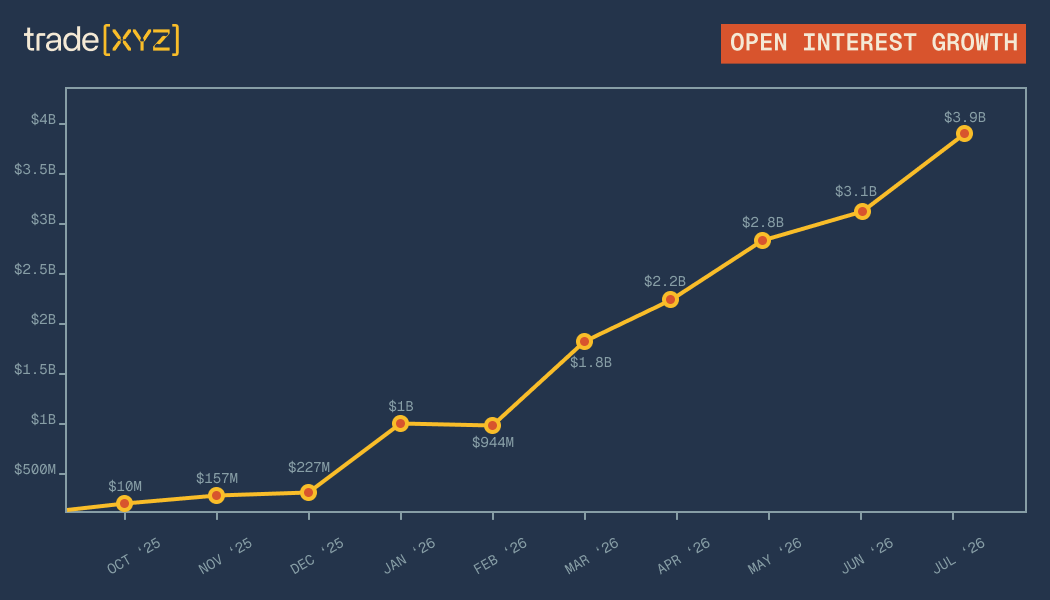
On July 27, trade.xyz released updated figures that marked fresh highs across the board. Cumulative volume reached $408.4 billion. Weekend cumulative volume rose past $26 billion. Peak daily volume hit $5.6 billion, open interest climbed to $3.9 billion, and peak daily unique traders topped 60,000.
Liquidity in HIP-3 has become heavily concentrated
Early HIP-3 rivals including Felix Exchange and Ventuals have already shut down in 2026 after trade.xyz drained away liquidity. trade.xyz has held more than 95% of both trading volume and open interest across the HIP-3 segment for a prolonged period.
Most of that trading does not actually happen on trade.xyz’s own interface. It takes place through Hyperliquid’s frontend. The two sides split protocol fees 50/50, and Hyperliquid uses its share for HYPE buybacks.
trade.xyz has also brought a large number of new users into the broader ecosystem. It has introduced more than 300,000 distinct wallets in cumulative terms. Monthly additions have remained in the tens of thousands, with the peak close to 80,000. Many traders arrived for stock or commodity perpetuals and then stayed inside the Hyperliquid ecosystem.
Depth has also reached a level where institutional participation can be taken seriously. Top index and commodity markets show order-book depth in the millions of dollars near the mid-price. Single-stock markets such as NVIDIA and Tesla also have enough liquidity to support larger positions. Operations have remained active rather than hands-off. Recent onchain activity shows frequent adjustments to position limits, Growth Mode settings, funding-rate multipliers and temporary trading halts.
The real dispute is about power, not an immediate split
The core issue is no longer whether trade.xyz leaves now. It is whether the power balance between the two sides has already started to tilt.
Those who think a move is possible focus on concentration. If one deployer nearly monopolizes a fast-growing RWA perp segment, and that segment already generates more volume than the crypto-native side, it naturally gains bargaining power. A future token, a change in how fees accrue, a push for a larger revenue share, or parallel deployment on other high-performance perpetual venues could all alter the current economics.
The opposing view starts with structure and incentives. trade.xyz’s strongest moat today — user access, liquidity networks, market-maker relationships and cross-margin composability — is deeply embedded in Hyperliquid. Leaving would mean rebuilding the matching stack, recreating depth and persuading users to move positions, which would be expensive and risky. A Multicoin partner said in a recent discussion that as long as Hyperliquid still controls distribution, trade.xyz has little reason to leave.
There is also a direct signal from the company side. At the 2026 Hyperliquid Summit, trade.xyz COO legal counsel Collins Belton said there was no reason to leave.
Aligned for now, but the fault lines are visible
On business logic, the two sides remain tightly aligned for now. trade.xyz gets high-performance infrastructure and an existing user base through HIP-3. Hyperliquid, for its part, uses a specialist team to fill out the RWA perpetual vertical quickly, a market it was not in a position to enter directly because of regulatory risk, while also gaining fee revenue and user growth. It is a classic open-infrastructure-and-vertical-expert arrangement.
The variables worth watching are not whether trade.xyz exits tomorrow. They are more concrete: whether the revenue split gets renegotiated, whether trade.xyz introduces its own token or equity instrument, whether it starts deploying the same markets elsewhere, and whether changes in the regulatory environment force an architectural shift.
For now, a full separation looks less likely than a gradual divergence in incentives. Still, as @0xCryptoSam argued, trade.xyz has already developed real leverage over Hyperliquid. That leverage is becoming a live example of how a successful application layer can reshape its relationship with the underlying protocol in crypto.
And it may not need a complete break to do that. The article’s final argument is that trade.xyz could deploy its frontend and risk engine on derivatives protocols on Monad or Solana without fully leaving Hyperliquid. If even 20% of order flow were diverted, Hyperliquid’s exclusivity premium would be broken. In that sense, the bigger threat may be parallel expansion rather than outright departure.