
ChangXin Memory Technology made its debut on Shanghai’s STAR Market on July 27, setting several first-day records in the A-share market. According to Odaily, it became the first technology stock in A-share history to open with a market capitalization above RMB 3 trillion, starting at RMB 3.31 trillion. It was also the first stock to clear RMB 100 billion in turnover within its first trading hour. By the close, the shares were up 465.82%, leaving the company with a market value of RMB 3.28 trillion, the highest in the A-share market and above Intel’s market capitalization internationally.
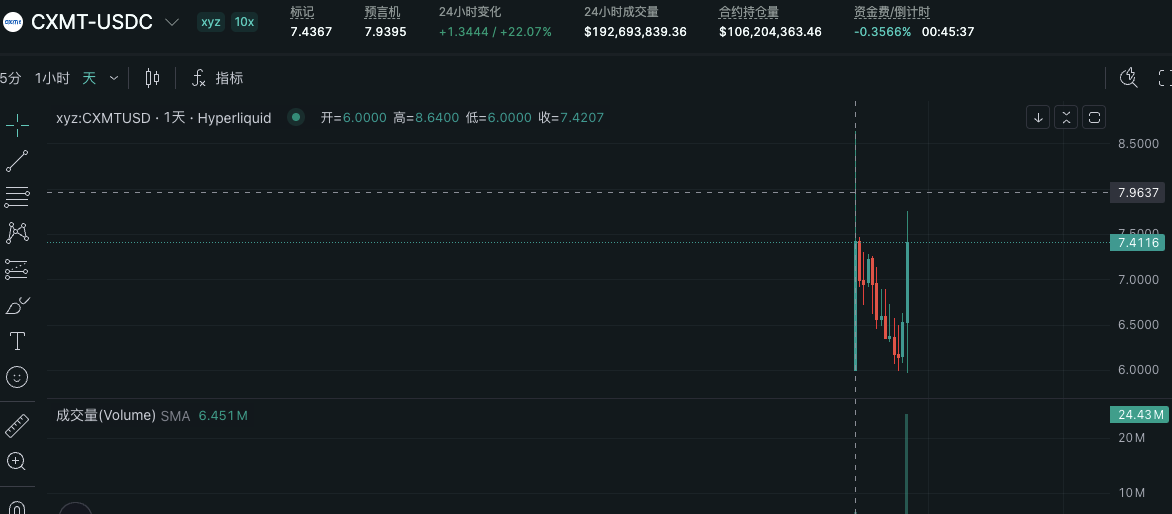
The listing also turned into a test of TradeXYZ’s ability to price an A-share IPO before regular stock trading began. CXMT, the platform’s first pre-market contract tied to an A-share listed company, traded very close to the stock’s opening price in Shanghai.
Pre-market CXMT pricing came close to the stock’s opening print
ChangXin opened at RMB 49.5 per share. Using the RMB 6.77 per dollar exchange rate cited in the report, that works out to about $7.31. At the same time, the CXMT contract on TradeXYZ was quoted at $7.12, a difference of less than $0.2.
Before the IPO, most Chinese brokerages and institutions had placed a reasonable first-day valuation range at RMB 2 trillion to RMB 3 trillion, according to Odaily. Expectations above RMB 3 trillion were described as already factoring in a scarcity premium tied to domestic substitution and future earnings assumptions, while RMB 4 trillion was framed as an outcome only in an extremely optimistic case.
TradeXYZ listed the CXMT pre-IPO perpetual on Hyperliquid’s HIP-3 market on July 15 with leverage of up to 5x. Within hours of launch, the Hyperliquid order book showed buy orders worth several million dollars around $6. The contract then moved sharply higher, reaching an intraday high of $8.64 on the first day. Based on that pre-market level, ChangXin’s implied market capitalization moved above $550 billion, or more than RMB 3.72 trillion, briefly overtaking Tencent and ranking 32nd globally by market value.
Odaily noted that the first day of trading in CXMT likely carried a strong speculative element. Because the contract offered exposure to investors who could not participate directly in the IPO allocation process or in A-share trading, early pricing may have overshot.
That enthusiasm faded. Ahead of the July 27 listing, the CXMT pre-IPO contract pulled back and was holding around $6.1 to $6.4 on July 26, equivalent to roughly RMB 41 to RMB 43, still implying a valuation near RMB 3 trillion. During the call auction before the A-share market opened on July 27, the contract moved closer to the stock’s auction price, and by 9:30 a.m., when Shanghai trading began, CXMT was at $7.12.
That alignment left little room for traders looking to arbitrage between on-chain and traditional markets. Odaily cited crypto KOL Jiang Zhuoer as saying ChangXin was “not playable anymore” because the auction-stage price and the TradeXYZ quote were almost the same and “right now you can neither buy nor arbitrage.”
After the listing, CXMT briefly traded at a discount
Once ChangXin began regular trading, CXMT was converted from a pre-IPO product into a standard XYZ perpetual contract, with maximum leverage increased to 10x. After that switch, the gap between the contract’s mark price and the A-share spot price widened, and CXMT traded at a discount to the stock.
Odaily linked the move to TradeXYZ’s oracle design. During the pre-IPO phase, when no external market price existed, CXMT was priced through an internal oracle. After the stock officially listed, the contract gradually shifted to an external oracle tracking the A-share spot market. That handoff created a mismatch between the mark price and the oracle price.

The report said TradeXYZ used a gradual convergence limit during the transition. Oracle prices updated roughly once every three seconds, but each move was capped at ±1%, and the contract’s mark price could only converge toward the target price at a controlled speed. During that catch-up phase, CXMT traded at a discount, with the gap at one point widening to $0.4.
When the A-share market is closed, the contract switches back to internal-oracle pricing, effectively returning to a pre-market trading mode.
Odaily added that ChangXin was not the first equity-style pre-IPO contract on TradeXYZ. The platform had previously been active in price discovery around U.S. listings such as Cerebras and SpaceX. In ChangXin’s case, the oracle had to do more than track the stock itself. It also had to layer in USD/CNY conversion, meaning trader PnL reflected both the share price and foreign-exchange moves.
On Odaily’s reading, the transition from the pre-IPO contract to the standard perpetual was relatively smooth despite the brief discount episode tied to the oracle shift, and it did not trigger the kind of public controversy seen during SpaceX’s listing.
Open interest approached $100 million
As of publication, open interest in the ChangXin contract on Hyperliquid stood at $91.85 million, having reached as high as $100 million. Twenty-four-hour trading volume was $232 million, or about 0.16% of ChangXin’s first-day spot turnover in the A-share market.
Odaily argued that volume alone does not capture TradeXYZ’s significance. A few hundred million dollars in on-chain turnover remains small beside traditional stock exchanges, but the platform changes who can participate in price discovery and how that participation happens.
For global investors, the report said, TradeXYZ offers a path to A-share price exposure without requiring direct access to China’s stock market. Retail participation in the STAR Market has long faced relatively high barriers, and offshore investors have had even less direct access. On TradeXYZ, by contrast, a wallet user holding stablecoins can get exposure without a securities account, minimum asset threshold, or geographic restriction, and can continue trading outside conventional market hours.
The largest on-chain short was down more than $1.39 million
The stock’s first trading day also dealt a heavy blow to bearish whale positions. Odaily highlighted the wallet identified as Hyperliquid’s “largest ChangXin short,” address 0xf2...1244, which had been adding to its CXMT short for several days before the listing.
According to hypurrscan data cited in the report, the address held 2.6 million CXMT short contracts worth about $18 million, with an average entry price of $6.4, equivalent to RMB 43.3. At press time, the position was showing an unrealized loss of $1.39 million.
Odaily also said that one hour before the stock listed, the trader had placed take-profit orders for the short between $2 and $4.5, equivalent to roughly RMB 13 to RMB 30. The report interpreted that as a view that ChangXin’s fair valuation topped out at RMB 2 trillion.

There were profitable longs as well. Address 0x2b6…32f6c had been adding to a CXMT long since July 23. Based on hypurrscan data cited by Odaily, the wallet held 977,000 CXMT longs worth about $6.77 million, with an average entry price of $6.71, or RMB 45. At press time, the unrealized profit was more than $200,000. The same trader also held a SK Hynix long worth $380,000.
The wallet had placed sell orders for the long between $7.1693 and $7.688. Odaily said that implied a view that ChangXin’s market capitalization could again challenge levels above RMB 3.4 trillion. During the session, the company’s market cap had already exceeded RMB 3.5 trillion at its peak.
Wallet labels pointed to regional differences in positioning
Odaily also cited HyperInsight data showing regional divergence in attributable wallet exposure on Hyperliquid on the night before the listing. Wallets tagged as U.S., Hong Kong, and mainland China were net long overall, while Korean-labeled wallets were the main short sellers in the sample.
- Korean-labeled wallets held about $760,000 in short positions, with short exposure about 38 times larger than long exposure.
- Taiwan-labeled wallets were also net short, at about $329,000.
- U.S.-labeled wallets held $1.6 million in longs and $345,000 in shorts, for net long exposure of about $1.255 million.
- Hong Kong-labeled wallets held $1.3 million in longs and $431,000 in shorts, for net long exposure of about $869,000.
- Mainland China-labeled wallets held $83,000 in longs and $16,000 in shorts, for net long exposure of about $67,000.
The report ended with a hypothetical calculation. If the $760,000 in Korean-labeled shorts had all been opened before the market opened at a uniform price of $6.48, with no later position changes and 1x leverage throughout, the theoretical unrealized loss would be about $48,500, equal to a loss rate of roughly 6.4%.