
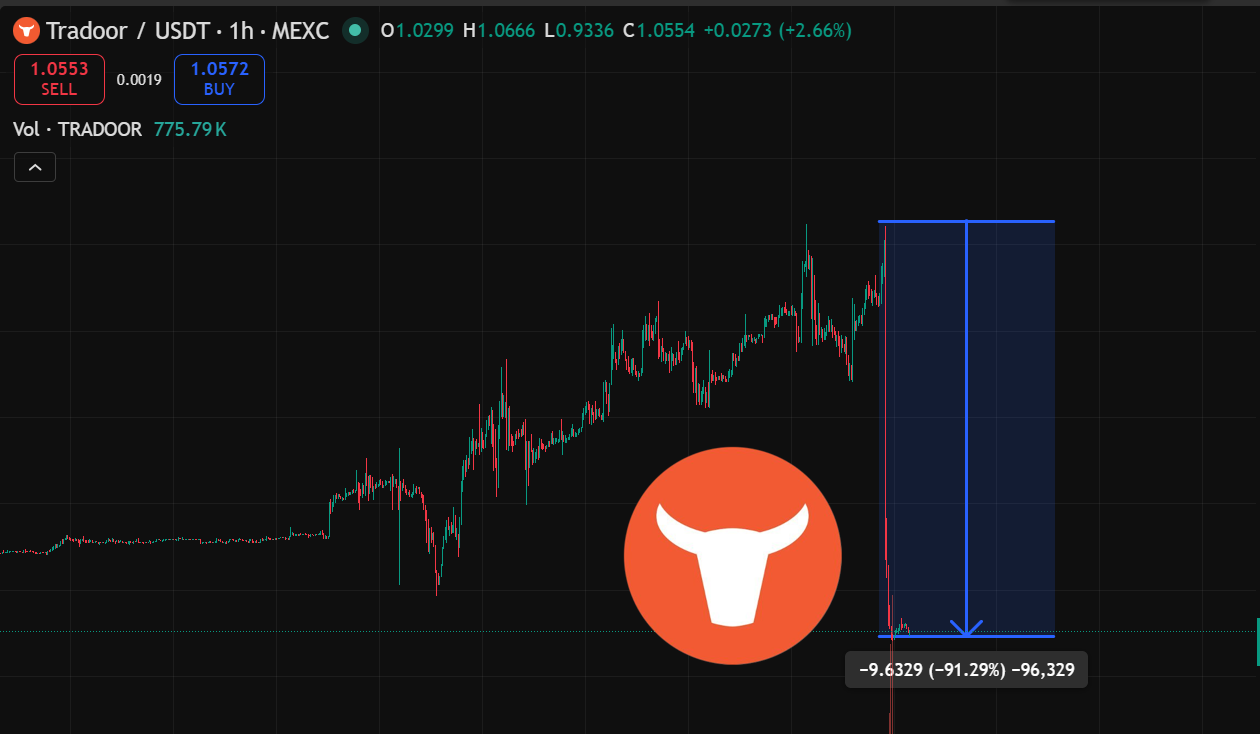
TRADOOR collapsed in the early hours of April 25, dropping 90% in 30 minutes from $300 to $25. The move erased nearly all of the token’s roughly 900% gain over the previous 90 days. On-chain analyst Specter said in a post on X that the selloff was tied to concentrated supply and a coordinated exit pattern.
Supply data points to heavy concentration
According to Specter’s investigation, TRADOOR was launched through Binance Alpha in September 2025 with an initial circulating supply of 60 million tokens. The largest share, 70.12%, was held by the team’s main wallet. Bitget accounted for 11.15%, while Binance Alpha held 5.16%. The rest was spread across other addresses. With that structure, price discovery could be shaped by a very small group of holders.
Specter said the team-controlled wallet withdrew 17.93 million TRADOOR from total supply and distributed the tokens across at least 13 wallets. One of the listed addresses was tied to Binance Alpha, with other allocations sent to separate wallets. He added that between September 19 and 21, 2025, several of those wallets moved tokens again into fresh addresses and were used for wash trading designed to create artificial volume and market attention. The pattern was simple on-chain. The market effect was not.
Bitget-held supply also comes under scrutiny
Specter said wallet activity linked to the team had been depositing TRADOOR to Bitget since November 2025. In his view, those transfers closely matched the 11.15% position shown under Bitget’s holdings. Based on that overlap, he argued there were reasonable grounds to suspect the Bitget-held allocation may have been controlled by the Tradoor team or an entity fully aware of the arrangement.
Earlier data cited by Specter showed that at launch, 10 addresses controlled 98% of supply, and a single address held as much as 75%. At the same time, the DEX liquidity pool was under $1 million. Under those conditions, even a moderately sized sale could trigger a sharp move.
Parallels drawn with RAVE and SIREN
Specter compared the TRADOOR case with the recent RAVE and SIREN episodes, arguing that all three followed a similar playbook. In the RAVE investigation, ZachXBT said the RaveDAO deployer wallet had quietly sent 18.58 million RAVE to Bitget before a price run-up. During the rally, insiders then withdrew 29.78 million tokens from Bitget, fueling a squeeze that liquidated 74% of Binance users holding short positions.
ZachXBT also said three Gnosis Safe wallets controlled more than 90% of RAVE’s 1 billion token supply. RAVE later fell nearly 99% from its peak, wiping out roughly $5.7 billion to $6 billion in market value. Those figures have renewed attention on centralized exchanges that listed the tokens involved in these cases.
Exchanges acknowledged probes, but no results yet
After the RAVE controversy broke, ZachXBT publicly urged Bitget CEO Gracy Chen and Binance CEO Richard Teng to step in, while offering a whistleblower reward of up to $25,000. Gracy Chen said Bitget had started investigating RAVE, and Richard Teng said Binance had opened a formal probe. No findings have been released so far.
In his latest post, Specter directly questioned whether Bitget was tolerating this kind of behavior. With RAVE, SIREN, and M all facing similar allegations in less than a month, the exchange’s role as a common listing venue is drawing heavier scrutiny.