
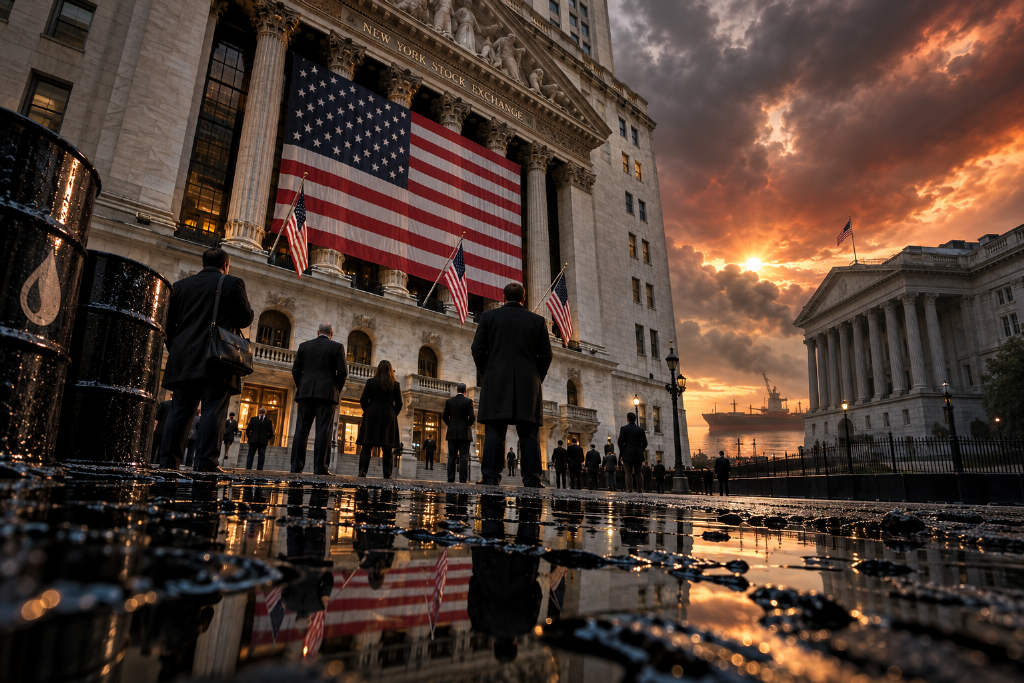
U.S. stocks closed lower for a third straight trading day, with the Dow Jones Industrial Average down 0.77%, the S&P 500 off 0.48%, and the Nasdaq Composite lower by 0.64%. Higher oil prices, rising Treasury yields and renewed concern over long-end funding costs set the tone for the session.
The latest move came as the U.S.-Iran conflict escalated sharply. Brent crude settled at $101.21 a barrel and WTI crude at $96.05, both the highest levels since late May. According to the report, Iran announced a new maritime "sanctions zone," U.S. forces struck an Iranian oil tanker, Houthi forces attacked multiple Saudi cities, and transport risk through the Strait of Hormuz rose materially.
Data from Bridgeton Research Group, a unit of Kpler, showed trend-following CTAs raised their long positioning in Brent and WTI to 91% and 90%, respectively, versus 45% and 36% at the end of August. The shift suggests systematic money is now treating the oil rally as a trend trade.
Trump comments add to the election and inflation debate
At the Republican convention in Dallas, Donald Trump said the U.S.-Iran conflict would "end immediately" after the November midterm elections and that oil prices would "drop sharply" at that point. He also said efforts to lower gasoline prices may not show results until after the midterms.
Trump also pledged that if Republicans win the midterms and retain both chambers of Congress, every adult U.S. citizen would receive a $5,000 "Trump dividend" funded by tariff revenue. Markets focused on the possible fiscal cost instead. The report said the plan could exceed $1 trillion, raising concern over whether it would add to fiscal deficits and inflation. Polling, it added, shows Trump’s approval rating remains weak, with war and cost-of-living pressure weighing on support.
Treasury buyback increase falls short of expectations
The U.S. Treasury raised its long-bond buyback cap to $6 billion, but that still came in below market expectations of $7 billion to $10 billion. After the announcement, bonds failed to rally and instead sold off.
A $39 billion 10-year Treasury auction on Wednesday stopped at 4.834%, the highest yield ever for that tenor at auction, with a bid-to-cover ratio of 2.71. Demand did not show clear improvement. The 10-year yield rose about 5 basis points to 4.85%, the highest since November 2023, while the 30-year yield moved above 5.30%.
The market read that as a sign the Treasury’s effort to stabilize the bond market was not forceful enough, and that Bessent’s attempt to push down long-end borrowing costs had run into resistance. Attention now turns to the 30-year Treasury auction due overnight. A weak result could send long-end yields higher again, while stronger demand could briefly ease term-premium pressure.
Dollar slips again as gold and copper climb
The U.S. dollar index fell for a fourth straight day, though losses were limited. The yen strengthened to near its strongest level since February. The report said a stronger yen and higher Treasury yields are hitting both carry trades and equity valuations at the same time.
Gold reclaimed the $4,400-an-ounce level and rose about 1% on the day. Copper prices in London and New York both hit fresh record highs. Three-month copper in London touched $14,858.50 a ton, while New York copper rose to $6.894 a pound. The report pointed to two drivers: concern that the Trump administration may impose tariffs on refined copper imports, which has led to stockpiling flows into the U.S., and still-firm demand from data centers, the power grid and new energy construction.
Storage and AI names outperform broader tech
While many long-duration technology giants came under pressure, storage, optical communications, AI networking and personal AI agent names moved higher.
Bernstein stayed constructive on storage and said global semiconductor sales in July rose 131.4% year on year, with memory chip sales up 451.7%. The firm maintained outperform ratings on Micron, SanDisk, Samsung and SK Hynix, saying earnings estimates could still move higher. Goldman Sachs also turned more positive on the space, saying Micron and SanDisk had broken above their summer downtrend while hedge fund positioning remained relatively light.
There was also a note of caution. Kioxia’s CEO said NAND prices "have already gone up enough," a sign that the group’s fast run-up may also bring sharper volatility in the short term.
Apple unveils iPhone Duo, Meta launches Muse
Apple introduced its first foldable phone, the iPhone Duo, with a starting price of $1,999. The China version starts at RMB 15,999 and the Hong Kong version at HK$17,499. Pre-orders begin on Oct. 16 Beijing time, with sales starting on Oct. 23. Apple also unveiled the iPhone 18 Pro lineup and the 2nm A20 Pro chip.
Apple shares slipped 0.28%. Bloomberg Intelligence estimated first-year iPhone Duo sales at about 14 million units, implying potential revenue of $28 billion. The report added that analysts see a chance Apple is trading margin for volume. Investors also focused on the high price tag, pressure on profitability and the temporary absence of some AI features in China and the European Union.
Meta Platforms jumped 6.55% after formally releasing its personal AI agent, Muse. The product includes a cloud-based virtual machine, 24/7 operation, nighttime reflection and proactive planning, and it can send emails, sell goods and book travel on behalf of users. The market viewed Muse as an early version of a real-world "Jarvis." Meta also plans to offer 100 million tokens for free each week, with a future monetization model based on commissions from commercial transactions.
Single-stock moves show a split market
Alphabet fell 2.09%. The company plans to invest at least 13 billion euros in Finland over the next two years to build and expand data centers. The report said the project strengthens long-term computing capacity but raises near-term concern over free cash flow.
It also said the Crux AI data center project backed by Google and Blackstone has been delayed, exposing practical limits to AI expansion in power, policy, infrastructure and delivery. Crux AI said its target of reaching 500 megawatts of computing capacity by 2027 is still moving forward, but executives estimate the probability of projects being delivered on schedule at only about 50%.
SK Hynix rose 7.05%, hit a record high and extended its winning streak to five sessions. Tight HBM demand tied to AI servers has kept sentiment firm, and institutions including Goldman Sachs and Bernstein have turned more positive on the memory cycle. JPMorgan assigned an overweight rating with a $245 target price. S&P Global Market Intelligence expects SK Hynix may announce a share buyback plan worth 20 trillion to 40 trillion won in the fourth quarter.
Elsewhere in memory, Micron rose 2.75%, SanDisk gained 1.51%, Western Digital added 1.04%, and Seagate fell 2.04%.
In optical communications, MaxLinear climbed 7.53% and led the group. The report said AI data center buildouts are moving beyond GPU purchases into interconnects, optical modules, switching chips and high-speed connectivity. Marvell Technology rose 4.26%, Corning added 1.51%, Lumentum gained 1.07%, and AAOI fell 3.25%. Arista reiterated its 2026 revenue target of $12.6 billion and said back-end GPU networking demand remains strong.
Energy shares also outperformed as oil moved above $100. The Energy Select Sector SPDR Fund (XLE) gained 0.83%, Exxon Mobil rose 2.22%, and Chevron added 1.91%. Airlines, transportation and energy-intensive manufacturers faced the opposite effect, with higher input costs weighing on those groups.
AMD advanced 3.04% as investors kept looking for AI chip names with upside outside Nvidia. Intel rose 1.69%, Qualcomm added 1.33%, and Nvidia slipped 0.91%. SpaceX fell 3.86% after roughly 7% of insider-held shares eligible for an early unlock became available for sale, involving about 319 million shares and implying potential selling pressure of as much as about $47.2 billion.
What markets are watching next
On Thursday, Sept. 10, the main items on the calendar are:
- 20:15, the European Central Bank rate decision;
- 20:45, ECB President Christine Lagarde’s press conference, with the focus on whether the ECB raises rates, along with energy inflation, wage pressure and December policy guidance;
- 20:30, U.S. August producer price index data, where the market expects monthly PPI at 0.4% and annual PPI around 5.2% to 5.3%;
- OPEC’s monthly oil market report, which will update global supply and demand, inventories and OPEC+ output execution.
On Friday, Sept. 11, attention turns to:
- Oracle and Adobe earnings after the U.S. close, with Oracle watched for cloud infrastructure orders, AI data center contract conversion and capital spending, and Adobe for whether Firefly and other generative AI features translate into faster subscription growth and higher revenue per user;
- 01:00, the $22 billion 30-year U.S. Treasury auction;
- CME’s 100-ounce silver futures contract moving to 24-hour trading.
From Sept. 11 to Sept. 13, the 2026 China Computing Power Conference will open in Langfang, focusing on computing infrastructure and AI buildout. Servers, data centers, liquid cooling, optical modules, switches, power supplies, domestic chips and computing power leasing could all draw attention around the event.