
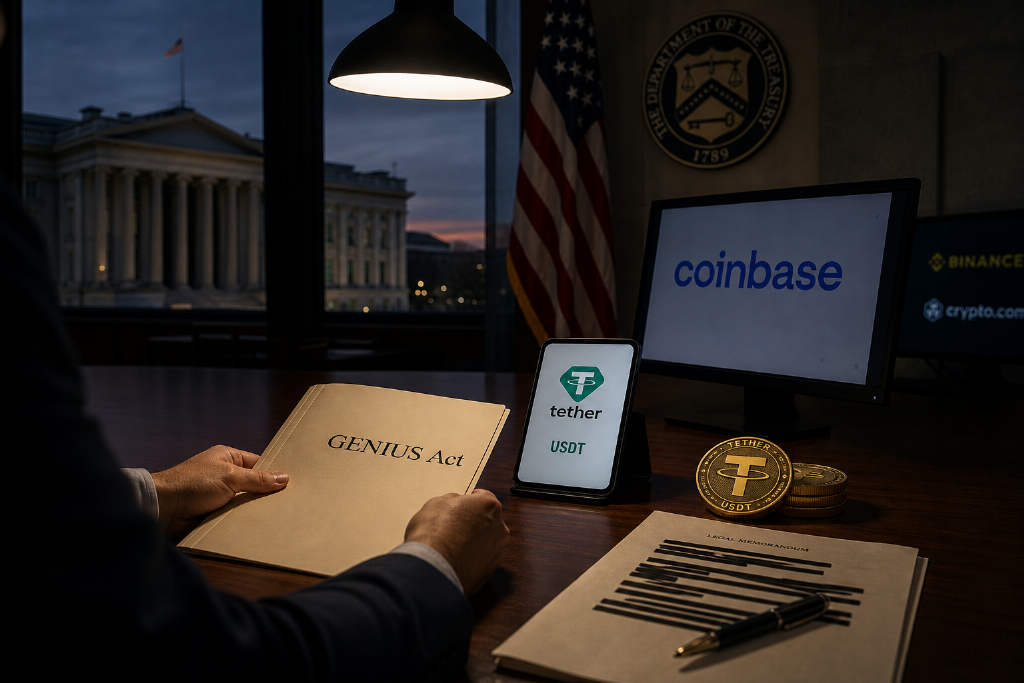
A proposed U.S. Treasury rule under Section 3 of the GENIUS Act could leave American crypto exchanges unable to keep offering Tether’s USDT to users in the United States. Austin Campbell, founder of Zero Knowledge Group, said on the Aug. 17 episode of the Bits + Bips podcast that Coinbase’s U.S. platform may end up having to delist the token.
“There may be a de minimis, but I’m starting to think Coinbase’s US platform might have to delist Tether,” Campbell said on the show, hours after the Treasury Department released the proposal.
Treasury proposal targets foreign-issued payment stablecoins
The proposal is Treasury’s notice of proposed rulemaking for Section 3 of the GENIUS Act, the part of the law that governs who may issue, offer, and sell payment stablecoins in the United States.
Starting Jan. 18, 2027, a digital asset service provider — a category that includes exchanges — generally may not offer or make available a foreign-issued stablecoin unless the issuer can and will comply with lawful U.S. orders and any reciprocal arrangement between Treasury and the issuer’s home jurisdiction.
Campbell summarized the restriction on the podcast in direct terms: “You cannot offer, sell, or make available a foreign-issued payment stablecoin in the US unless that issuer can and will comply with lawful orders and reciprocal arrangements.” In his reading, that means USDT could still be used offshore, but not in the U.S. market.
Campbell points to Europe’s MiCA precedent
Campbell said the setup already has a recent template in Europe. Under the European Union’s Markets in Crypto-Assets, or MiCA, regime, EU-regulated exchanges faced a similar choice: carry a compliant stablecoin or risk their own license status. In that environment, USDT lost listings.
Coinbase removed USDT for users in the European Economic Area effective March 31, 2025, according to the report. Crypto.com and Binance made similar moves in the same quarter.
“I will remind people that’s not new, and we’re not going first,” Campbell said. “The European Union with MiCA basically said, ‘If you’re not registered, goodbye.’”
Tether’s split approach: offshore USDT and onshore USAT
USDT has about $183 billion in circulation, equal to roughly 59% of the stablecoin market. The report says Tether did not pursue the kind of registration MiCA required, and that its response to the U.S. framework is more layered than a simple refusal.
The company has split its strategy. It has kept USDT as an offshore dollar-pegged token while launching a separate U.S.-domestic stablecoin, USAT, in January 2026. USAT was built to comply with the GENIUS Act, issued through Anchorage Digital Bank, and is run by Bo Hines, the former head of the White House’s crypto council.
Chris Perkins, head of Franklin Crypto and Campbell’s co-host on the show, pointed to that separation during the discussion. “They also have USAT onshore being led by Bo Hines,” Perkins said. “I don’t think that they’re just ignoring Genius. I think they have a plan.”
That split is what makes Campbell’s scenario more than a loose hypothetical in the report’s framing. If USDT remains foreign-issued and unregistered while USAT carries Tether’s compliant U.S. business, USDT would fit the kind of foreign-issued stablecoin the proposal appears designed to cover.
The rule is not final and leaves room for comment
The Treasury measure is still only a proposal, not a final rule. Treasury has opened a comment window of roughly 60 days, and the restriction on foreign issuers would not take effect until Jan. 18, 2027.
A possible path remains open for foreign issuers. Treasury could determine that another country’s regulatory regime is comparable to the U.S. framework and allow an issuer from that jurisdiction to register. The report says no country has received that determination so far.
The proposal also does not address stablecoin yield, a separate issue that has become entangled with debate around the CLARITY Act.